11
11
In a significant day for the cryptocurrency and broader financial markets, key US regulatory bodies have taken notable steps towards shaping the future of digital asset oversight. Commodity Futures Trading Commission (CFTC) Chair Michael Selig has initiated a public comment period for proposed rulemaking concerning prediction markets, a move that could significantly impact platforms like Kalshi and Polymarket. Concurrently, investors have filed a lawsuit alleging that US banking giant JPMorgan Chase facilitated fund flows within a $328 million cryptocurrency Ponzi scheme. Adding to the day’s developments, the Securities and Exchange Commission (SEC) and the CFTC have formalized their commitment to regulating crypto and other emerging markets in a more harmonious fashion through a signed memorandum of understanding.
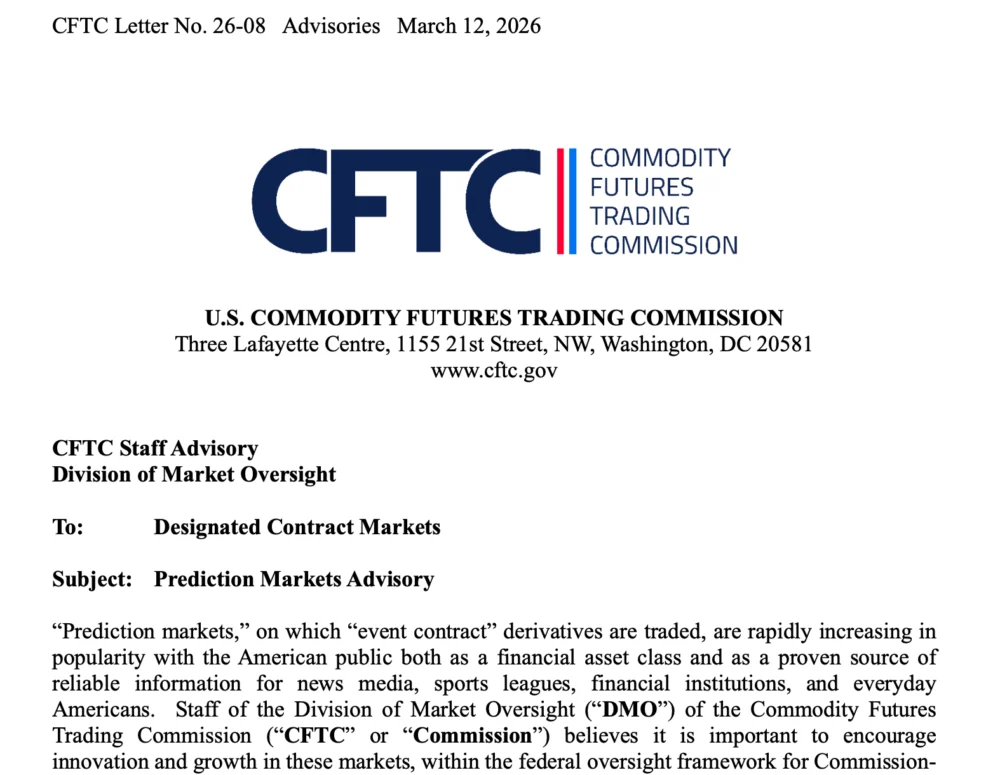
CFTC Chair Michael Selig has put forward a proposed rule that may lead to the amendment or issuance of new regulations specifically for event contracts on prediction markets. In a notice issued on Thursday, the CFTC’s staff classified these event contracts as a "financial asset class." The regulator has also submitted an Advanced Notice of Proposed Rulemaking for publication in the Federal Register, inviting public feedback on the application of the Commodity Exchange Act (CEA) to prediction markets.

Selig expressed enthusiasm for prediction markets, stating in an X post, "Prediction markets are one of the most exciting innovations in financial markets. Yet for too long, the CFTC has failed to provide guidance for these markets being used by millions of Americans. This ends today." This initiative signals a proactive approach by the CFTC to provide clarity and a regulatory framework for these evolving financial instruments, which allow individuals to bet on the outcomes of future events.
In a separate and concerning development, JPMorgan Chase is facing a lawsuit for its alleged involvement in enabling a $328 million cryptocurrency Ponzi scheme orchestrated by the now-defunct Goliath Ventures. Investors filed a proposed class-action lawsuit in the US District Court for the Northern District of California on Tuesday, accusing JPMorgan of allegedly ignoring suspicious transactions and providing Goliath Ventures with the necessary infrastructure to collect investor funds.
The lawsuit highlights a perceived hypocrisy, noting that despite JPMorgan CEO Jamie Dimon’s repeated criticisms of Bitcoin (BTC), the bank allegedly failed to prevent crypto scammers from executing fraudulent wire transactions. The complaint asserts that "Chase, by virtue of its Know Your Customer actually knew that Goliath was acting as a ‘private equity’ cryptocurrency pool operator investing money for investors, without being licensed at all to sell these investments." This suggests that the bank, through its customer due diligence processes, should have been aware of Goliath’s activities and the illicit nature of its operations.

The legal action comes after the US Attorney’s Office for the Middle District of Florida announced the arrest of Goliath CEO Christopher Delgado on February 24. Delgado faces potential charges of wire fraud and money laundering, with a maximum penalty of 30 years in federal prison if convicted on all counts. Prosecutors stated that Goliath Ventures, previously known as Gen-Z Venture Firm, operated the alleged Ponzi scheme from January 2023 through January 2026. The lawsuit further claims that JPMorgan served as Goliath’s sole banking institution for a significant period, from January 2023 to approximately May or June 2025. During this time, Goliath reportedly obtained at least $328 million from an estimated 2,000 investors.
In parallel, two of the United States’ most influential financial regulators, the SEC and the CFTC, have agreed to enhance their coordination in overseeing financial markets. This collaboration aims to address long-standing "regulatory turf wars" between the agencies. A memorandum of understanding (MOU) signed on Wednesday underscores the "pivotal time" to regulate in harmony, particularly as new technologies like cryptocurrency present challenges in market monitoring.
According to the MOU, both the SEC and CFTC acknowledged the increasing complexity of financial markets due to technological advancements. In a separate statement, SEC Chair Paul Atkins described the memo as a crucial step in mending the relationship between the agencies. He stated, "For decades, regulatory turf wars, duplicative agency registrations, and different sets of regulations between the SEC and CFTC have stifled innovation and pushed market participants to other jurisdictions." The agreement signifies a commitment to streamline regulatory processes and foster a more cohesive approach to market oversight.

The agencies also explicitly mentioned in the MOU their ambition to provide a "fit-for-purpose regulatory framework for crypto assets." This indicates a shared objective to develop clear and effective regulations tailored to the unique characteristics of digital assets, aiming to balance investor protection with the promotion of innovation in the crypto space. This coordinated effort between the SEC and CFTC is seen as a positive development for the industry, potentially reducing regulatory uncertainty and fostering greater clarity for market participants.