11
11

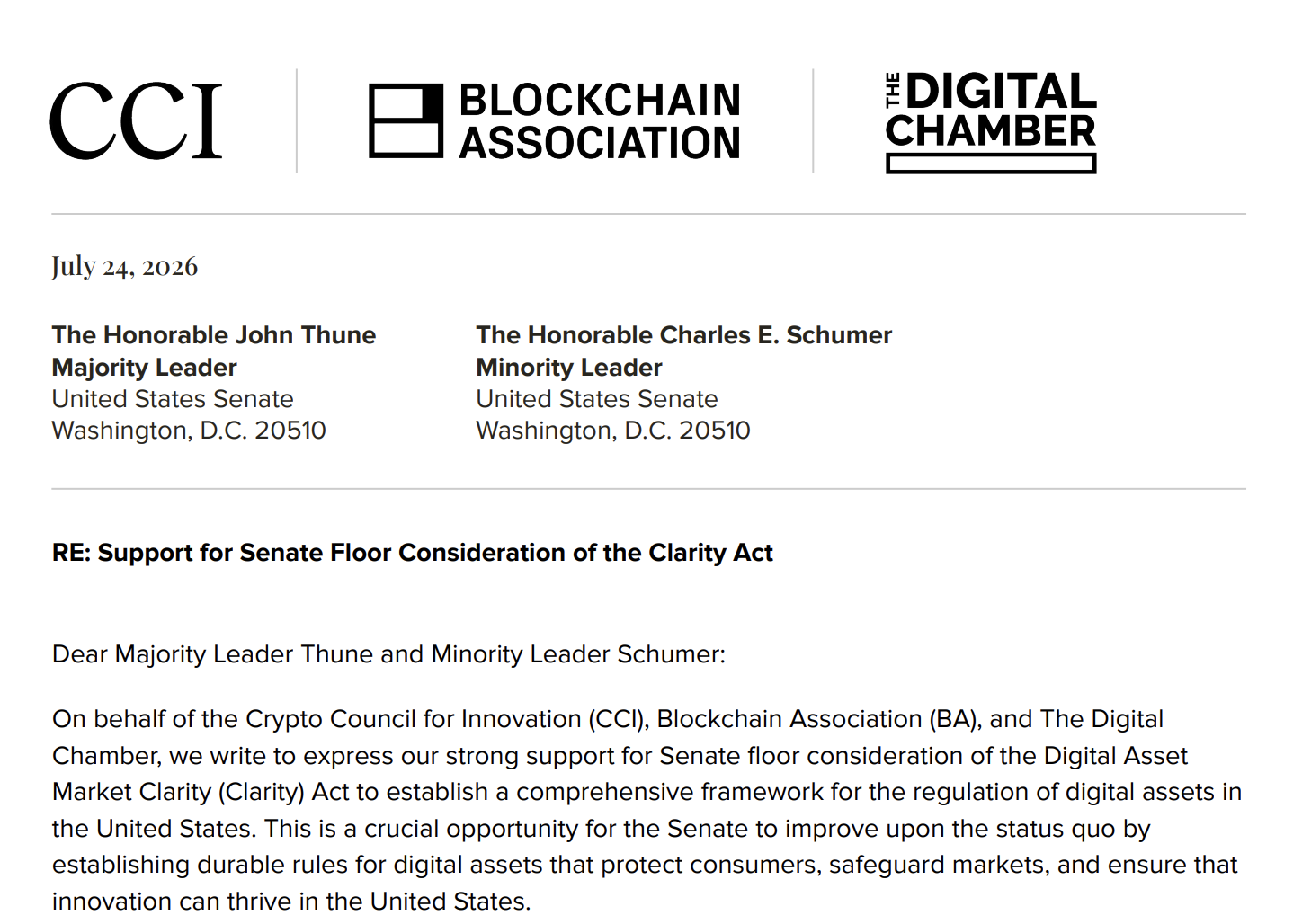
In a significant push for regulatory clarity in the burgeoning digital asset market, prominent cryptocurrency advocacy groups have formally called upon U.S. Senate leaders to prioritize the "floor consideration" of the Digital Asset Market Clarity (CLARITY) Act. The Crypto Council for Innovation, Digital Chamber, and Blockchain Association jointly penned a letter on Friday addressed to Senate Majority Leader John Thune and Minority Leader Chuck Schumer, urging swift action on the legislation. This appeal comes as Republican lawmakers are actively seeking a vote on the bill before the Senate adjourns for its state work periods in August.
While the CLARITY Act has successfully navigated through both the Senate Banking and Agriculture committees, indicating a degree of bipartisan progress, certain lawmakers have expressed reservations, stating their intention to withhold support until specific, key provisions are adequately addressed. The letter from the advocacy groups acknowledges these ongoing deliberations, stating, "[We] recognize that constructive bipartisan negotiations remain underway to secure and expand support for this critical piece of legislation." They further expressed appreciation for the "good-faith efforts of Senators on both sides of the aisle" and encouraged the continuation of these discussions.

The CLARITY Act is widely anticipated to be one of the most consequential pieces of legislation to impact the cryptocurrency industry, with its passage requiring a supermajority of 60 votes in the Senate, where Republicans currently hold a narrow 52-47 majority over Democrats. Earlier in the week, Republican lawmakers released the text of the market structure bill, which includes ethics provisions aimed at preventing corruption by barring public officials from issuing or sponsoring cryptocurrencies. However, a segment of Democratic lawmakers has voiced concerns that these measures do not sufficiently address potential avenues for corruption.
Senator Ruben Gallego, a vocal critic of the Republican-proposed ethics provisions, articulated his dissatisfaction on Thursday, describing the counterproposal as "not a serious effort." He further elaborated, as reported by Politico, that after extensive bipartisan work, the offered amendments were a misinterpretation of the months of negotiation and were "not even remotely close" to the agreed-upon direction.
The call for legislative action from industry leaders underscores the urgency for a defined regulatory framework in the United States. Coinbase CEO Brian Armstrong articulated this sentiment in a post on X (formerly Twitter) on Wednesday, stating, "The status quo in the US isn’t working." He highlighted the absence of a federal framework as a vulnerability that allows bad actors to exploit U.S. customers, leading to a significant portion of the industry moving offshore, beyond the reach of U.S. regulators. Armstrong believes the CLARITY Act offers a solution by establishing "strong consumer protections, real tools for law enforcement, and a path for America to lead in this industry."
Orest Gavryliak, Chief Legal Officer of the decentralized finance (DeFi) platform 1inch, echoed these sentiments during an appearance on Cointelegraph’s Chain Reaction podcast on Friday. Gavryliak emphasized that the CLARITY Act would provide a much-needed framework for non-custodial protocols, moving away from what he described as "regulating with enforcement." He explained that current regulatory approaches often attempt to fit decentralized protocols into existing custodial frameworks, which are ill-suited for the unique nature of non-custodial solutions. "Some regulators, they try to be friendly to non-custodial protocols or projects, they still try to fit us in into the custodial frameworks and make us use custodial solutions to solve problems that they used to in this legacy custodial or traditional finance, which is wrong [and] doesn’t apply to us at all," Gavryliak stated. "That’s why it’s very important for CLARITY to pass."
The timing of a potential floor vote is becoming increasingly critical. Should lawmakers fail to hold a vote before the Senate recesses in August, consideration of the CLARITY Act could be postponed until the weeks leading up to the 2026 U.S. midterm elections. This timeline could introduce further complexities and challenges to bipartisan agreement. As of Friday, the prediction market Kalshi indicated a 40.3% probability that the bill would pass before the Senate’s August recess, highlighting the uncertainty surrounding its immediate legislative future.
The push for the CLARITY Act comes amid a broader discussion about the U.S. approach to digital asset regulation. The bill’s aim is to provide much-needed clarity on the classification and regulation of various digital assets, a move that proponents argue will foster innovation while simultaneously safeguarding investors and the financial system. The inclusion of ethics provisions, while intended to bolster trust and prevent conflicts of interest, has become a focal point of contention, with ongoing negotiations attempting to bridge the gap between differing perspectives on how best to achieve these goals. The outcome of these negotiations and the eventual floor consideration of the CLARITY Act will be a pivotal moment for the future of the cryptocurrency industry in the United States.