11
11
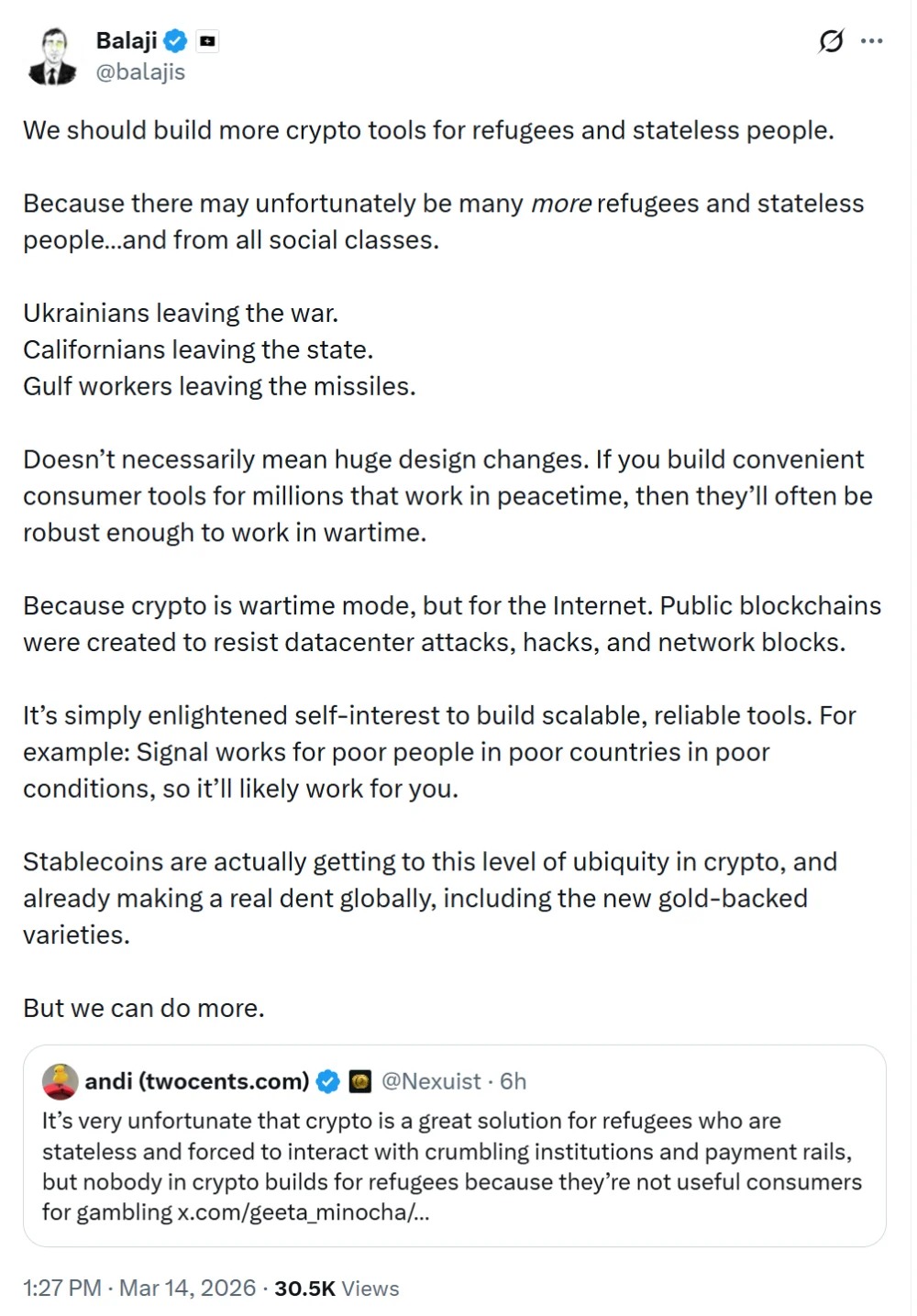
Tech investor and former Coinbase Chief Technology Officer, Balaji Srinivasan, has issued a strong call to action for the cryptocurrency industry, urging it to accelerate the development of financial tools specifically designed to serve refugees and stateless people. In a widely circulated post on the social media platform X (formerly Twitter) on Saturday, Srinivasan highlighted the escalating global challenges that contribute to displacement. He pointed to the intensification of international conflicts and the increasing trends of economic migration as key drivers, citing the harrowing experiences of Ukrainians fleeing war-torn regions and the departures of workers from Gulf countries due to mounting regional tensions.
Srinivasan articulated his vision with a direct appeal: "We should build more crypto tools for refugees and stateless people." His argument is rooted in the inherent capabilities of blockchain-based systems to provide a robust financial infrastructure, particularly in scenarios where traditional financial institutions falter, become inaccessible, or are deliberately undermined. He characterized the current digital landscape as being in "wartime mode for the internet," emphasizing that decentralized networks, by their very design, are resilient and capable of functioning even under adverse conditions such as sophisticated cyberattacks, widespread infrastructure failures, or stringent financial restrictions. Srinivasan underscored the critical advantage of public blockchains: their ability to maintain transaction processing continuity even when centralized systems face significant disruptions. This inherent decentralization offers a crucial layer of security and accessibility for individuals cut off from conventional financial services.
Srinivasan’s remarks were prompted by a parallel discussion initiated by Andi Duro, the founder of the research site TwoCents. Duro expressed a critical observation: while the potential for cryptocurrency to effectively serve refugees is evident, the industry has largely neglected to develop products tailored to their specific needs. "It’s very unfortunate that crypto is a great solution for refugees who are stateless and forced to interact with crumbling institutions and payment rails," Duro stated. He critically added, "But nobody in crypto builds for refugees because they’re not useful consumers for gambling." This sentiment suggests a perception that the industry’s innovation is often driven by profit-seeking applications rather than humanitarian needs.
Despite Duro’s critique, Srinivasan acknowledged that the crypto space has indeed made some strides in this area. He pointed to the burgeoning role of stablecoins as a significant development. Srinivasan noted that stablecoins are already achieving substantial global reach, functioning as a borderless form of digital money that bypasses many of the limitations of traditional cross-border transactions. However, he maintained that these efforts are insufficient, adding, "But we can do more." This indicates a belief that while progress has been made, there is a considerable gap between current capabilities and the full potential of crypto to address the financial plight of displaced populations.
The discussion about the utility of cryptocurrencies in volatile geopolitical and economic climates gains further context from recent market trends. As reported by Cointelegraph, the market capitalization of the USDC stablecoin has been on a notable upward trajectory, nearing a record high of $80 billion. This surge in USDC’s circulating supply, which reached approximately $79.2 billion, surpassed its previous peak set in December and saw a significant increase from around $70 billion in early February. Analysts have attributed this substantial inflow into USDC to a phenomenon of capital flight from the United Arab Emirates. This movement of assets is believed to be a direct response to growing turbulence within the UAE’s real estate market. Data indicates that the DFM Real Estate Index has experienced a sharp decline since the onset of recent geopolitical conflicts, prompting investors to seek more stable or liquid assets. While not directly linked to refugee finance, this trend illustrates how digital assets like stablecoins can serve as a refuge for capital during times of economic uncertainty and geopolitical stress, a function that could be amplified for individuals facing more extreme circumstances.

The broader implications of Srinivasan’s call to action resonate with the inherent design principles of blockchain technology. Decentralized ledger technologies offer a degree of censorship resistance and accessibility that is unparalleled by many traditional financial systems. For individuals who have been forced to flee their homes, often with little more than the clothes on their backs and perhaps a mobile device, access to traditional banking services is frequently impossible. They may lack identification, proof of residency, or a stable address, all of which are typically prerequisites for opening bank accounts. Furthermore, in conflict zones or regions experiencing hyperinflation, existing financial systems can become unreliable or even collapse entirely, rendering savings worthless and preventing access to essential funds.
In such scenarios, a blockchain-based wallet, accessible via a smartphone or even a basic internet connection, could provide a lifeline. Cryptocurrencies, particularly stablecoins pegged to major fiat currencies, can offer a store of value and a medium of exchange that is not beholden to the stability of a particular nation-state’s economy or the integrity of its financial infrastructure. The ability to receive remittances from family members abroad directly into a crypto wallet, without relying on intermediaries that may be slow, expensive, or inaccessible, could be transformative for refugees.
The challenge, as highlighted by Andi Duro, lies in the industry’s focus. While significant resources are poured into developing sophisticated decentralized finance (DeFi) applications, trading platforms, and non-fungible token (NFT) marketplaces, the creation of user-friendly, secure, and accessible tools for vulnerable populations often takes a backseat. This is not to say that no efforts have been made. Projects focused on identity solutions for the unbanked, remittance platforms leveraging crypto, and initiatives aimed at providing financial inclusion in developing regions do exist. However, a concerted, industry-wide push to specifically address the needs of refugees and stateless individuals remains a largely untapped opportunity.
Srinivasan’s emphasis on "wartime mode for the internet" also points to the potential for crypto to serve as a resilient communication and financial network during crises. When traditional communication channels are disrupted by conflict or government censorship, decentralized networks, including those built on blockchain, can offer a means for individuals to stay connected and to conduct essential financial transactions. This resilience is not just theoretical; public blockchains have historically demonstrated their ability to withstand significant network stress and even targeted attacks.
The path forward, as suggested by Srinivasan, involves a more deliberate and focused effort by developers, entrepreneurs, and investors within the crypto ecosystem. This could include developing simplified wallet interfaces, creating educational resources in multiple languages, establishing partnerships with humanitarian organizations, and designing mechanisms for secure and efficient distribution of aid through decentralized channels. The potential benefits are immense: empowering individuals displaced by conflict and economic hardship, providing them with a degree of financial autonomy, and fostering greater inclusion in a globalized world. The call from Balaji Srinivasan is not just a suggestion; it is an imperative for an industry that often champions decentralization and empowerment, to extend these principles to those who need them most.