 11

The landscape of software development is undergoing a fundamental transformation as the initial surge of artificial intelligence productivity reaches a critical plateau, according to new research and internal findings released by Atlassian. In its 2026 State of Developer Experience report, the software giant highlights a significant shift in how AI impacts engineering teams, moving from a tool for simple code generation to a complex management challenge that requires a total redesign of the product development lifecycle (PDLC). The findings suggest that while AI has made the act of building software easier than ever, it has simultaneously created new bottlenecks in decision-making, quality control, and multidisciplinary coordination.
The research provides a stark year-over-year comparison of how developers perceive AI-driven efficiency. In 2025, 68% of developers reported that AI tools saved them 10 or more hours per week. However, in 2026, that figure has plummeted to just 26%. The data indicates that the time once saved by automated code generation is now being consumed by the overhead of overseeing AI agents. Currently, 49% of developers spend four or more hours each week managing, prompting, and auditing AI-generated outputs. This shift marks a transition from the "build" phase being the primary constraint to a new era where the bottleneck lies in determining what is worth building and ensuring that AI-generated prototypes and code meet rigorous production standards.
In response to these findings, Atlassian has introduced the AI PDLC Playbook, a strategic framework derived from internal experiments conducted across its 10,000-member research and development organization. The company’s initiative aims to transform how product, design, and engineering teams collaborate, moving away from siloed AI adoption toward an integrated, "AI-first" system. By testing these methodologies on both new "greenfield" projects and complex legacy systems with high security and compliance requirements, Atlassian has identified three guiding principles for the next generation of product development.
The first principle focuses on redirecting human attention to where judgment most significantly impacts the outcome. Atlassian’s research posits that because AI agents can now execute tasks faster than humans can review them, the traditional model of supervising every step is no longer sustainable. Instead, workflows must be redesigned to allow agents to handle routine investigative work, leaving humans to intervene only at critical decision points.
A primary example of this principle in action is Atlassian’s approach to security vulnerabilities. Traditionally, security scanners would flag potential issues, leaving engineers to spend hours investigating and fixing predictable patterns across thousands of repositories. Under the new AI-integrated model, an automated pipeline identifies the vulnerability, proposes a specific fix, and runs comprehensive tests before an engineer is ever alerted. The engineer then begins their work not with a problem to solve, but with a proposed solution to validate. Internal data shows that AI agents now prepare fixes for 52% of all identified security vulnerabilities at Atlassian, a shift that saves approximately 50 engineering days per week. This allows senior engineers to apply their specialized expertise to high-level architectural decisions rather than routine maintenance.
The second principle addresses the continuity of context as work moves through the development pipeline. Atlassian warns that while agents can build at high speeds, they risk building the wrong product if they lack the evolving context of the project. Traditionally, context is lost during handoffs between product managers, designers, and engineers, as each discipline must reconstruct the reasoning behind previous decisions.

To solve this, Atlassian is implementing "spec-driven development." In this model, teams use AI to capture decisions in shared, living specifications. These specifications do not merely serve as documentation but act as the source of truth for AI agents to generate Jira tasks and execute code. This ensures that the reasoning behind a feature travels with the work as it progresses. The impact of this context-heavy approach was observed in a pilot program involving Confluence. The pilot revealed that engineers were able to ship two production features in just two and four developer weeks, respectively. Historically, those same features were estimated to require between 30 and 40 developer weeks. This suggests that when human and agent collaborators build on a shared, evolving understanding, the efficiency gains are exponential rather than incremental.
The third principle involves widening the scope of who can contribute to the development process while strictly protecting craft accountability and quality standards. AI has effectively decoupled the ability to produce work from the expertise required to evaluate it. This allows for a democratization of technical tasks, where non-engineers can contribute directly to the codebase under the guidance of expert oversight.
Atlassian tested this by launching an internal initiative where product managers (PMs) and designers—many of whom had never written production code—used AI to implement small customer-facing improvements. In this ecosystem, engineers shifted their roles to become "scopers" and "reviewers," setting the technical standards and reviewing the AI-assisted output of their peers. The results of this three-month experiment saw more than 50 PMs and designers shipping over 100 engineering-approved changes directly to production. This model suggests that the future of roles in software development will be multidisciplinary, where deep expertise in design or product management is enhanced by the ability to execute technical changes, provided the system maintains rigorous checks and balances.
Despite the ability for more people to build more things, Atlassian emphasizes that the goal is not merely to increase the volume of output. Instead, the focus is on bringing expert human judgment into more of the work and creating a shared language between disciplines to reach better outcomes faster. The company’s approach to this cultural shift follows a specific hierarchy: analyzing how AI changes individual tasks first, determining what new skills are required second, and only then evolving job roles.
The central thesis of Atlassian’s report is that the industry must move beyond simply adding AI tools to existing workflows. The real opportunity lies in the "messy middle"—the points of friction where work moves between different disciplines and where human judgment is most vital. By focusing on these handoffs and the shared context between product, design, and engineering, organizations can reduce the "management tax" that currently hinders AI productivity.
Atlassian concludes that the leaders of the next era of technology will not be defined by how much code they generate or how many agents they deploy. Rather, success will be determined by how effectively teams can transform ideas into customer value through a redesigned system that learns and improves with every development cycle. The company has made its full AI PDLC Playbook available to the public, offering a roadmap for other organizations to navigate the transition from AI experimentation to a fully integrated AI-first development lifecycle.
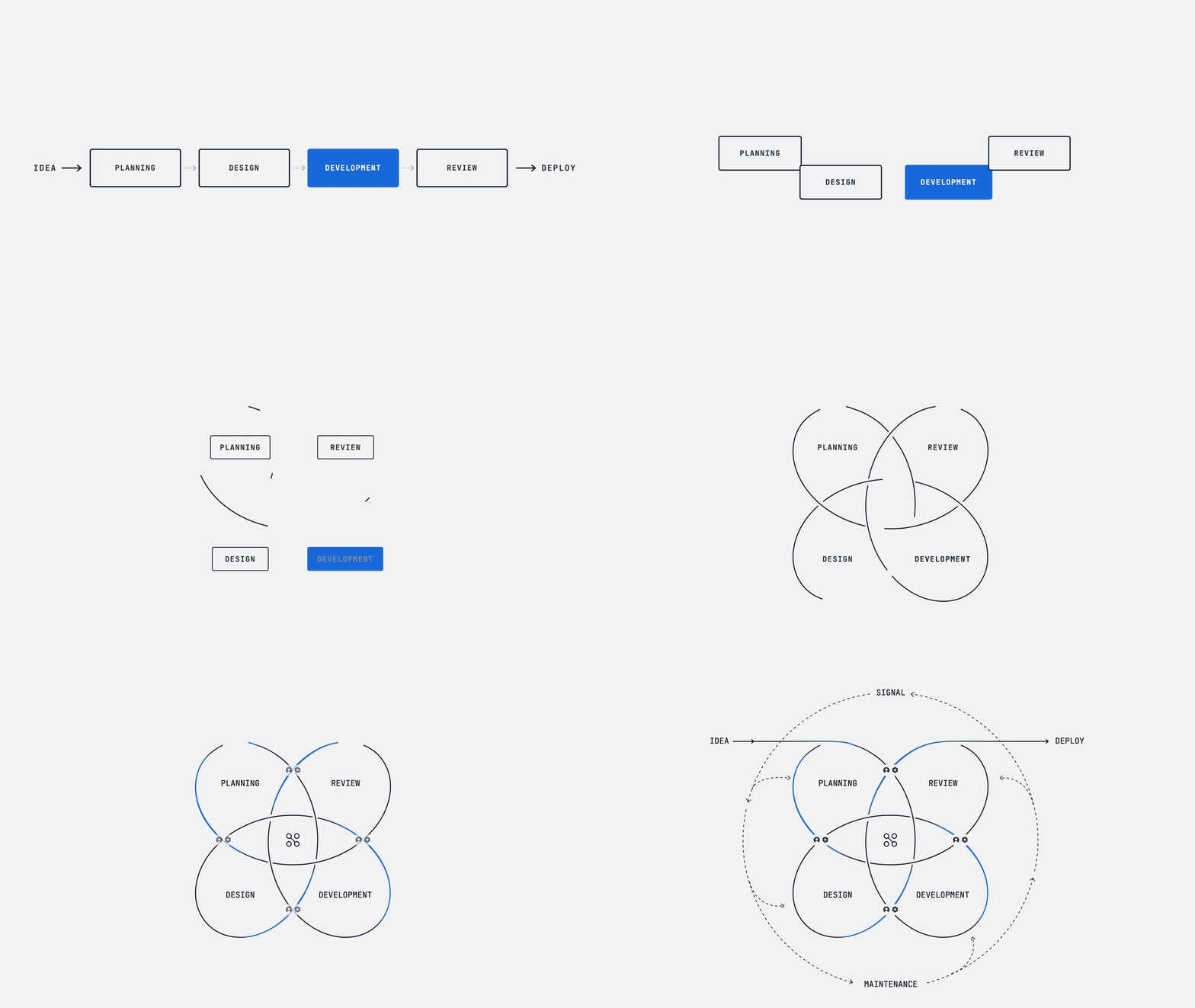
The data provided by Atlassian serves as a cautionary note for the industry: the initial "free" hours provided by AI in 2025 have evolved into a complex management responsibility in 2026. For organizations to regain that lost time, they must stop looking at individual jobs and start looking at the system as a whole. The transition from a waterfall or traditional agile approach to a "knot" or loop-based development cycle—where design, requirements, and engineering happen simultaneously—is presented as the only viable path forward in an environment where agents can outpace human production. By focusing on human judgment, compounding context, and multidisciplinary contribution, Atlassian argues that the software factory of the future can finally move past the bottleneck of "how to build" and focus entirely on "what to build" to create the most value for the end user.