 11

In a modern sales landscape increasingly saturated with automated outreach and digital "white noise," the role of the Sales Development Representative (SDR) is undergoing a profound transformation. According to a comprehensive study conducted by Atlassian’s Teamwork Lab, the integration of artificial intelligence is not replacing the human element of sales but is instead serving as a critical catalyst for a more personalized, strategic, and efficient approach to pipeline generation. The research, which included contributions from Toni Cadden, SDR Regional Manager, and Lora Kassanchuk, Global Head of Mid-Market SDRs, suggests that while AI can handle the heavy lifting of data synthesis, the "human touch" remains the ultimate competitive advantage in securing high-value business relationships.
The Teamwork Lab’s investigation, conducted in August and September 2026, involved a series of ten semi-structured interviews with eight SDRs across three major global regions—the United States, EMEA (Europe, Middle East, and Africa), and APAC (Asia-Pacific), including India. The study also incorporated perspectives from an SDR intern and a Mid-Market Account Executive (AE). The findings highlight a clear shift in how sales professionals allocate their time, moving away from manual administrative burdens and toward high-value, relationship-driven activities.
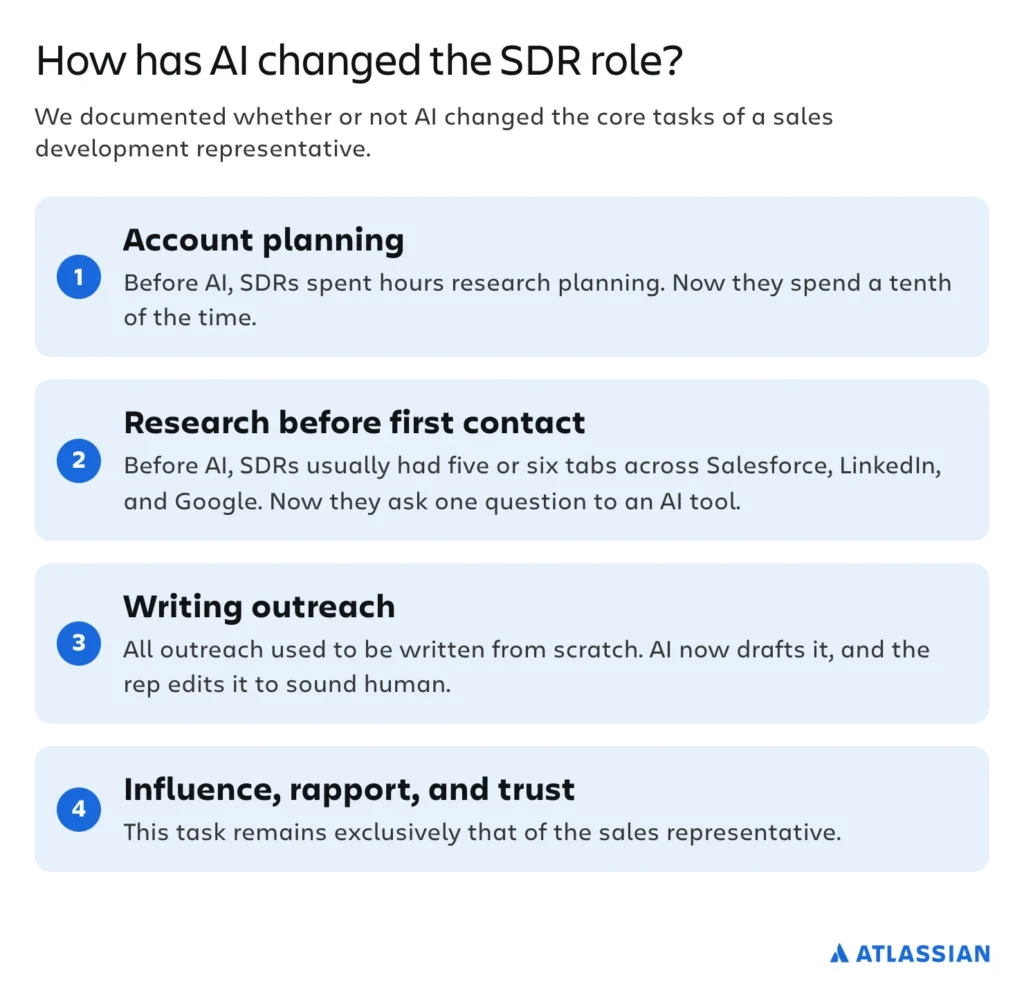
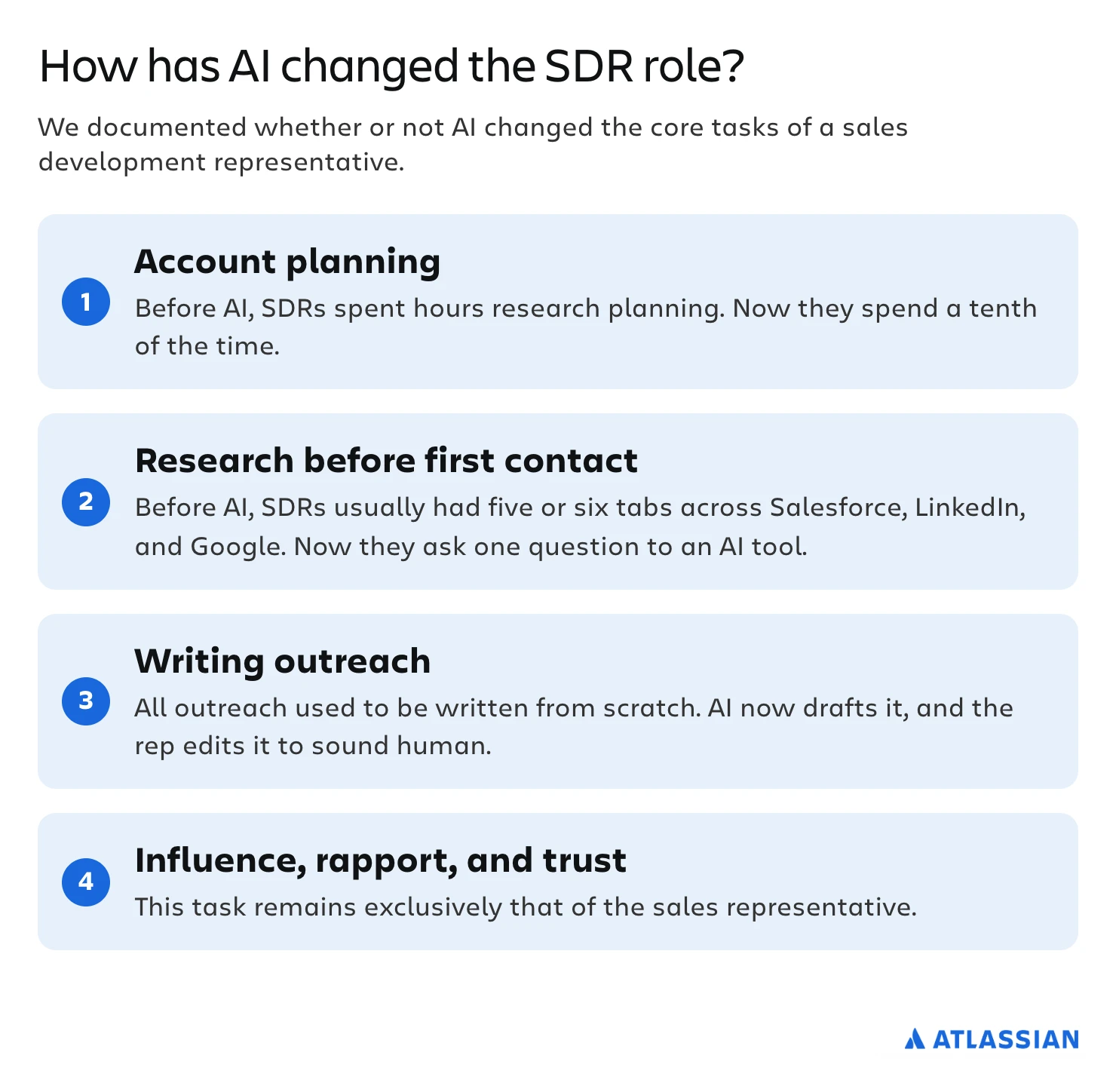
Historically, the SDR role has been defined by "prep work"—the labor-intensive process of account planning, sizing up potential fits, identifying buying signals, and mapping out complex stakeholder hierarchies within target organizations. Previously, these tasks could consume hours of an SDR’s day, leaving limited windows for actual engagement. The Atlassian study found that AI has effectively collapsed this timeline. Tasks that once required significant manual effort now take approximately one-tenth of the time.
By utilizing AI to augment repeatable tasks, SDRs are now able to "size up" accounts with unprecedented speed. This efficiency allows them to focus their energy on the qualitative aspects of a lead that AI might overlook. However, this shift has introduced a new challenge: information overload. While AI can generate vast quantities of data, SDRs now face the time-consuming task of sorting through generic outputs to find the specific, useful insights relevant to a particular account. The role has evolved from a "data gatherer" to a "data curator," requiring a keen eye for detail to ensure that the information used in outreach is truly substantive.
The study highlighted several internal success stories where Atlassian reps leveraged AI to build bespoke systems that streamline their workflows. One notable example is the development of "SDR Mission Control." This system functions as a centralized "front door" for various sales tasks, which are then routed to specialized sub-agents.
This tool has not only benefited SDRs but has also bridged the gap between SDRs and Account Executives. A Mid-Market AE noted that the tool is now a shared resource, allowing both roles to evaluate leads strategically. In the traditional model, the SDR’s primary responsibility was to deliver leads, while the AE owned the strategic knowledge exercise. Now, the responsibility is shared. While the SDR still manages the pursuit of leads and the AE manages the advancement of opportunities through the sales funnel, AI has sharpened the quality of the leads being moved forward. Luis Vidro, an Account Executive at Atlassian, noted that this shift has transformed the SDR from a mere provider of leads into a strategic partner in the knowledge-gathering process.
The research also underscored the importance of speed in the sales cycle. A significant breakthrough came from an Atlassian intern who addressed a long-standing bottleneck in the inbound lead process. For four years, leadership had aimed to integrate Salesforce inbound lead dashboards with Slack to enable real-time alerts. Research indicates that responding to an inbound lead within one hour significantly increases the likelihood of conversion.
During a six-week internship, the intern successfully wired the dashboard to Slack, ensuring the team received instant notifications. This achievement aligns with broader Atlassian research into "new grads," which found that hires with a year or less of experience are more likely to be daily AI users than their more senior counterparts. This suggests that the next generation of sales talent is entering the workforce with an "AI-first" mindset, capable of solving technical hurdles that have historically slowed down sales organizations.

Despite the efficiency gains provided by AI, the Atlassian SDRs interviewed drew a firm boundary regarding customer-facing interactions. A consistent theme across all regions was the refusal to allow AI to communicate directly with customers or internal stakeholders without human oversight. Every SDR interviewed maintained that while AI is an excellent tool for preparation, it cannot replace the nuance of human intervention.
To support this balance, Atlassian’s internal engineering team developed "Sales Sidekick," an AI agent designed to act as an information layer rather than an orchestration layer. When a rep dials a prospect, Sales Sidekick provides a personalized call script, account history, and suggested discovery questions in real-time. Crucially, the agent never makes the call or decides what is ultimately said. It serves as a support system, leaving the "orchestration"—the actual conversation and decision-making—to the human representative.
Patrick Konadu, an SDR at Atlassian, emphasized that the ability to build rapport through humor and empathy is something AI cannot replicate. "The ability to make the customer laugh, that ability to make the customer share information that they wouldn’t have shared otherwise—that is something that I truly believe that no AI tool can give me in any capacity," Konadu stated. This sentiment was echoed by another SDR who reported booking ten meetings in a single week after abandoning AI-generated email templates in favor of a more casual, "text-a-friend" style of writing.
Beyond lead generation, SDRs are playing an increasingly vital role in testing and refining AI-driven sales strategies. Because SDRs operate at a high volume—sending hundreds of messages and making dozens of calls weekly—they exist in a tight feedback loop. They can identify almost immediately which messaging resonates and which AI-generated workflows are failing.
This high-velocity environment makes the SDR team an ideal testing ground for the broader sales organization. Their ability to rapidly iterate on AI-assisted outreach provides Atlassian with the data necessary to refine its sales tactics before they are rolled out to AEs or other departments. This feedback loop ensures that the company’s sales strategy remains grounded in real-world results rather than theoretical AI capabilities.
The evolving relationship between SDRs and AEs is also a point of strategic importance. While some might argue that AEs could absorb SDR duties as AI simplifies prep work, the study argues against this consolidation. The primary focus of an AE is to close deals, whereas the SDR is dedicated to building the pipeline. Without the specialized focus of the SDR, a gap emerges in the early stages of the market goals, as no one is dedicated to the consistent advancement of new prospects.
Lora Kassanchuk summarized the current state of the SDR role by highlighting the inherent resourcefulness of the profession. "SDRs have always been naturally scrappy and resourceful," she said. "Give them a locked door and they will find a window; give them AI and suddenly they are building doors of their own." This perspective suggests that AI is not a threat to the SDR role but a tool that empowers them to expand their influence and effectiveness.
The bottom line of the Teamwork Lab’s research is that AI is a powerful tool for augmentation, not replacement. By removing the "dull" and "boring" aspects of account research and administrative preparation, AI allows SDRs to reinvest their time into the human-centric duties that drive revenue: discovery calls, demos, and relationship building. The study concludes that for any organization considering the implementation of AI in sales, the most effective strategy is to use technology to bolster the preparation phase while strictly protecting the human relationships that generate the pipeline and close deals.
The methodology for this study involved 10 semi-structured interviews conducted between August and September 2026. The participants represented a diverse cross-section of the Atlassian sales force, including representatives from mid-market, enterprise, and strategic segments. The time savings and productivity results reported, such as the increase from five calls to twenty per week, were self-reported by the participants, reflecting the real-world impact of AI on their daily professional lives.