 11

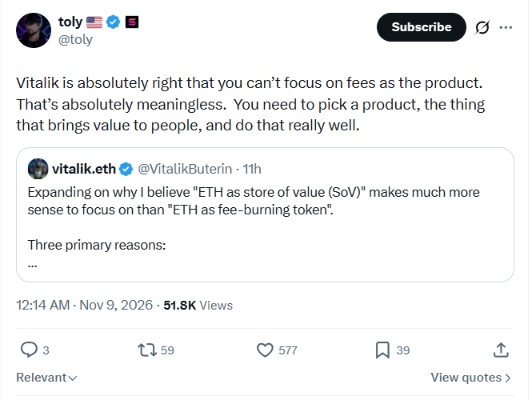
Ethereum co-founder Vitalik Buterin has asserted that the network should prioritize promoting Ether (ETH) as a store of value rather than an asset whose value is derived from burning transaction fees. In a recent online discussion, Buterin argued that the narrative of "ETH as a fee-burning token" was never as robust as it appeared and that optimizing for this would undermine Ethereum’s core strengths of "decentralization and capture resistance."
Instead, Buterin posits that Ethereum’s value proposition should stem from the stability offered by its unwavering commitment to "decentralization and CROPS" – an acronym representing censorship and capture resistance, open source principles, privacy, and security. He believes these attributes will gain even greater significance in an "era of AI disruption."
The sentiment for ETH as a deflationary asset gained traction following the 2021 EIP-1559 upgrade. This upgrade, particularly during periods of high network activity, temporarily pushed Ethereum into deflationary territory. This led to prominent figures and platforms within the crypto community, such as the Bankless podcast, to champion Ethereum as "ultrasound money." However, recent trends indicate a decline in transaction fees and revenue, making this narrative less sustainable. Data from January to October of the current year shows a significant drop in median transaction fees, from 35 cents to 3.5 cents, even as the number of daily transactions increased by over 50%.
This shift in perspective has drawn criticism from some Bitcoin proponents, who staunchly uphold Bitcoin’s (BTC) store of value status. Dan Held, founder of Held Media, characterized Buterin’s comments as an attempt by Ethereum to "pivot to Bitcoin’s SoV narrative after all of its previous narratives collapsed. Again." Held further questioned the viability of a protocol with a "constantly changing monetary policy" being considered "sound money," drawing a parallel to fiat currency. Conversely, Ethereum supporters point out that the network’s monetary policy has remained consistent since The Merge in 2022, with each modification aimed at reducing, rather than increasing, issuance.
Ethereum maximalists have largely welcomed Buterin’s clear articulation of a narrative direction for the protocol. Gabriel Shapiro, an attorney at MetaLeX, described it as a "nature is healing moment" from Buterin and expressed confidence that "on fundamentals ETH can be a much better SoV than both ZEC and BTC." Even Anatoly Yakovenko, co-founder of Solana, agreed with Buterin’s assessment that "you can’t focus on fees as the product," while also subtly alluding to Ethereum’s own product.

Democratic Control Signals Uncertain Regulatory Future for Crypto
The recent U.S. midterm elections, which saw Democrats secure control of both the Senate and the House of Representatives, have introduced an element of uncertainty regarding the future of cryptocurrency regulations. Despite significant spending by crypto-focused Super PACs – including an unsuccessful $64 million effort to unseat Senator Sherrod Brown – their overall electoral impact appears to have been limited.
Stand With Crypto reports that a majority of legislators in both chambers are now considered pro-crypto. The organization designates 50 out of 100 senators as "pro-crypto" and only 33 as "anti-crypto." Similarly, 241 members of Congress are identified as supportive of the industry, with only 106 actively opposed. However, individuals with potentially less favorable views towards crypto will hold positions of influence. Senator Sherrod Brown is expected to join the Senate Agriculture Committee, and Senator Elizabeth Warren is a strong candidate to chair the Senate Banking Committee.
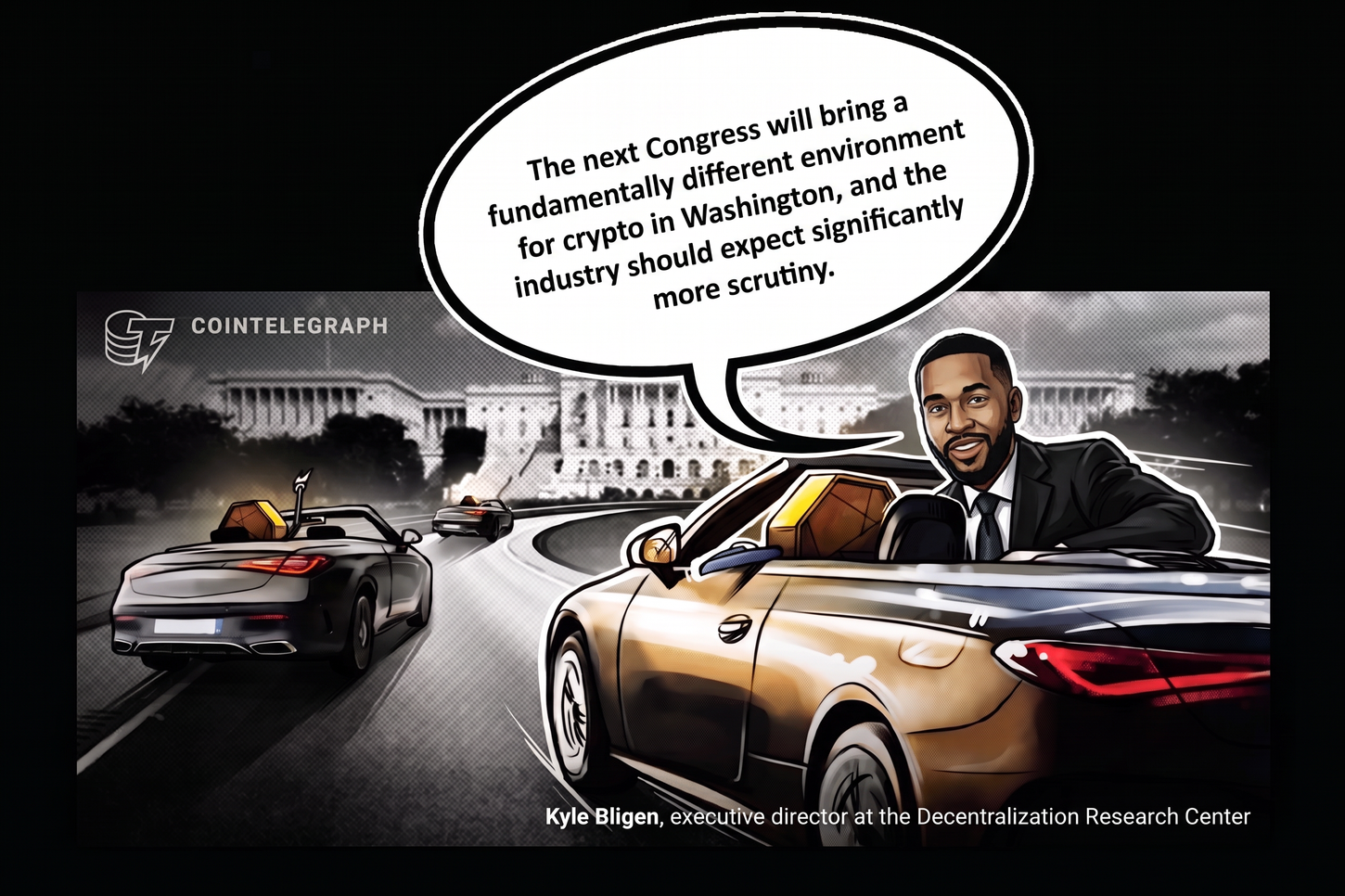
Kyle Bligen, executive director at the Decentralization Research Center, stated, "The next Congress will bring a fundamentally different environment for crypto in Washington, and the industry should expect significantly more scrutiny." Reports indicate that Democrats are considering expanding upon proposals from Representative Maxine Waters to create a broader market structure bill. There remains a possibility for the CLARITY Act to be revived, contingent on the inclusion of more robust ethics provisions, particularly concerning alleged corruption involving former President Donald Trump.
Fidelity Digital founder Hadley Stern commented on the governance challenges posed by a sitting president’s family launching memecoins and stablecoins, drawing a stark contrast to his own professional conduct. "If I’d done that at Fidelity, I’d have been walked out the same afternoon," Stern remarked. The "TRUMP" memecoin experienced a significant decline this week, becoming the largest loser among the top 100 cryptocurrencies. The election outcome also coincided with a downturn in AI-related stocks and a drop in Bitcoin’s price below $76,000.
North Korean Hackers Behind Binance’s $6.34 Billion Breach
Binance has revealed that North Korean hackers first infiltrated its systems in June, exploiting a vulnerability when an employee downloaded a compromised Homebrew installation while attempting to install an AI coding tool. Although the exchange detected the initial incident, the attackers had already acquired sensitive information about employees involved in Binance’s wallet infrastructure.
In September, a more sophisticated attack occurred when individuals posing as recruiters targeted another software engineer. This engineer was deceived into downloading a malicious file disguised as a coding assignment. On October 20, the attackers leveraged the compromised computer and an internal AI tool to gain access to the systems of two additional engineers, deploying malware. This ultimately allowed them to access the exchange’s internal wallet-signing service, facilitating the theft of billions of dollars.
Binance co-CEO Richard Teng described the incident as a "months-long campaign" rather than a single breach.
Ethereum Developer Targets 2028 for Quantum Resistance
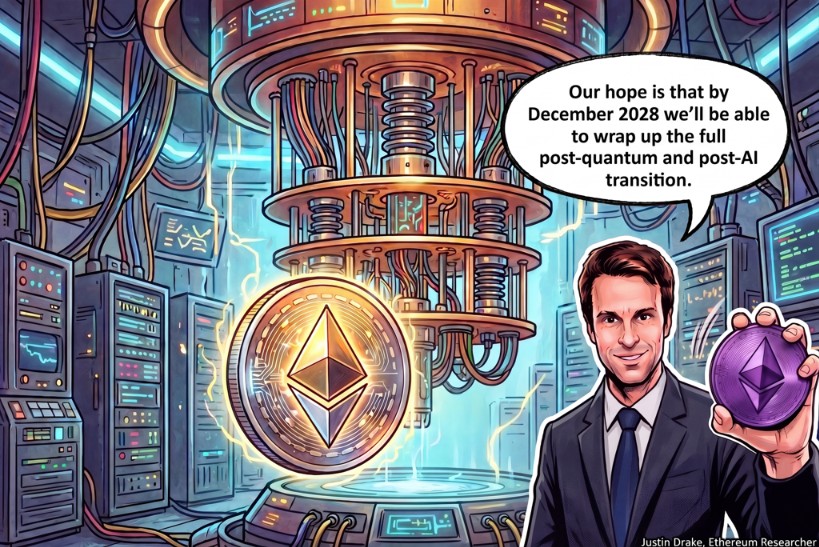
Justin Drake, a researcher at the Ethereum Foundation, has set an accelerated target of December 2028 for the completion of Ethereum’s post-quantum and post-AI transition. This timeline is a year earlier than the foundation’s previously announced deadline for achieving quantum resistance.
Speaking at Devcon 8 in Mumbai, Drake outlined the ambitious schedule, expressing the hope that "by December 2028 we’ll be able to wrap up the full post-quantum and post-AI transition." He indicated that developers have approximately 24 months to implement three additional network upgrades. The Ethereum Foundation’s September roadmap had originally set December 2029 as the deadline for quantum resistance. However, progress on the roadmap has been impacted by delays to the Glamsterdam upgrade, which has been indefinitely postponed due to security concerns related to eight smart contract invariants.
THORChain Resumes Operations Despite FBI Warning
THORChain has proceeded with resuming trading on most of its networks on November 4, disregarding an explicit warning from the FBI not to process funds linked to the recent Binance hack. The permissionless protocol’s decision led to a 15% surge in its native RUNE token within 24 hours, as trading for Bitcoin, Ethereum, Bitcoin Cash, Dogecoin, Litecoin, Tron, and Zcash was re-enabled. Trading for Avalanche, Base, and XRP had already been operational.
Chainalysis reported that THORChain processed over $46 million from the hack within the first 72 hours, generating approximately $200,000 in fees, according to the Wall Street Journal. The trading halt was reportedly triggered by an unrelated Ethereum block reorganization.
THORChain co-founder JPThor highlighted the event as proof of the protocol’s decentralization. "The fact that the FBI did in fact call out the protocol – and nobody could do anything – means in fact the protocol is decentralised," he stated. "Nobody in their right mind in a western country would flagrantly ignore a direction like that."
Market Performance and Predictions
At the close of the week, Bitcoin (BTC) saw a 4.5% decrease, trading at $74,302. Ethereum (ETH) was down 6.3% to $2,117, and XRP (XRP) declined 5% to $1.11. The total cryptocurrency market capitalization stood at $2.49 trillion, according to CoinMarketCap.

Among the top 100 cryptocurrencies, the week’s top performers included Pieverse (PIEVERSE) with a 39.2% gain, Injective (INJ) up 11.1%, and Tether Gold (XAUt) with a 4.2% increase. The largest decliners were OFFICIAL TRUMP, down 32.8%, Worldcoin (WLD) down 20.8%, and Ethena (ENA) down 19%.
Grayscale’s Zach Pandl suggested that the Binance hack, while potentially causing a temporary dip in market confidence, could ultimately lead to enhanced security practices across exchanges. Pandl, head of research at Grayscale, emphasized the importance of institutional custody solutions, such as those offered by U.S.-based crypto exchange-traded products, which typically involve robust security measures and insurance.
Binance France is ceasing operations in the country, with all user accounts scheduled to be closed on December 31. Users with remaining assets on the platform will incur monthly fees starting November 29. A monthly maintenance fee of 0.025% of the balance, with a minimum charge of 10 USDC, will be applied to accounts with a balance on that date. This development follows earlier reports in June that Binance had restricted access to certain services for European Union users due to a failure to secure Markets in Crypto-Assets (MiCA) regulatory authorization.
Suspicious prediction market activity was observed prior to the release of two recent New York Times/Siena political polls, according to a report. Researchers from Vanderbilt University noted a significant bet placed on Polymarket just before a poll showing Nebraska Senator Pete Ricketts in the lead was released. While it remains unclear if the user had insider information, they reportedly won over $77,000. Similar substantial bets were also placed on other prediction markets.
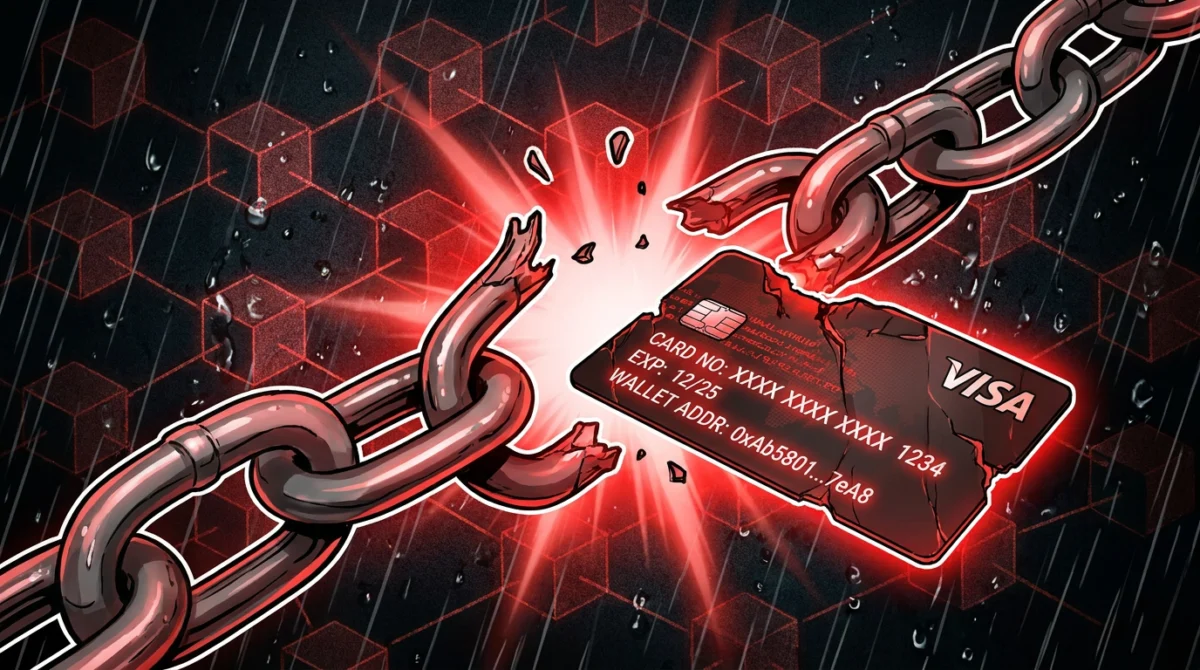
Gnosis Pay, a provider of crypto-linked Visa debit cards, disclosed a security breach that exposed customers’ payment card details, home addresses, and cryptocurrency wallet addresses. The company detected unauthorized access to its legacy consumer card system on November 3 and initiated containment measures promptly. Gnosis Pay stated that customer funds and its enterprise platform remained unaffected.
Magazine Features Explore Crypto’s Regulatory Landscape and Investment Strategies
This week’s magazine features delve into critical topics shaping the crypto space. One article examines the implications of the Democratic sweep in the U.S. midterm elections for the CLARITY Act, exploring potential shifts in consumer protections and industry concessions. Another feature provides guidance for Bitcoin holders who have received eCash following a fork, detailing how they can trade and utilize their new tokens. Australian Bitcoiners are offered strategies to navigate the anticipated capital gains tax hike in 2027, including options like setting up Self-Managed Super Funds or companies. Finally, an article investigates the potential for decentralized phone networks to support the burgeoning AI revolution, while also acknowledging skepticism from industry observers.