 11
11

Atlassian has officially launched Rovo, a sophisticated AI-powered platform designed to bring meaning-aware search, interactive chat, and autonomous agents to its core ecosystem, including Jira and Confluence, as well as a wide array of connected third-party tools. The primary objective of Rovo is to empower teams to navigate the complexities of modern enterprise data environments, allowing them to locate critical artifacts and historical context with a level of speed and accuracy that traditional search methods have historically failed to provide. By focusing on intent and semantic meaning rather than simple keyword matching, Rovo aims to eliminate the friction associated with fragmented information and help teams move forward with greater confidence.
In the contemporary workplace, the volume of data generated across various platforms often leads to a phenomenon where information becomes siloed and difficult to retrieve. Traditional enterprise search systems, many of which are built on aging architectures from the mid-2000s, rely heavily on exact keyword matching and basic filters. This model frequently fails because it requires users to remember specific document titles, ticket IDs, or precise phrasing. When a user cannot recall the exact name of a Jira ticket or a Confluence page, these systems often return a deluge of loosely related results, forcing the user to manually wade through pages of irrelevant data. This inefficiency leads to lost productivity, duplicated efforts, and a higher risk of making business decisions based on incomplete or outdated information.
Rovo addresses these systemic failures by prioritizing what a user actually means. Atlassian’s development of Rovo is centered on understanding the specific "language of work"—a dialect that includes company-specific acronyms, project codenames, incident patterns, and technical runbooks. Because traditional search consistently lets teams down in these specialized areas, Atlassian has invested heavily in smarter, more contextual search capabilities that can parse the nuances of professional communication.
The core of Rovo’s functionality is its semantic search engine. Unlike classic search tools that treat queries as isolated strings of text, semantic search is designed to understand the underlying question. For example, when a product manager asks, "how did we prioritize features for the mobile launch?" Rovo does not simply look for documents containing those exact words. Instead, it analyzes the intent behind the query, identifying relevant discussions in Jira tickets, decision logs in Confluence, and related Slack or Microsoft Teams conversations that might not share the exact terminology but are contextually linked to the mobile launch prioritization process.
The evolution of Rovo has been marked by a continuous iteration of its embedding models, which serve as the foundation for its semantic understanding. As the platform has scaled, Atlassian has transitioned through various stages of model development to improve accuracy. These upgrades are rigorously validated using both offline and online metrics. Offline, the team monitors Recall@k and Mean Reciprocal Rank (MRR) to ensure that the most relevant results are appearing at the top of the list. Online, the team utilizes experiments tracking user behavior, such as click-through rates, "long-clicks" (indicating the user found what they needed), and overall session success rates.
A standout feature of the Rovo platform is its "task-aware" search capability. This function recognizes that the same search query can yield different requirements depending on the user’s current activity. If a developer is working within a specific Jira project, Rovo prioritizes results related to that project’s codebases and tickets. If a user is browsing high-level strategy documents in Confluence, the search results shift to reflect that broader organizational context. This domain-aware retrieval is specifically optimized for getting real-world work done, transforming search from a passive lookup tool into an active assistant.
In practical application, Rovo is designed to handle "noisy" or imperfect data. In most enterprise environments, data is rarely clean or perfectly labeled; it often consists of half-filled tickets, informal comments, and non-standardized templates. Rovo’s architecture allows it to reconstruct a decision trail even when the input is vague. For instance, if a developer searches for "that flaky payments test from last week," Rovo can connect the dots between recent test failure logs, Jira issues tagged with "payments," and comments from team members discussing intermittent errors. Similarly, if an on-call engineer searches for "mitigate high CPU on search cluster," Rovo can retrieve specific operational know-how, such as relevant incident postmortems or specific runbooks, rather than just returning every document that mentions "CPU."
Behind the scenes, Rovo’s ranking algorithm goes beyond simple text similarity. It incorporates a variety of signals to determine relevance, including the recency of the information, the user’s specific permissions and access levels, and the frequency of interaction with certain documents or teammates. This multi-layered approach ensures that the information surfaced is not only relevant in a linguistic sense but also timely and actionable.
As Rovo reaches a milestone of more than five million monthly active users, Atlassian is looking toward the future of the platform with several key areas of investment. One of the primary focuses is developing a deeper understanding of work context. Atlassian intends for Rovo to better model how different elements of work are interconnected—linking high-level initiatives to specific epics, individual issues, incident timelines, and eventual postmortems. This will allow the AI to answer complex questions across various levels of the organization, from strategic planning to operational execution.
Furthermore, Atlassian is moving toward more proactive and assistive behaviors within the Rovo interface. Rather than waiting for a user to initiate a search, the platform will increasingly offer summaries, compare different project options, and highlight potential risks directly within the user’s existing workflow. This proactive assistance is grounded in the organization’s actual data, ensuring that the AI’s suggestions are relevant to the specific business context.
A significant technical advancement in the Rovo roadmap is the implementation of tenant-specific embedding fine-tuning. This initiative aims to align Rovo’s semantic space with the unique language and workflows of individual organizations. By using anonymized and privacy-preserving signals, Atlassian can adapt its models to understand the specific acronyms and project structures unique to a single company. This move shifts the technology away from a "one-size-fits-all" model toward a bespoke search and Retrieval-Augmented Generation (RAG) experience that feels tailored to each customer.
To scale the quality and performance of these AI initiatives, Atlassian has entered into a strategic collaboration with NVIDIA. By leveraging NVIDIA’s accelerated computing and AI software stack, Atlassian has been able to significantly enhance Rovo’s retrieval capabilities. A notable example of this collaboration involves the fine-tuning of the Llama-Nemotron-Embed-1B-V2 model. By applying NVIDIA’s fine-tuning recipes for Nemotron RAG embedding models on public datasets similar to Jira, Atlassian achieved a 26% to 40% uplift in retrieval quality, as measured by Recall@60 and Normalized Discounted Cumulative Gain (NDCG@1).
The efficiency of this process was highlighted by the fact that the fine-tuning recipe required less than one day to complete. It utilized the NVIDIA NeMo Data Designer for synthetic data generation and cleaning, followed by fine-tuning with NVIDIA NeMo Automodel. This rapid iteration cycle allows Atlassian to deliver more accurate and trustworthy results to Rovo users without the lengthy development timelines typically associated with such significant model improvements.
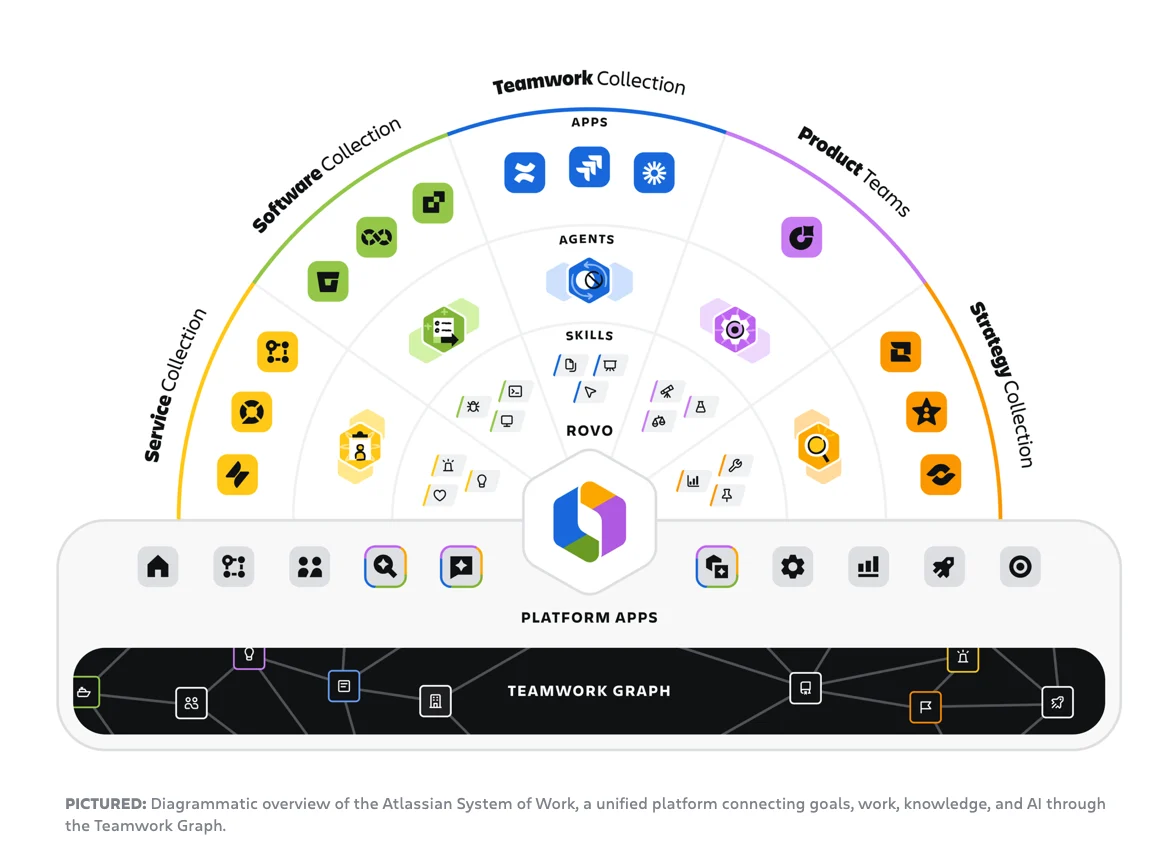
Looking ahead, Atlassian views "Agentic AI" as the next major frontier for Rovo. Semantic search is increasingly becoming the backbone of how work is discovered and acted upon across various digital tools. As autonomous AI agents become more integrated into professional teams, they will rely on the same trusted semantic layer and shared context provided by Rovo to be genuinely effective. To support this transition, Atlassian is evolving its "System of Work" to include tools like NVIDIA NemoClaw. This open-source stack simplifies the deployment of "always-on" assistants, allowing them to run safely and efficiently. As part of the NVIDIA Agent Toolkit, NemoClaw installs the NVIDIA OpenShell runtime, providing a secure environment for the next generation of agents and open-source models like NVIDIA Nemotron to operate within the enterprise.
Through these advancements, Atlassian is positioning Rovo not just as a search tool, but as a central intelligence layer for the modern enterprise. By combining semantic understanding, task-aware retrieval, and deep technical partnerships with leaders like NVIDIA, the platform aims to solve the perennial problem of information discovery, allowing teams to focus on high-value work rather than the hunt for data.