 11
11
Atlassian has officially launched Rovo, a sophisticated AI-powered tool designed to integrate meaning-aware search, interactive chat, and autonomous agents directly into its flagship platforms, including Jira and Confluence, as well as connected third-party applications. This development represents a significant shift in how modern enterprises manage and retrieve internal information, moving away from legacy keyword-based systems toward a semantic model that understands intent, context, and the complex relationships inherent in professional collaboration. By focusing on the underlying meaning of a query rather than the specific nomenclature or ticket IDs, Rovo enables teams to navigate vast repositories of digital artifacts—such as documentation, Jira tickets, and decision trails—with a level of precision that traditional enterprise search tools have historically failed to provide.
The necessity for such a system arises from the fundamental limitations of traditional search architectures in the workplace. For decades, enterprise search has relied on keyword matching and basic filters, a model that frequently breaks down when faced with the nuances of real-world work. In many organizations, information is siloed across different departments, and the "language of work" is often composed of proprietary acronyms, project-specific codenames, and evolving incident patterns. When a search engine only looks for exact character matches, it misses the context of the user’s intent, leading to hours of wasted time hunting for documents, the unintentional duplication of efforts, and critical business decisions being made without the benefit of full historical context. Rovo is engineered to bridge this gap by treating search as a problem of semantic understanding rather than simple pattern recognition.
Rovo’s semantic search capabilities are built on a foundation of sophisticated embedding models. Unlike the search boxes of the early 2000s, which functioned primarily as indices of text, Rovo’s architecture understands the conceptual relationships between terms. For instance, if a user asks, “How did we prioritize features for the mobile launch?” the system does not merely look for those specific words; it searches for the concepts of "prioritization," "feature sets," and "mobile development" across various formats, including Confluence pages and Jira backlogs. This transition to semantic search allows Rovo to find answers to complex questions rather than just returning a list of documents that happen to contain matching keywords.
To ensure the accuracy and reliability of these results, Atlassian has continuously iterated on its embedding models. The evolution of these models is governed by rigorous validation processes, including offline metrics such as Recall@k and Mean Reciprocal Rank (MRR), as well as online experiments that track user behavior, such as click-through rates, "long-clicks" (indicating the user found what they were looking for), and overall session success. This data-driven approach ensures that as Rovo scales, its ability to understand the specific dialect of a given organization—its unique runbooks and project structures—becomes increasingly refined.
A cornerstone of Rovo’s utility is its "task-aware" search functionality. Atlassian recognizes that a single query can imply vastly different needs depending on the user’s current environment. Rovo tailors its retrieval strategy based on the active workflow. If a developer is working within a Jira project, a search query may prioritize technical documentation, bug reports, and code repositories. Conversely, if a project manager is in Confluence, the same query might prioritize strategy docs, meeting notes, and roadmap visualizations. This domain-aware retrieval is optimized for the practical realities of getting work done, ensuring that the most relevant information is surfaced based on the immediate task at hand.
In practical application, Rovo demonstrates its value by making sense of "noisy" or unstructured data. In an enterprise environment, data is rarely perfectly labeled; it often consists of half-filled tickets, informal comments, and non-standardized templates. Rovo’s AI is designed to navigate this ambiguity. For example, if a developer inputs a vague query like “that flaky payments test from last week,” Rovo can connect the concept of "flaky" to recent build failures, identify "payments" as a specific module, and filter the results by the "last week" timeframe, even if the specific ticket doesn’t use those exact words. Similarly, it can reconstruct decision trails by pulling together disparate pieces of information—such as a Confluence page detailing an architectural shift, a Jira ticket where the change was implemented, and Slack messages or comments explaining the rationale—to answer a question like “Why did we switch auth providers?”
To further enhance these capabilities, Atlassian has partnered with NVIDIA to leverage its advanced AI software stack and accelerated computing power. This collaboration has been instrumental in scaling the quality and performance of Rovo’s search and Retrieval-Augmented Generation (RAG) systems. Specifically, Atlassian has utilized the NVIDIA NeMo framework to fine-tune embedding models, such as the Llama-Nemotron-Embed-1B-V2. By applying NVIDIA’s fine-tuning recipes to public datasets that mimic Jira’s structure, Atlassian achieved a remarkable 26% to 40% improvement in retrieval quality, as measured by Recall@60 and Normalized Discounted Cumulative Gain (NDCG@1).
The technical workflow for this optimization involved the NVIDIA NeMo Data Designer for synthetic data generation and data cleaning, followed by fine-tuning with NVIDIA NeMo Automodel. This process, which took less than a day to execute, demonstrates the efficiency of using purpose-built AI tools to sharpen the accuracy of enterprise search. The result is a system that provides more trustworthy and relevant answers, directly impacting the productivity of the more than five million monthly active users who currently engage with Rovo.
Looking toward the future, Atlassian is investing in several key areas to deepen Rovo’s impact. One primary focus is a more profound understanding of work context. Rovo is being trained to better model the hierarchical and lateral connections inherent in enterprise projects—linking high-level initiatives to epics, individual issues, incident timelines, and eventual postmortems. This will allow the AI to answer questions at various levels of abstraction, whether the user is seeking operational details or high-level strategic insights.
Furthermore, search is evolving from a reactive tool into a proactive assistant. Atlassian intends for Rovo to do more than just return documents; it will eventually summarize findings, compare different options, and highlight potential risks within a workflow, all while remaining grounded in the organization’s actual data. Another significant initiative is tenant-specific embedding fine-tuning. By using anonymized, privacy-preserving signals, Atlassian aims to align Rovo’s semantic understanding with the specific language, acronyms, and unique workflows of individual organizations. This level of personalization ensures that the AI feels bespoke to each company rather than a one-size-fits-all solution.
The ultimate goal of this evolution is the realization of Agentic AI. Atlassian views semantic search as the backbone of a new ecosystem where AI agents act as members of the team. These agents require a shared context and a trusted semantic layer to be effective. To support this, Atlassian is integrating NVIDIA NemoClaw, an open-source stack designed to simplify the deployment of "always-on" assistants. As part of the NVIDIA Agent Toolkit, NemoClaw facilitates the installation of the NVIDIA OpenShell runtime, providing a secure environment for running next-generation agents and open-source models like NVIDIA Nemotron.
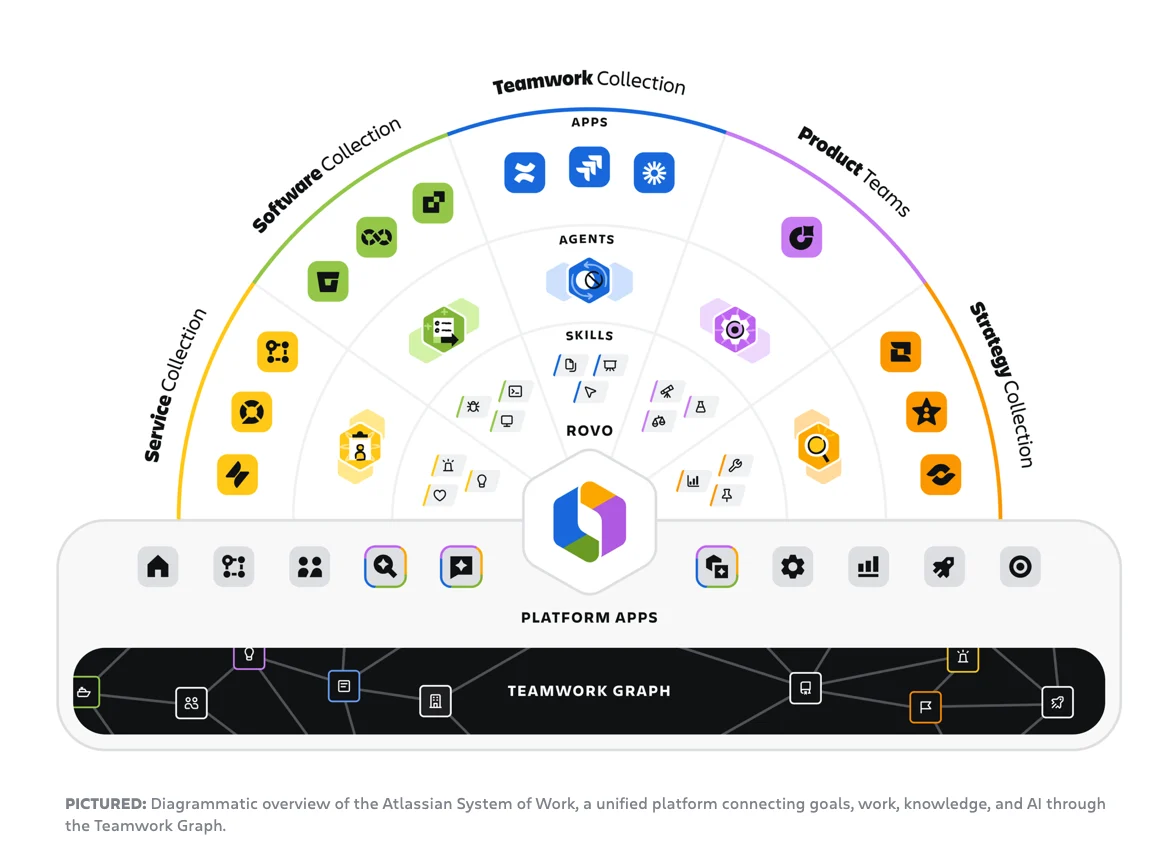
By continually evolving its AI-powered "System of Work," Atlassian is positioning Rovo not just as a search tool, but as a central intelligence layer for the modern enterprise. Through its sophisticated use of semantic understanding, task-awareness, and strategic partnerships with technology leaders like NVIDIA, Atlassian is addressing the long-standing challenges of workplace information retrieval, ensuring that teams can find what they need and move forward with clarity and confidence.