11

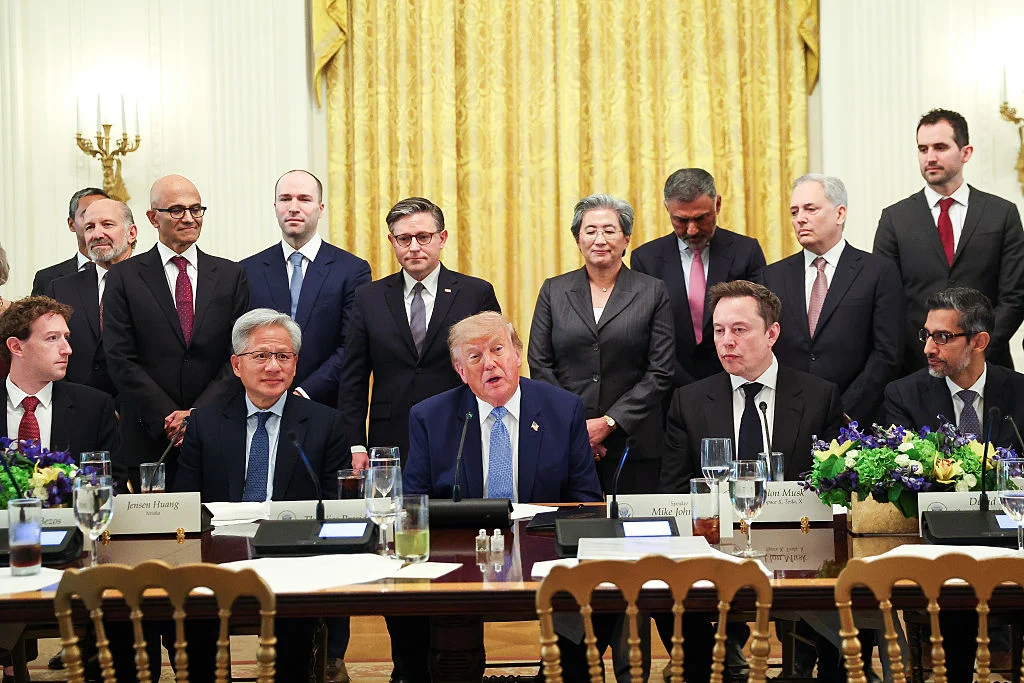
WASHINGTON D.C. — September 30, 2026 — In a move intended to underscore the United States’ commitment to responsible technological advancement, President Donald Trump and a formidable contingent of artificial intelligence industry leaders announced a landmark "Joint Commitment on Frontier Responsibilities" on Tuesday. The voluntary pledge aims to establish robust controls and safety measures as the rapid development of artificial intelligence continues to accelerate globally. However, the significant announcement was overshadowed almost immediately by a glaring error: the word "United States" was conspicuously misspelled as "Unites States" on a photo of the signed agreement shared by the President on his Truth Social platform.
The document, intended to signify a unified front between government and industry on the critical issue of AI safety, featured the misspelling directly beneath President Trump’s signature. While the names of the other prominent signatories and their respective companies were correctly spelled, the fundamental error quickly drew attention. Gizmodo reporter Matt Novak was among the first to publicly highlight the gaffe on social media, prompting immediate inquiries to the White House for comment regarding the oversight. As of the time of this report, no official response from the White House had been issued concerning the typo.
This seemingly minor spelling mistake carries potentially broader implications, raising questions about the thoroughness and attention to detail invested in drafting and reviewing such a high-profile document before its public release. In an era where precision and gravitas are expected from agreements involving national leadership and global tech titans, such an error could subtly undermine the perceived seriousness and rigor of the commitment itself. The pledge’s announcement followed intense discussions at the White House, where top AI executives converged once again to deliberate on the trajectory and societal impact of advanced artificial intelligence.
The gathering brought together some of the most influential figures in the AI landscape, including Meta CEO Mark Zuckerberg, Nvidia CEO Jensen Huang, and Anthropic CEO Dario Amodei. Their presence underscored the critical juncture at which AI development stands, necessitating ongoing dialogue between innovators and policymakers. This meeting occurred just weeks after a notable divergence of opinion within the AI community regarding the pace of development. Previously, prominent voices such as OpenAI CEO Sam Altman, Anthropic’s Amodei, and even Tesla and X CEO Elon Musk had advocated for a deceleration of AI advancements, citing potential existential risks and the need for more robust safety protocols.
President Trump and Nvidia’s Huang, however, had publicly rejected calls for slowing down AI progress. The President’s stance has consistently emphasized national competitive advantage, articulating a belief that "We’re the most sophisticated country in the world, and frankly I want to keep it that way because whoever wins AI, wins." This perspective frames AI development not just as a technological race but as a geopolitical imperative, where leadership in superintelligence is synonymous with global dominance. The "Joint Commitment on Frontier Responsibilities" appears to be an attempt to bridge these differing viewpoints, offering a middle ground that acknowledges the need for safety without overtly advocating for a slowdown.
The voluntary pledge outlines a framework for companies involved in training and deploying "frontier models" – referring to the most advanced and powerful AI systems currently under development. These models, characterized by their unprecedented capabilities and potential for rapid, unforeseen advancements, are the primary focus of the safety commitment. The document stipulates that signatory companies should "ensure that their technology behaves as intended and that any issues are promptly identified and resolved." This broad directive is further detailed by recommendations for practical measures, including the establishment of independent boards for oversight and the implementation of robust internal controls designed to monitor and mitigate risks inherent in cutting-edge AI.
A critical aspect of the "Joint Commitment" is its voluntary nature. Unlike legislative mandates or binding regulations, this pledge carries no explicit legal or regulatory ramifications should any signatory fail to uphold its commitments. This reliance on self-governance and corporate responsibility reflects a common approach in the nascent stages of regulating rapidly evolving technologies, where industry input and flexibility are often prioritized over prescriptive legal frameworks. While some critics might view the lack of legal teeth as a weakness, proponents argue that a voluntary agreement can foster quicker adoption of best practices and allow for iterative adjustments in a field where technology evolves faster than traditional legislative processes.
Following the White House summit and the announcement, Mark Zuckerberg addressed reporters at a press conference. He characterized the accord as "a start" that the "whole industry could come to," further adding that "it was sort of a historic conversation." Zuckerberg’s comments highlight the industry’s recognition of the growing imperative for collective action on AI safety, even if the initial steps are voluntary and foundational. The commitment represents a formal acknowledgment from key players that the power of AI necessitates a shared responsibility for its ethical and safe deployment.
In a related development, the President also issued an executive order mandating a significant shift in governmental terminology regarding artificial intelligence. All government departments and agencies are now required to cease using the term "artificial intelligence" and instead adopt "superintelligence" or its acronym "SI." This rebranding effort appears to align with President Trump’s vision of the technology’s ultimate potential and its strategic importance. The transition from "AI" to "SI" could be interpreted as an attempt to elevate the perceived status and transformative power of these technologies, emphasizing their capacity to surpass human cognitive abilities in various domains. While the implications of such a linguistic shift on policy or public perception remain to be fully seen, it clearly signals a presidential focus on the most advanced and potentially world-altering forms of intelligent systems.
The confluence of a high-profile industry-government pledge, a critical spelling error, and a sweeping terminology mandate paints a complex picture of the current state of AI governance in the United States. As frontier models continue their rapid advance, the effectiveness of voluntary commitments and the symbolic weight of presidential directives will be closely scrutinized by both the tech community and the wider public. The conversation around AI safety, acceleration, and national competitiveness is clearly intensifying, with Tuesday’s events adding new layers of discussion and debate.