 11

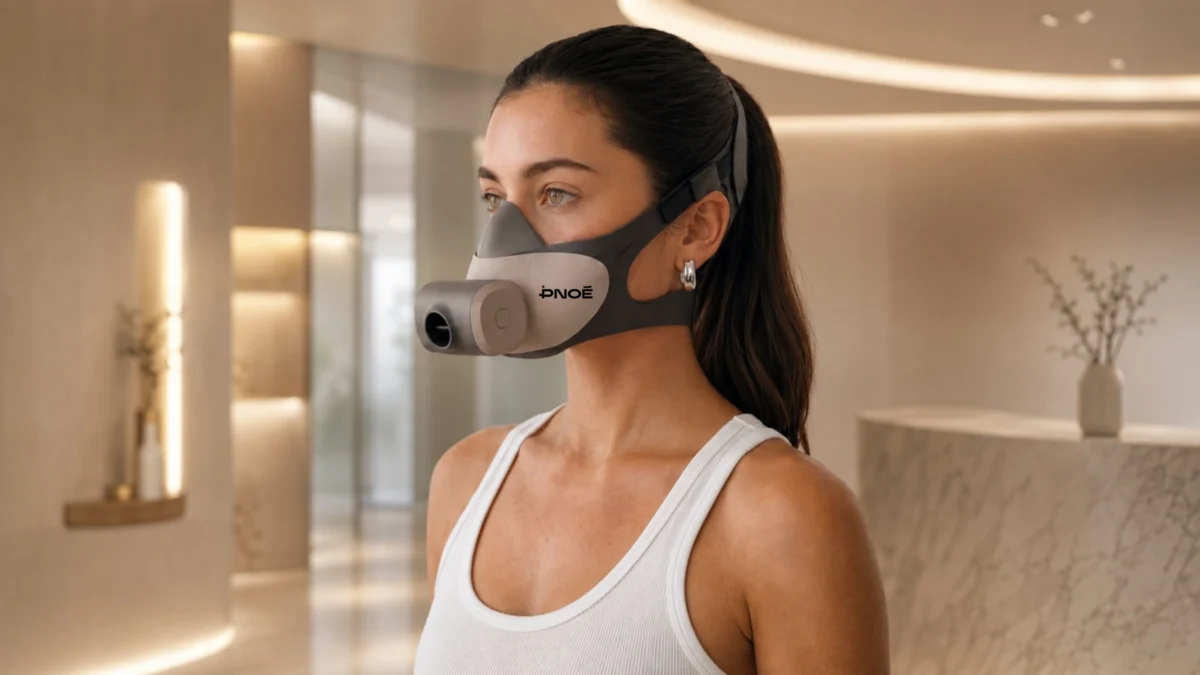
At first glance, the newest device from PNOÄ presents an imposing silhouette, evoking comparisons to the formidable mask worn by Bane, Batman’s hulking adversary in the comic books. This striking appearance—a mask covering the nose and mouth, secured by straps around the back of the head—belies a purpose far more benign and beneficial: to meticulously measure an individual’s oxygen consumption and carbon dioxide exhalation. The data gleaned from this sophisticated metabolic analysis is then translated into personalized, actionable advice concerning diet, exercise regimens, and ultimately, the company hopes, a pathway to a longer, healthier life.
PNOÄ, a company strategically headquartered in Malden, Massachusetts, with significant operational presence in Athens, Greece, is poised for a major product launch. On October 1, the PNOÄ 2.0 will officially debut, marking a significant evolution from its predecessor. The most pivotal enhancement in this new iteration is its unprecedented self-administration capability. According to Apostolos Atsalakis, co-founder and CEO, the device is designed for ultimate user convenience. During a recent Zoom conversation from the company’s Athens office, Atsalakis explained the simplified process: "Someone can walk into a gym, just wear the mask, push the button, sit down," and breathe normally for a mere eight minutes. "That’s it. It’s that easy," he emphasized, highlighting the groundbreaking accessibility of the new system.
This self-serve functionality represents a critical advancement. PNOÄ’s earlier device mandated the presence and operation by a trained technician, a requirement that inherently restricted its deployment to specialized facilities. The PNOÄ 2.0, by contrast, removes this barrier, opening vast new avenues for its application. Atsalakis anticipates its widespread adoption in fitness centers that may not possess dedicated staff for such testing, and even envisions its potential integration into pharmacies, thereby democratizing access to advanced metabolic insights.
The scientific principles underpinning PNOÄ’s technology are robust and well-established, rooted in over a century of research. Metabolic testing, which systematically analyzes the gases exchanged during respiration to ascertain how the human body generates energy, has long been the undisputed gold standard for quantifying VO₂ max. VO₂ max, or maximal oxygen uptake, represents the maximum rate at which the body can consume oxygen during strenuous exercise, serving as a widely accepted and crucial indicator of cardiorespiratory fitness. However, the traditional methods for conducting these tests have historically involved bulky, prohibitively expensive equipment, primarily confined to specialized sports physiology laboratories and hospital settings. Consequently, access to such detailed metabolic analysis has largely been the exclusive domain of elite athletes striving for peak performance and participants in high-end executive wellness programs.
PNOÄ, a company with a decade of innovative development, promises to disrupt this traditional landscape. Its core offering is to deliver the same rigorous accuracy as laboratory-grade equipment, but in a highly portable and user-friendly package. This hardware innovation is synergistically paired with sophisticated software that translates complex physiological data into clear, actionable recommendations. "We made it accessible to everyone," Atsalakis proudly stated, encapsulating the company’s mission to bring elite-level health insights to the general public.
The company asserts that its comprehensive test captures an impressive array of 23 distinct biomarkers. Beyond the critical measurement of VO₂ max, these biomarkers include one’s resting metabolic rate (RMR), which quantifies the number of calories the body expends simply to maintain basic functions at rest. Another vital metric is metabolic flexibility, which assesses the body’s efficiency in switching between burning fats and carbohydrates for energy—a key indicator of metabolic health. Atsalakis compellingly argues that these multifaceted metrics provide answers to fundamental health questions that conventional blood tests often cannot address, such as an individual’s precise caloric needs or the most effective training strategies tailored to their unique physiology.
The timing of PNOÄ’s enhanced offering could not be more opportune. In recent years, VO₂ max has ascended to the status of a prominent buzzword among enthusiasts and researchers in the burgeoning field of longevity. This heightened interest is largely fueled by a growing body of scientific research that consistently links higher levels of cardiorespiratory fitness to significantly reduced mortality rates. Atsalakis underscores the profound importance of this metric, proclaiming VO₂ max to be the "strongest predictor of human longevity." He envisions PNOÄ’s comprehensive data as an indispensable "scorecard" for individuals navigating the complexities of the rapidly expanding wellness industry.
The PNOÄ 2.0 represents not just a functional upgrade but also a significant design evolution. It is notably smaller and more compact than its predecessor, featuring a streamlined architecture with fewer internal components. Atsalakis highlighted that this simplification directly contributes to enhanced reliability. The device’s sleek design was the result of an intensive collaborative process with the Milan-based Design Group Italia. Atsalakis described this journey as involving "a lot, a lot, a lot of iterations," a testament to the challenges inherent in pioneering a self-administered metabolic testing device, a concept largely unexplored before PNOÄ.
Furthermore, the PNOÄ 2.0 thoughtfully addresses a pertinent concern that has gained prominence in the post-pandemic era: hygiene, specifically the question of "who wore it last?" The innovative design provides a reassuring solution: the electronic components are engineered to detach completely from the silicone mask and head straps. This modularity ensures that while the more costly hardware can be safely shared among multiple users, each individual maintains their own personal, hygienic mask.
Despite its sophisticated clinical capabilities, PNOÄ maintains a careful and responsible stance regarding the claims it makes. The device has not received clearance from the U.S. Food and Drug Administration (FDA), and Atsalakis explicitly stated, "we do not provide medical recommendations." Instead, PNOÄ consciously positions itself as a wellness device. Atsalakis drew a clear analogy: "It’s like a body composition device, like a scale." He further clarified the distinction, emphasizing, "A doctor cannot prescribe medication based on our results." This careful delineation ensures that the company operates within its designated wellness domain, providing data for personal optimization rather than clinical diagnosis.
While currently classified as a wellness tool, the future trajectory for PNOÄ could potentially expand into the medical sphere. Researchers have long investigated the diagnostic potential of compounds found in human breath, exploring their capacity to signal serious diseases such as cancer. Atsalakis harbors a belief that the company’s rapidly expanding repository of metabolic data could, in due course, enable it to flag potential health issues. However, he candidly acknowledged that achieving full diagnostic capabilities remains "definitely a couple of years away," with stringent regulatory hurdles likely extending that timeline even further. "We’re not there yet," he confirmed, maintaining a realistic outlook on future developments.
PNOÄ’s origins can be traced back to Atsalakis’s foundational PhD research in sensing technologies conducted at the prestigious University of Cambridge. During an era when wearable technologies were rapidly gaining traction, he became captivated by the wealth of physiological information that could be unveiled through the analysis of human breath. This intellectual curiosity soon blossomed into a business venture when he co-founded the company with Panos Papadiamantis, a childhood friend who now serves as PNOÄ’s chief product officer.
The startup gained early momentum by participating in Y Combinator’s Winter 2019 batch, a period predating the current widespread recognition and robust industry status of "longevity." Since then, PNOÄ has successfully raised approximately $22 million in funding, including a recently concluded $11 million round. Its impressive roster of investors includes prominent firms like 50 Years and notable individuals such as Lars Rasmussen, the co-founder of Google Maps, who himself is now based in Athens, further underscoring the company’s international appeal and technological credibility.
PNOÄ operates on a strictly business-to-business (B2B) model, selling its advanced metabolic testing solutions directly to enterprises that, in turn, offer the service to their own clientele. Its diverse and prestigious client portfolio includes industry leaders such as Equinox, where the device is available in nearly all clubs, according to Atsalakis. Other notable clients span across luxury hospitality (Four Seasons hotels), elite sports (Red Bull, the NBA), healthcare systems (Mount Sinai Health System), and specialized med spa chains (Restore Hyper Wellness).
Geographically, the United States constitutes approximately 85% of PNOÄ’s current business, a market Atsalakis characterizes as "by far the most advanced globally" for longevity-focused innovations. Building on this strong foundation, the company is actively pursuing strategic expansion into European markets and, through established partnerships, extending its reach into Latin America and Asia, aiming for a truly global presence.
Businesses subscribing to PNOÄ’s services pay a monthly fee ranging from $400 to over $1,000. This comprehensive subscription package includes the necessary hardware, proprietary software, extensive training for staff, and essential marketing materials—a holistic offering Atsalakis aptly dubs a "business in a box." A key feature of PNOÄ’s integrated system is its ability to link test results directly to the specific services offered by a client business. This allows, for example, a gym or spa to provide highly personalized recommendations based on a customer’s unique metabolic profile. Atsalakis noted that many clients strategically utilize the test during customer onboarding, positioning it as an insightful intermediate step between a full clinical workup and the often-estimated metrics provided by consumer smartwatches.
This "middle ground" in personalized health data is, however, becoming increasingly competitive. Major technology companies like Apple, Garmin, and Whoop all offer estimations of VO₂ max derived from heart-rate data captured by their wearable devices. Similarly, consumer-focused devices such as Lumen provide breath analysis to gauge the body’s utilization of fats and carbohydrates. At the upper echelons of this market, traditional metabolic carts continue to reign as the gold standard in specialized laboratories and hospitals, serving the most stringent research and clinical needs.
PNOÄ, which currently employs a dedicated team of 110 professionals, has recently achieved profitability, a significant milestone, while simultaneously sustaining an impressive annual growth rate exceeding 100%. Atsalakis revealed the company’s strategic plan to raise a Series B funding round within the next six to twelve months. This capital infusion will be instrumental as PNOÄ continues its ambitious mission to place its distinctive mask—Bane comparisons and all—onto more faces, further broadening access to precise metabolic insights and contributing to a healthier, longer-living global population.






