11

For many users, the YouTube algorithm is a deeply personal and meticulously cultivated digital companion. It’s a sophisticated system, often described as sacred, that has spent years accumulating data on individual preferences, viewing habits, and engagement history, meticulously fermenting this vast dataset into a bespoke selection of videos presented on the home screen. While acknowledged not to be flawless, the platform’s underlying algorithmic intelligence has proven remarkably adept at anticipating what its diverse user base desires to see. Illustrating this precise personalization, one user reported their current top three videos consisted of an in-depth Apple Watch analysis, a timely update on Big Brother season 28, and a comedic clip titled "I Lost to the Muppets" from comedian Chris Fleming, each immediately prompting a click. This deep understanding of individual tastes has long been a hallmark of YouTube’s success, yet users have often sought more direct ways to influence this powerful recommendation engine.
Addressing this long-standing user desire for greater agency, Google, the parent company of YouTube, introduced a significant new feature at its "Made on YouTube" event on Wednesday. Among several new functionalities unveiled, the most prominent was the "Custom Feeds" button, designed to provide users with unprecedented direct control over the videos populating their front page. This represents a rare and substantial opportunity for YouTube users to actively tweak their algorithmic feed, moving beyond the traditional, indirect methods of influence such as simply pressing the "thumbs up" or "thumbs down" button, or blocking specific creators. Historically, user interaction with the algorithm has been largely reactive, but Custom Feeds introduces a proactive, conversational dimension.
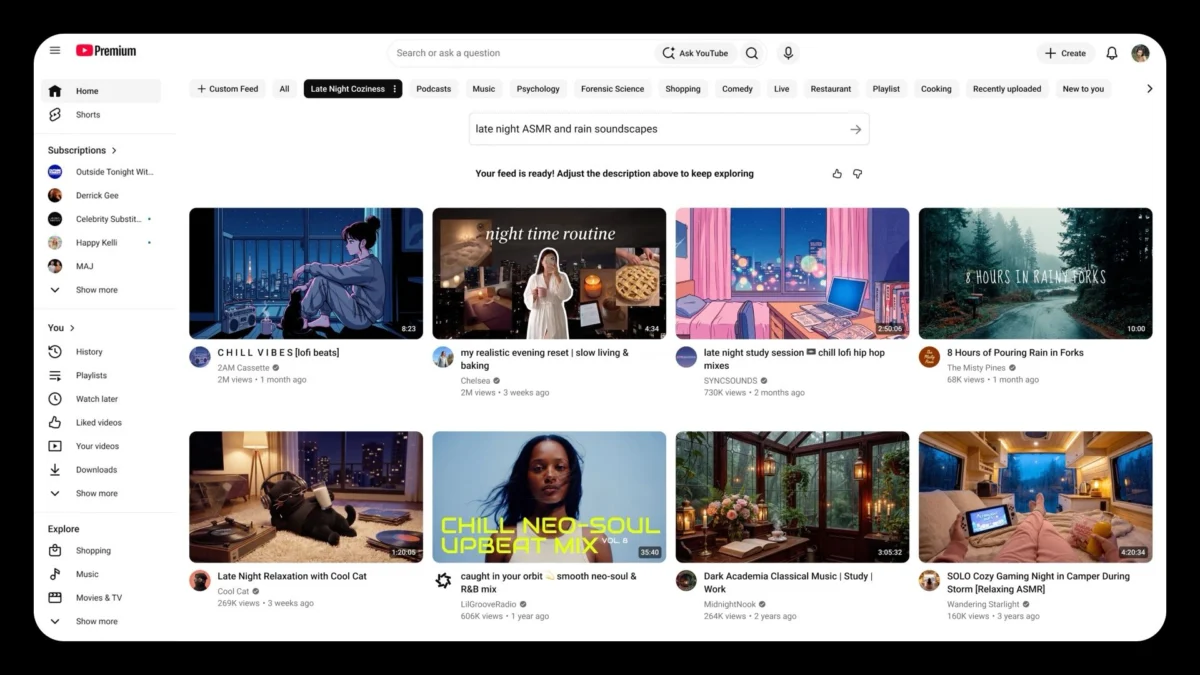
The process for engaging with this innovative tool is designed to be intuitive and accessible. Users can locate and click the prominently displayed "Your custom feeds" button, positioned conveniently below the search bar on their YouTube interface. Upon activation, they are prompted to articulate a request for the specific type of feed they wish to generate. The underlying technology powering this personalized experience is a suite of advanced large language models (LLMs). These sophisticated AI models are tasked with processing the user’s natural language request, interpreting its nuanced meaning, and subsequently generating a freshly personalized homepage populated with relevant video content. One compelling example of a suggested prompt provided by YouTube highlighted the feature’s capability to capture abstract "vibe" requests: "I want a rainy Shanghai vibe: café jazz, street food, and vlogs." This demonstrates the LLMs’ capacity to translate descriptive, atmospheric language into concrete content recommendations, moving beyond simple keyword matching.

YouTube’s decision to roll out Custom Feeds follows a period of rigorous internal testing. The feature was initially introduced as an experimental offering earlier in the year, allowing the company to gather user feedback and refine its functionality. Based on the positive reception and successful performance during this experimental phase, YouTube determined it was a valuable and well-suited addition to its platform. The company has announced plans for a comprehensive rollout, making Custom Feeds available to all users across the United States in the near future, regardless of their preferred viewing device—whether mobile, desktop, or smart TV. This broad accessibility underscores YouTube’s commitment to integrating the feature deeply into the user experience.
Emily Moxley, YouTube’s vice president of product management, articulated the strategic rationale behind the new feature, stating, "Users are always telling us that they want more control. They want more ability to steer their algorithm. With custom feeds, we’re giving them a natural-language way that they can do that. They can tell us exactly what they want." This statement highlights a core philosophy guiding the development: empowering users through intuitive, natural interaction. The traditional algorithm, while highly effective, has often been perceived as a "black box" by users, making it difficult to understand or influence its decisions. Custom Feeds aims to demystify this process by allowing users to communicate their desires directly, much like having a conversation with a highly intelligent content curator.
To test the efficacy of this new natural-language interface, one user provided a multifaceted and specific prompt: "Gooey macaroni and cheese recipe videos, Caleb Hearon clip compilations, and crystal singing bowl videos under 15 minutes." The resulting custom feed generated by the LLM was remarkably precise, delivering exactly the requested blend of content. This curated selection offered a "perfect zen blend for rotting on the couch after a long day," illustrating the feature’s ability to cater to very particular moods and combinations of interests. Furthermore, the system demonstrated its intelligence by suggesting potential refinements or additions to the initial prompt, such as "uploaded this month" for recency or "without talking or commentary" for a more ambient experience. These proactive suggestions enhance the user’s ability to fine-tune their feed even further, showcasing the dynamic capabilities of the generative AI.
The Custom Feeds button is strategically placed within the YouTube interface, appearing alongside other popular topic tabs such as "Music" and "Podcasts" directly below the search bar. This placement ensures easy discovery and integration into the existing user workflow. A crucial aspect of its design is that experimenting with this tool does not permanently alter or replace a user’s standard, algorithmically driven homepage. Users retain the flexibility to access their default, comprehensive feed at any time by simply clicking the "All" button. Moreover, the platform allows users the convenience of saving multiple custom feeds, enabling them to switch between various personalized content selections tailored to different moods, activities, or interests throughout their day.

This feature truly shines when users seek to blend multiple, often disparate, preferences into a single cohesive viewing experience. It surpasses the capabilities of a standard YouTube search, which typically provides results based on keywords rather than complex, nuanced requests. Custom Feeds excels at dynamically responding to intricate video demands, whether that involves curating videos on several distinct topics while adhering to a specific length constraint, or attempting to capture an elusive "vibe" perfectly suited to a user’s current disposition. For instance, finding videos that are both educational and relaxing, or a mix of high-energy music and calming visualizers, becomes effortlessly achievable.
The introduction of Custom Feeds is part of a broader, company-wide strategic focus by YouTube, and indeed Google, on generative AI. YouTube’s event for 2026, where Custom Feeds was announced, heavily emphasized the integration and expansion of generative AI features across its platform. A key component of this larger AI push includes the enhancement of the "Ask YouTube" tool. This chatbot-style addition to YouTube’s search capabilities, initially launched earlier in the year at Google I/O, allows users to pose more specific and complex questions about videos. The latest updates revealed at the Made on YouTube event indicate that Ask YouTube is now even better equipped to answer detailed inquiries, particularly when users are engaged in shopping for specific products, further blurring the lines between content consumption and e-commerce.
Interestingly, the product development team at YouTube had also explored a more radical feature that would have allowed users to directly manipulate their overall recommendation algorithm. However, this concept was ultimately shelved. Emily Moxley explained the decision: "We found users were nervous and afraid to do that. They were worried about messing it up." This insight underscores a crucial psychological barrier: while users desire more control, they also fear inadvertently disrupting a system that, despite its imperfections, generally serves them well. The Custom Feeds button was specifically designed to circumvent this apprehension, providing a "low-stakes place to experiment" where users can explore new content avenues without the perceived risk of fundamentally altering their long-term algorithmic profile. It acts as a temporary, curated playlist generator rather than a permanent algorithmic re-programmer.
YouTube’s Custom Feeds feature is not an isolated development but rather indicative of a significant, emerging trend across the software industry. A growing number of major platforms are now empowering users to subtly or directly adjust their algorithmic feeds through requests facilitated by generative AI tools. This shift reflects a broader industry movement towards greater user agency and personalization. Late last year, Meta, for example, launched its "Your Algorithm" feature on Instagram, providing users with options to refine the types of posts they see within their Reels feed. Similarly, Spotify, the leading music streaming service, introduced its "Prompted Playlists tool" in January 2026 for users in the U.S. and Canada, enabling them to customize their music-listening habits by describing their desired playlist in natural language. These parallel innovations across diverse platforms highlight a collective recognition that user satisfaction and engagement can be significantly boosted by providing more transparent and controllable algorithmic experiences, marking a new era of personalized digital consumption.