11


Asset manager VanEck has voiced strong criticism regarding the executive compensation structure at Metaplanet, a prominent Bitcoin treasury company. Despite recent measures taken by Metaplanet to mitigate shareholder dilution, VanEck argues that these efforts are insufficient to adequately align management’s interests with those of its investors. The critique was detailed in a comprehensive report by VanEck examining executive compensation practices across the ten largest digital asset treasury companies.
In its analysis, published on Friday, VanEck assigned Metaplanet’s compensation structure a "Bad" rating, positioning it as the sole company among those reviewed to fall into the lowest assessment category. The primary concerns highlighted by VanEck stem from Metaplanet’s equity plan, which represents 14.7% of its fully diluted shares, and the significant exposure of its officers, which stands at 8.2%.
To contextualize these figures, VanEck’s report reveals a stark contrast when compared to peer companies. Metaplanet’s officer exposure is approximately ten times the average of 0.8% observed across the other nine analyzed firms. Furthermore, its overall equity plan is nearly four times the peer average. For comparative purposes, Strategy, recognized as the largest corporate Bitcoin (BTC) holder, boasts an equity plan equivalent to 2% of its fully diluted shares, with officer exposure at a more modest 0.5%. VanEck positively rated Strategy’s compensation structure as "Good," commending its fixed equity reserve and the requirement for shareholder approval for any plan increases.
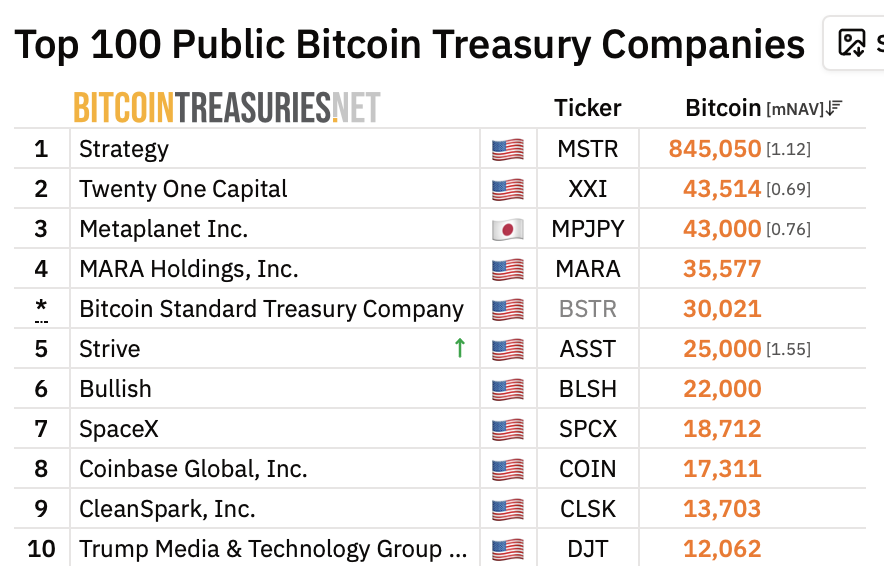
Metaplanet, a Japanese entity, currently holds the position of the third-largest publicly traded corporate Bitcoin holder, with a substantial treasury of 43,000 BTC, according to data from BitcoinTreasuries.net. The company’s strategic focus on accumulating Bitcoin has positioned it as a significant player in the digital asset space.

Bitcoin Purchases Led to Expansion of Executive Option Pool
The significant disparity in executive compensation metrics at Metaplanet can be partly attributed to its former compensation structure. This previous arrangement allowed the company’s stock option pool to automatically expand in proportion to the issuance of new shares, particularly those allocated to fund Bitcoin purchases. This mechanism proved to be a substantial driver of dilution. Initially, the option pool stood at 46 million shares. However, the automatic adjustment clause, tied to Bitcoin acquisitions, saw this pool balloon to 319.5 million shares, effectively creating approximately 273 million additional potential shares.
This substantial expansion of the executive stock pool had previously drawn considerable backlash from some Metaplanet shareholders. These concerned investors had publicly called on the company to rescind the additional potential shares generated by this adjustment mechanism, arguing that it disproportionately benefited management at the expense of existing shareholders.
In response to the mounting criticism and shareholder pressure, Metaplanet took steps to address the issue. In August, the company terminated the automatic adjustment mechanism that had fueled the pool’s growth. Subsequently, in September, Metaplanet implemented a significant reduction in the overall pool size, cutting it by 41% from its peak of 319.5 million shares down to 188.2 million shares. Despite these actions, VanEck maintains that these changes "fall well short of the mark," indicating that the problem of excessive dilution has not been adequately resolved.
Recommendations for Improved Alignment and Reduced Dilution
VanEck’s Friday report put forth specific recommendations for Metaplanet to rectify its executive compensation structure and better align management with shareholder interests. The asset manager strongly urged Metaplanet to reverse the approximately 273 million-share expansion that was a direct consequence of the previous adjustment clause. Furthermore, VanEck suggested that any remaining executive compensation rights should be replaced with a new compensation plan that has undergone and received explicit shareholder approval.
In a separate but related point, VanEck also highlighted that unless past equity grants are subject to clawback provisions, a significant portion of the dilution has already been realized. This implies that even with the reduction in the overall pool, the economic impact of the previously issued options on existing shareholders may be irreversible.
Beyond these immediate corrective actions, VanEck recommended the adoption of broader best practices in executive compensation. Specifically, the report advised tying executive compensation to performance metrics that directly reflect the company’s Bitcoin holdings, such as "Bitcoin per fully diluted share." This would create a more direct link between executive rewards and the value generated from the company’s core asset. Additionally, VanEck recommended the implementation of a formal written grant-timing policy. Such a policy would provide transparency and governance around the timing of equity grants, further mitigating potential conflicts of interest and ensuring fairness.
The analysis by VanEck underscores a critical ongoing debate within the digital asset industry regarding the governance and executive compensation practices of companies holding significant cryptocurrency treasuries. As these companies mature and attract a wider base of institutional and retail investors, the alignment of management incentives with shareholder value creation becomes increasingly paramount. Metaplanet’s situation serves as a case study, illustrating the potential pitfalls of compensation structures that can lead to substantial shareholder dilution if not carefully designed and overseen. The ongoing scrutiny from influential asset managers like VanEck suggests that companies in this space will face continued pressure to adopt more robust and transparent compensation frameworks.