11

The landscape of software development is undergoing a significant transformation as the industry shifts toward AI-native delivery cycles, necessitating a more integrated approach to quality assurance. To address the persistent disconnect between code production and quality validation, a new intelligent, assignable agent known as BearQ for Jira has been launched. This tool is designed to close the loop between the code built by development teams and the quality of the final shipped product by embedding autonomous testing capabilities directly into the Jira workflow.
In the current development environment, many teams find themselves caught in a challenging position between two suboptimal extremes. On one hand, they rely on high-maintenance manual or automated test suites that are prone to breaking as the application evolves. On the other hand, they may attempt to use generic artificial intelligence tools that, while powerful, lack the specific delivery context required to understand the nuances of a particular project. When testing remains disconnected from the platform where work is planned and managed, teams frequently lose visibility into critical user journeys, acceptance criteria, and the overall scope of a release. This fragmentation often results in significant blind spots, the emergence of late-stage defects, the proliferation of noisy test suites, and costly handoffs between product managers, engineering teams, and quality assurance (QA) professionals.
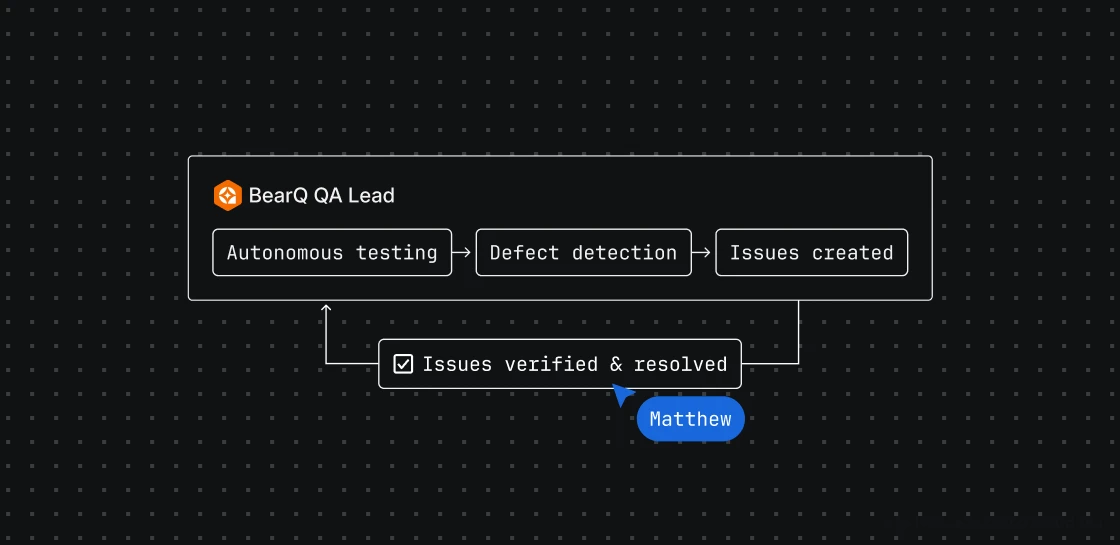
The introduction of BearQ for Jira seeks to rectify these inefficiencies by grounding the testing process in the requirements and decisions that teams collaborate on daily. By acting as an AI teammate that can be assigned to specific Jira work items, BearQ brings end-to-end testing directly into the delivery pipeline. The agent is designed to explore user journeys, generate adaptive test coverage, and identify defects early in the lifecycle, effectively bridging the gap between the code generated by agents or developers and the final quality standards required by the organization.
The operational framework of BearQ for Jira is built upon the principle of grounding testing in real delivery context. Traditionally, software testing has often been initiated through disconnected tickets, outdated specifications, or cumbersome handoffs that occur late in the development process. BearQ reverses this model by transforming Jira work items into living test context. The process begins once code has been generated and a pull request (PR) or a preview environment is made available. At this stage, a team member can assign the work item directly to BearQ or utilize Atlassian’s Rovo Chat to mention the agent and initiate the testing phase.
Upon activation, BearQ instantly parses the available information within the Jira environment, including acceptance criteria, technical requirements, and historical comment threads. This allows the agent to author relevant test cases, document the necessary reproduction steps for potential issues, and actively explore browser behavior to ensure the application functions as intended. This level of integration ensures that quality assurance remains a constant, embedded part of the workflow rather than a separate, siloed activity. Whether the initial triage is led by Rovo or BearQ begins validation immediately, the system is designed to eliminate the need for manual context gathering and to reduce the friction associated with cross-departmental handoffs.
One of the primary technical advantages of BearQ for Jira is its ability to adapt tests as an application evolves. Fast-moving product teams often find that maintaining brittle, static test scripts becomes a full-time occupation, as even minor changes to features or shifts in workflows can cause traditional automated tests to fail. BearQ addresses this by leveraging real-time Jira context to autonomously explore and map the application. This exploratory capability allows the agent to discover untested user paths and edge cases that are frequently missed by pre-defined, scripted tests. Because the agent generates tests that dynamically adapt to changes in application behavior, delivery teams can identify regressions before code reaches the staging environment. This shifts the timeline from planned changes to validated results from a matter of days to a matter of minutes.
Furthermore, BearQ for Jira is designed to scale QA capacity without requiring teams to relinquish control or sacrifice governance standards. As an autonomous teammate, the agent can expand the testing footprint by validating across the entire application, while human team members maintain the ability to set guardrails, direct the agent’s focus, and retain oversight where it is most critical. This collaborative model allows for a broader range of testing coverage while ensuring that the final decisions remain in the hands of the development and QA leads.
The agent’s reporting capabilities are also integrated into the Jira ecosystem to ensure that findings are actionable and transparent. When BearQ identifies regressions, user experience (UX) issues, or data inconsistencies, it automatically creates Jira issues. These issues are populated with comprehensive evidence and clear reproduction steps, allowing developers to address the problems without the need for extensive back-and-forth communication. By reducing the time spent on triaging noisy or poorly documented bug reports, the system enables faster feedback loops and quicker resolutions. This efficiency allows QA professionals to shift their focus toward high-impact risks and strategic quality improvements rather than repetitive manual checks.
The necessity for such a tool is underscored by the increasing complexity of modern software applications. As teams adopt AI-native delivery models, the volume of code and the speed of iterations can easily overwhelm traditional QA processes. By bringing an intelligent agent into the environment where planning and execution occur, BearQ aims to ensure that quality is not an afterthought but a continuous component of the development lifecycle. The integration with Atlassian’s existing tools, such as Rovo Chat, further enhances the utility of the agent by allowing it to participate in the natural communication flow of a project team.
The deployment of BearQ for Jira represents a move toward "agent-orchestrated workflows," where human expertise is augmented by specialized AI agents that handle high-volume, context-heavy tasks. In this model, the agent is not merely a tool but a functional member of the team capable of interpreting complex requirements and executing technical validations. The ability to parse comment threads and technical requirements means that the agent is aware of the "why" behind a change, not just the "what," providing a level of depth that generic testing tools cannot match.
For organizations looking to implement this technology, BearQ for Jira is currently available on the Atlassian Marketplace. The setup process involves connecting BearQ to an existing Jira workspace, which then allows for the immediate assignment of tasks to the agent. This connection facilitates a unified workflow where testing and delivery are no longer separate stages but are instead part of a synchronized process.
In summary, BearQ for Jira addresses the core challenges of modern software quality assurance by providing an intelligent, context-aware agent that lives within the Jira environment. By grounding testing in real-time requirements, adapting to application changes, and scaling QA capacity through autonomous exploration, the tool helps teams maintain high standards of quality without slowing down the pace of delivery. The automation of bug reporting and the integration with Atlassian’s collaborative tools ensure that the entire development team remains aligned on the scope and quality of every release. As software delivery continues to accelerate, the role of intelligent agents like BearQ is expected to become increasingly central to maintaining the balance between speed and reliability in the production of high-quality software.