11

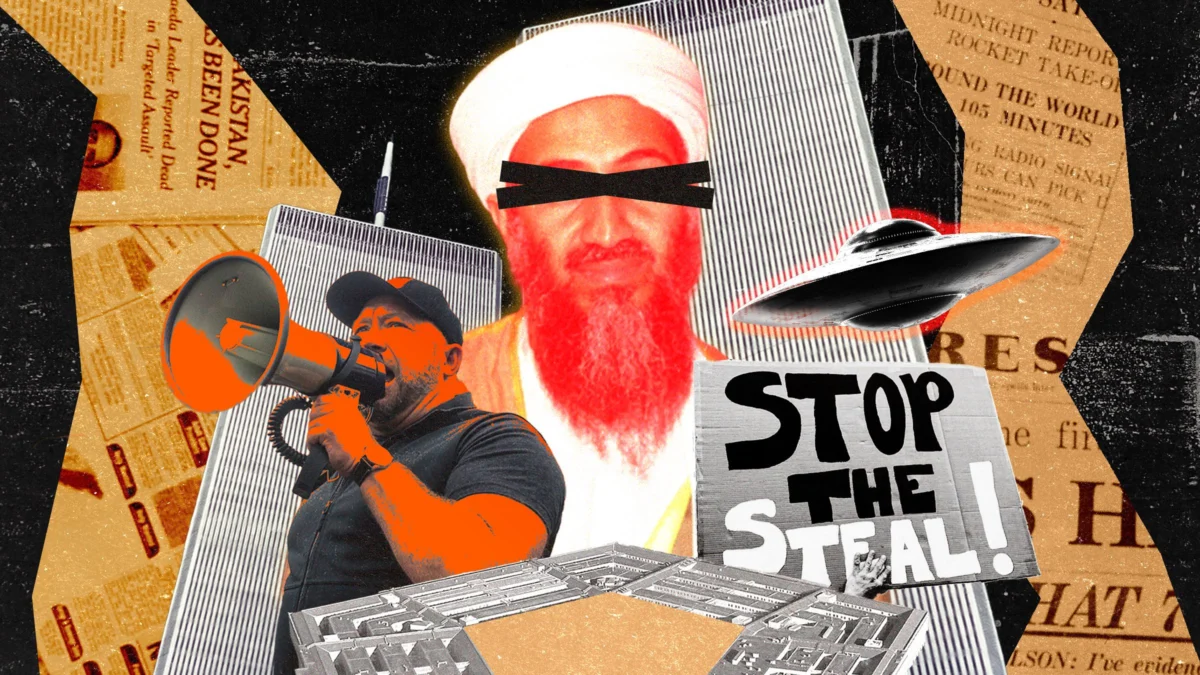
The intricate and often unsettling tapestry of conspiracy theories surrounding the September 11 attacks, collectively known as "9/11 Truth," began weaving its threads months before the devastating events themselves, revealing a complex origin story rooted in misinformation and anti-government sentiment. This stew of false narratives, often tinged with antisemitism, purports that the United States government possessed foreknowledge of, or even actively participated in, the 2001 attacks. Yet, perhaps the most peculiar aspect of this pervasive worldview is that its foundational seed was sown a full three months prior to that fateful day.
It was on June 28, 2001, when Milton William "Bill" Cooper, a controversial radio personality, took to the airwaves on his nationally syndicated show, "The Hour of the Time." He had just watched a news report on CNN that profoundly disturbed him. Cooper recounted to his listeners, "Supposedly, a CNN reporter found Osama bin Laden, took a television camera crew with him, went into Osama bin Laden’s hideout, interviewed him and his top leadership, his top lieutenants and colonels and generals in their hideout." He continued, claiming the reporter emerged to declare, "Within three weeks, Osama bin Laden is going to attack the United States and Israel."
Cooper had captured part of the story correctly, though with significant distortions. A reporter had indeed managed to reach the inner sanctum of al Qaeda, nestled in the rugged mountains near Kandahar, Afghanistan. However, the correspondent was not from CNN but rather a Middle Eastern broadcaster, MBC. Furthermore, Baker Atyani, the MBC correspondent, had actually interviewed Mohammed Atif, al Qaeda’s military chief, not Osama bin Laden himself. During the chilling exchange, Atif ominously warned Atyani, "In the coming weeks, there will be a big surprise; we are going to hit American and Israeli installations." He added a grim prediction: "The coffin business will increase in the United States." According to Atyani, bin Laden, who was present during the interview, merely smiled and nodded in approval of Atif’s threats.
To Cooper, analyzing the situation on his radio show that day, this interview presented a stark dilemma for the US government. It either represented a monumental embarrassment for an administration that had spent years fruitlessly hunting bin Laden, or, more sinisterly, it was undeniable evidence that the government was deliberately misleading the public about the true nature and immediacy of the threat posed by the al Qaeda leader.
"Now, don’t you think that’s kind of strange, folks?" Cooper provocatively asked his audience, his voice dripping with skepticism. "The largest intelligence apparatus in the world, with the biggest budget in the history of the world, has been looking for Osama bin Laden for years and years and years and can’t find him. The FBI, also under the leadership of Louis Freeh, has been looking for Osama bin Laden for years and years and years and years and years and many years and can’t find him. Some doofus jerk-off reporter with a camera crew waltzes right into his hideout and interviews him?" His incredulity was palpable, designed to sow doubt about official narratives.
Cooper then presented his listeners with a stark, binary conclusion. "Now that tells us two things: Either everyone in the intelligence community and all of the intelligence agencies of the United States government are blithering idiots and incompetent fools, including the entire apparatus of the FBI and all of their personnel—or they’re lying to us. They’re not looking for him at all." This statement encapsulated his deep-seated distrust in governmental institutions.
He didn’t stop there. Cooper went on to assert, without evidence, that "the CIA created Osama bin Laden" and that "they’re now using him to help bring about world government by making him the big boogeyman because they can’t use [Iraqi dictator] Saddam Hussein anymore." This intricate web of claims connected bin Laden directly to a shadowy globalist agenda.
Cooper emphatically argued that the entire threat emanating from bin Laden was nothing more than a carefully orchestrated farce—what would later become widely known as a "false flag" operation. He declared, "If you believe it, you are one of the stupidest jerks that ever lived on the face of this earth, and whatever’s going to happen they’re going to blame on Osama bin Laden." A mere 10 weeks later, after the horrific events of September 11, Cooper’s chilling comment would be reinterpreted by his followers as a chilling prophecy.
The September 11 attacks and their immediate aftermath fundamentally reshaped nearly every facet of American society. From the pervasive "security theater" that became a daily reality—the strict 3.4-ounce liquid restrictions at airports, the defensive bollards now ubiquitous in urban landscapes—to the dramatic expansion of the surveillance state through legislation like the Patriot Act, and the two decades of prolonged war in Afghanistan. Beyond these tangible shifts, the attacks fostered a deep undercurrent of fear and anxiety that continues to permeate the culture. However, few accurately recognize one of 9/11’s most profound and insidious impacts: how it irrevocably altered society’s understanding and relationship to verifiable facts and objective truth.
This complex narrative, poorly understood by many, has roots stretching back to the UFO conspiracies of the 1980s and tentacles reaching forward to the January 6, 2021, assault on the National Mall. It is a story that particularly illuminates the transformation of Alex Jones from a fringe Austin, Texas, talk show host into one of the 21st century’s most influential and disruptive political forces. This profound transformation began in the immediate minutes and hours following the devastating September 11 attacks.
Cooper himself first rose to prominence in the 1980s, emerging as one of the initial "UFO whistleblowers." This group comprised purported former military or intelligence veterans who claimed to possess insider knowledge regarding government cover-ups of alien civilizations, captured spacecraft, and recovered extraterrestrial life-forms. This era marked the first golden age of modern conspiracism, a period when public trust in government plummeted in the wake of the Vietnam War, the Watergate scandal, and the shocking revelations of dark assassination plots exposed by the Pike and Church committees. Books delving into government cover-ups and urban legends like the Bermuda Triangle and the "Philadelphia Experiment" became unlikely bestsellers.
Cooper asserted he had served as a naval intelligence officer in the 1970s and, during his tenure with a high-ranking admiral, claimed to have covertly accessed the contents of the admiral’s cabinet of classified material. As Colin Dickey observed in a review of a Cooper biography, this cabinet became "a repository of secrets known only to Cooper, whose contents seemed to change and evolve over the years, fitting whatever need Cooper’s current conspiracies had." In its early iterations, Cooper hinted that this clandestine collection held the definitive truth about the JFK assassination and the government’s hidden contact with alien beings.
In the 1990s, amidst the burgeoning popularity of far-right talk shows epitomized by figures like Rush Limbaugh, Cooper himself became a national radio personality. His shortwave program, "The Hour of the Time," broadcast a potent "witches’ brew" of sinister government conspiracies, revisionist alternate histories, dire warnings about the impending New World Order, revelations of secret societies, and a generous dose of general-purpose skepticism. Cooper frequently exhorted his audience with his now-famous mantra, "Wake up, sheeple!" Much of his conspiratorial worldview, however, contained thinly veiled, and often explicitly overt, antisemitism.
For a brief period, Cooper stood as one of the nation’s most recognized "UFO-ologists," though his often erratic claims led to frequent feuds with others in the field. He eventually consolidated his grand conspiratorial narrative in his 1991 memoir, "Behold a Pale Horse," a work that can only be described as a fever-dream of paranoia.
"Behold a Pale Horse" is a truly astonishing piece of writing, defying easy categorization. At one point, it controversially quotes the entire text of "The Protocols of the Elders of Zion," a fabricated antisemitic screed from the early 1900s that falsely alleged a secret Jewish plot for global domination and the overthrow of Christianity. Cooper’s work essentially laid the groundwork for what would become QAnon three decades later, outlining a vast, decades-long, and all-encompassing global conspiracy aimed at stripping America and its freedoms from "real Americans," all in service of some shadowy global super elite. The book became an underground bestseller, maintaining its popularity to this day, and found a particularly receptive audience within the burgeoning militia movement.
This newfound fame coincided with the launch of his talk radio career on WWCR, World Wide Christian Radio, in January 1993. Operating from his home in Arizona, Cooper commanded a powerful 100,000-watt signal, allowing him to reach vast swathes of the country. Over time, Cooper cultivated two immensely important—and later infamous—superfans. One was a young Gulf War veteran named Timothy McVeigh, who, in the early spring of 1995, journeyed with a companion (whose exact identity remains disputed) to Arizona, seeking to speak with Cooper at his residence. "The last thing he said before they left in their green Mercury Marquis station wagon with a puke-yellow interior was, ‘Watch Oklahoma City,’" Cooper would later recount. Shortly after this chilling meeting, McVeigh carried out the devastating attack on the Alfred P. Murrah Federal Building, an act of domestic terrorism that claimed 168 lives and injured nearly 700 people.
Then there was Alex Jones, a local public-access talk show host based in Austin, Texas. Jones first garnered national attention for his fundraising efforts to rebuild the church at the Branch Davidian compound in Waco, Texas. That site had tragically burned down in 1993, marking the devastating end of a 51-day siege by the US government, as federal agents attempted to arrest the leader of the Branch Davidian cult, David Koresh. In the siege’s final moments, agents deployed armored vehicles to introduce tear gas into the compound; the buildings subsequently caught fire—it was never definitively determined how the fires started—and most of the Davidians remaining inside perished in the blaze. The tragedy resulted in 75 fatalities, including approximately two dozen children. The Waco siege became a pivotal flashpoint, fueling anti-government sentiment among the far right throughout the 1990s.
Jones found significant inspiration in Cooper’s model, and Cooper, in turn, became something of a mentor to the budding radio host, even calling in for an interview on Jones’s early shows. Jones’s program on KJFK-FM lasted until 1999, and he was even voted "Best of Austin" radio host by a local newspaper, which famously described him as "either Austin’s great exposer of truth or a black helicopter conspiracy nut, depending on your worldview." However, his increasingly extreme conspiracism made securing sponsors difficult, leading KJFK to fire him in December 1999. Undeterred, Jones quickly pivoted to a new venture on the rapidly expanding internet: Infowars.com.
On September 11, 2001, as the nation reeled from the attacks, Cooper reacted with outrage but also with dire warnings of what was to come. "Folks, I can assure you that 72 hours from now, we will be at war. We will be bombing two or maybe three countries… Because that’s how it works. When governments are attacked, they lash out. Thousands of people who had nothing whatsoever to do with what is happening at the World Trade Center and the Pentagon are going to die," Cooper declared, adding prophetically, "Nothing will be the same after today."
Broadcasting that very day on Infowars and a network of approximately 100 syndicated stations, Jones went even further than his mentor. "I went on the air and said, ‘Those were controlled demolitions,’" he later recounted to Rolling Stone, immediately laying the groundwork for the most central tenet of 9/11 Truth.
In the weeks and months that followed, Cooper and Jones’s paths diverged politically and personally. Cooper, increasingly disillusioned, came to view Jones as a copycat, a fearmonger, and a liar, even dedicating a show on September 26, 2001, to simply titled "Alex Jones—Liar."
As Jones delved deeper into the burgeoning 9/11 conspiracies in the aftermath of the attacks, Cooper, who had stopped paying taxes, was drinking heavily, and was engaged in sometimes violent disputes with his neighbors, began prophesying his own demise. In November 2001, law enforcement officers arrived at his Arizona compound to arrest him on an outstanding warrant for aggravated assault. Cooper opened fire, shooting one deputy in the head, and was subsequently killed in the returning police gunfire.
With Cooper’s death, the field was left clear for the unhindered rise of Alex Jones.
In the ensuing years, Alex Jones became the preeminent force in the dissemination of 9/11 conspiracies. The movement, which coalesced under the banner of "9/11 Truth," encompassed a host of diverse and increasingly elaborate theories: that United Airlines Flight 93 had been shot down by US fighter jets rather than crashing in Shanksville, Pennsylvania; that the Pentagon had been struck by a missile, not a hijacked airliner; and