 11


Europe’s securities regulator has issued a stark warning regarding the increasing interconnectedness between the cryptocurrency sector and traditional financial markets. The European Securities and Markets Authority (ESMA) has indicated that these growing ties could significantly amplify the risk of financial shocks propagating throughout the broader economic system. This concern is highlighted in ESMA’s latest risk monitoring report, published on Thursday, which calls for enhanced vigilance over the "growing linkage between increasingly vulnerable crypto-asset markets and the broader financial system."
The report specifically points to several developments that are deepening the nexus between crypto and traditional finance, thereby increasing the potential for financial spillovers. Among these are the expanding adoption of tokenized equities and recent high-profile exploits within decentralized finance (DeFi). Tokenized equities, while still representing a nascent segment compared to the vast global stock markets, are demonstrating a notable upward trend in traction. ESMA anticipates that this growth could introduce novel participants and infrastructure into the financial ecosystem, potentially reshaping established market structures. The introduction of these new elements, coupled with the inherent volatility and evolving regulatory landscape of crypto assets, creates a fertile ground for unforeseen systemic risks.

Beyond tokenized equities, ESMA has also identified prediction markets as an emerging area of concern. The regulator has expressed heightened apprehension regarding the potential for insider trading and market manipulation within these platforms. ESMA’s analysis suggests that the integration of cryptocurrencies into prediction markets can complicate the detection of illicit activities such as insider trading, wash trading (a form of market manipulation where an individual or entity simultaneously sells and buys the same financial asset to create misleading activity), and coordinated market manipulation schemes. The pseudonymous nature of many cryptocurrency transactions, combined with the rapid and global accessibility of prediction markets, presents a formidable challenge for regulatory oversight.
This warning from ESMA arrives at a time when prediction markets are already facing a significant regulatory reckoning in the United States. A key point of contention revolves around the classification of event contracts, with ongoing debates concerning whether they fall under federal derivatives law or state-level gambling regulations. The Commodity Futures Trading Commission (CFTC) has been actively issuing guidance for prediction markets throughout 2026, while simultaneously asserting its exclusive jurisdiction over federally regulated event contracts. This assertion of authority has led to legal confrontations, with the CFTC initiating lawsuits against several states, including Kentucky, Minnesota, New Mexico, New York, Illinois, and Connecticut. These legal actions were prompted by attempts by state authorities to apply state gambling laws to operators of prediction markets.
The jurisdictional dispute over prediction markets could potentially escalate to the US Supreme Court. On September 2, New Jersey officials submitted a petition to the Supreme Court, urging it to definitively rule on whether states can enforce sports gambling laws against prediction markets that are already registered with the CFTC. This petition stems from ongoing litigation across at least 20 states that are grappling with the same regulatory ambiguity. While it remains uncertain whether the Supreme Court will agree to hear the case, a future ruling could establish a critical precedent, determining whether state or federal authorities hold the ultimate jurisdiction over the regulation of prediction markets.
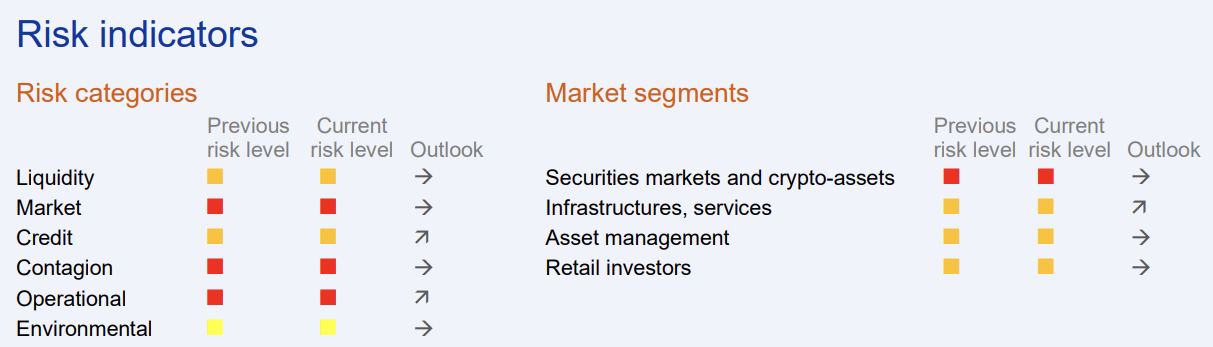
The ESMA report underscores a broader trend of increasing convergence between digital asset markets and traditional finance. While this convergence offers potential benefits such as increased efficiency and broader market access, it also introduces new avenues for systemic risk. The interconnectedness means that a significant disruption in the crypto market, whether due to technological failure, regulatory crackdown, or a sudden loss of investor confidence, could have ripple effects across the traditional financial system. This is particularly concerning given the relative immaturity and volatility of the crypto market, which lacks the established safeguards and regulatory frameworks present in traditional finance.
The regulator’s emphasis on "increasingly vulnerable crypto-asset markets" suggests a recognition of the ongoing challenges within the digital asset space, including regulatory uncertainty, susceptibility to hacks and exploits, and the speculative nature of many digital assets. As these markets mature and integrate further with established financial institutions, the potential for contagion risk becomes more pronounced. ESMA’s call for closer monitoring signifies a proactive approach to identifying and mitigating these emerging threats before they can destabilize the broader financial landscape.
The implications of ESMA’s warning extend beyond Europe, as the global nature of financial markets means that risks in one jurisdiction can quickly spread to others. The report serves as a timely reminder for regulators worldwide to assess and address the systemic risks posed by the evolving relationship between crypto and traditional finance. The development of robust regulatory frameworks, clear jurisdictional boundaries, and enhanced supervisory capabilities will be crucial in navigating this complex and rapidly changing financial environment. The future of financial stability may depend on the ability of regulators to effectively manage the challenges and opportunities presented by the growing digital asset ecosystem.






