11


New Jersey’s Attorney General, Jennifer Davenport, and the state’s interim director for the Division of Gaming Enforcement, Mary Jo Flaherty, have formally petitioned the United States Supreme Court to hear a pivotal case that could determine the jurisdictional authority over prediction market companies. The core of the dispute centers on whether state authorities or federal agencies hold the ultimate say in regulating these platforms, particularly when their operations intersect with existing gambling laws.
The petition, filed on Wednesday, seeks a writ of certiorari to bring before the nation’s highest court New Jersey’s enforcement actions against Kalshi, a prediction market platform that offers contracts based on sporting events. Officials cited ongoing civil cases initiated by gaming authorities in "at least 20 states," highlighting a widespread concern among state governments regarding the regulatory ambiguity surrounding prediction markets. The central question presented to the Supreme Court is whether prediction market companies can simultaneously comply with federal regulations under the Commodity Futures Trading Commission (CFTC) while violating state-specific gambling laws.
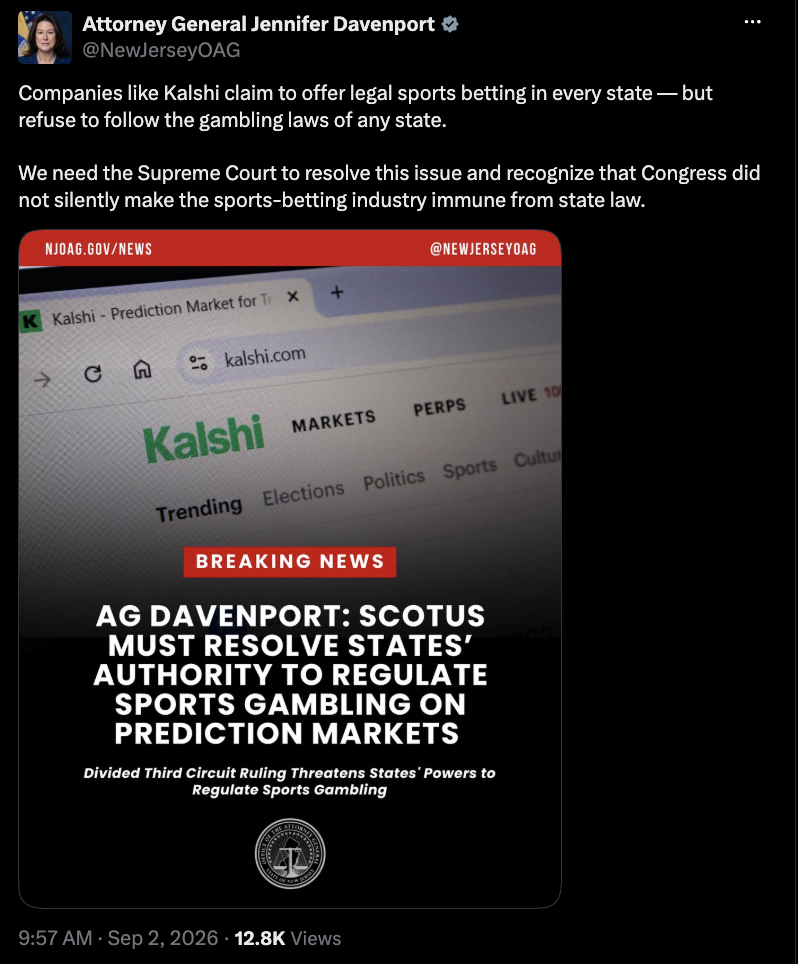
Attorney General Davenport articulated the state’s position forcefully, stating, "Companies like Kalshi claim to offer legal sports betting in all 50 States, but they refuse to follow the gambling laws of any State. These companies have no right to offer their sports bets without following state law, which is why dozens of States across the ideological spectrum have opposed them. We’re calling on the Supreme Court to resolve this issue and recognize that Congress did not silently make the sports-betting industry immune from state law."

The petition specifically frames the legal question for the Supreme Court as: "whether the 2010 Dodd-Frank Wall Street Reform and Consumer Protection Act preempted States from regulating sports bets that occur within their jurisdictions if those bets are offered on markets registered with the [CFTC]." This directly challenges the notion that federal registration under the CFTC automatically shields these operations from state-level oversight. Cointelegraph reached out to the CFTC for comment but had not received an immediate response at the time of reporting.
This move by New Jersey’s legal team directly challenges a significant April ruling by the U.S. Court of Appeals for the Third Circuit. In that instance, a 2-1 decision favored Kalshi, rejecting the New Jersey gaming authorities’ bid to halt the company’s operations. The appellate court judges found that Kalshi had a "reasonable chance of success" in arguing that the CFTC’s Commodity Exchange Act preempted state law. The Third Circuit’s decision hinged on the CFTC’s classification of sports bets on prediction market platforms as "swaps," thereby falling under the agency’s regulatory purview. New Jersey’s appeal aims to counter this, arguing that federal law does not preempt state sports-gambling laws, regardless of CFTC registration.
The potential consequences of a Supreme Court ruling in this matter could be far-reaching for Kalshi and the broader prediction market industry. According to an announcement from the New Jersey AG’s office regarding the petition, "Because federal law prohibits trading swaps off CFTC-registered markets, a victory for Kalshi would mean that all sports gambling off such CFTC-registered markets would seemingly become illegal even if state law allows it." This highlights a complex regulatory landscape where federal preemption, if broadly applied, could render certain activities illegal at the state level even if state law permits them, or conversely, allow operations to bypass state laws if they are federally registered.
A spokesperson for Kalshi, Dani Lever, expressed disagreement with New Jersey’s decision to pursue an appeal to the Supreme Court. Lever stated that the company should not be subjected to regulation by "50 different regulators." She further conveyed Kalshi’s continued confidence in the lower court rulings, asserting, "We remain confident in the lower courts’ rulings, and nothing in New Jersey’s filing today changes our view." This indicates a firm stance from Kalshi, which views the current regulatory framework as sufficient and the state’s appeal as an unnecessary complication.
The ultimate decision of whether the Supreme Court will indeed hear this case remains uncertain. Legal experts have been closely observing the evolving landscape of prediction market regulation, with many speculating that the justices might weigh in on this matter. Previously, attention had been directed towards a case that reached the appellate court in Nevada. However, the New Jersey petition introduces another significant avenue for the Supreme Court to address the jurisdictional quandaries. Regardless of which specific case the court chooses to review, or if it emerges from a future enforcement action against another prediction market company, any decision rendered by the Supreme Court could definitively shape which governmental bodies possess the authority to regulate prediction markets across the United States. This could have profound implications for how these platforms operate, how they are perceived by regulators and the public, and the legal framework governing the rapidly evolving market for event-based contracts.
The situation underscores a fundamental tension between federal oversight of financial markets and state authority to regulate gambling and consumer protection. Prediction markets, by offering contracts that can be settled based on future events, often tread a fine line between financial instruments and speculative wagers. This ambiguity has fueled the ongoing legal battles and the current push for clarity from the highest judicial authority in the land. The Supreme Court’s eventual engagement with this issue, or its decision to refrain from doing so, will undoubtedly leave a lasting impact on the future of prediction markets and their regulatory standing.