 11


The recent surge in Bitcoin’s price, pushing it back above the $80,000 mark, underscores the increasingly intertwined relationship between the cryptocurrency industry and traditional capital markets. Michael Saylor’s strategy, heavily reliant on a receptive market to finance its Bitcoin acquisitions, and Circle’s operational outlook, which increasingly resembles a bet on the growth of dollar-denominated financial infrastructure, are both benefiting from a backdrop bolstered by U.S. Treasury bond buyback plans. This symbiotic relationship is fundamentally reshaping the companies, balance sheets, and networks driving the current rebound in the crypto market.
This week’s analysis of the crypto business landscape reveals how this integration is manifesting. The robust rally in Bitcoin, exceeding $80,000, has directly translated into significant gains for crypto-related stocks. Mining companies and digital asset treasury firms have posted double-digit increases, mirroring a broader market recovery sentiment. This recovery is significantly influenced by the U.S. Treasury’s strategic decision to double the volume of certain long-dated bond buybacks, a move that injects liquidity and stimulates risk appetite across financial sectors, including digital assets.
Among the prominent beneficiaries of this trend are Canaan, MARA Holdings, and Strive, which have emerged as top performers in the past week. Major cryptocurrency platforms like Coinbase and Robinhood have also experienced upward price movements. Bitcoin itself has extended its weekly advance, recording gains of over 23%, while Ether has seen an even more impressive surge, gaining nearly 30% to trade above $2,500, according to data from CoinMarketCap.
Adding to the positive sentiment, former President Donald Trump has renewed his calls for Congress to pass the CLARITY Act. While this bill, aimed at establishing clearer regulatory frameworks for U.S. crypto markets, remains stalled and failed to advance before the August recess, its discussion injects a degree of political attention into the sector. Furthermore, Trump has independently revived the prospect of government Bitcoin purchases, though neither of these potential outcomes is assured.
Bernstein Forecasts New Growth Cycle for USDC, Boosting Circle’s Outlook
Analysts at Bernstein are expressing a bullish outlook on Circle, predicting a new growth cycle for its USD Coin (USDC) stablecoin. They anticipate that this resurgence in USDC supply growth, which has recently shown signs of acceleration, could provide a substantial boost to the company over the next twelve months. In a research note released on Monday, Bernstein highlighted that the supply of USDC increased by approximately $2 billion within a seven-day period, effectively ending a six-month phase of stagnant or declining growth.

Bernstein has maintained its "Outperform" rating on Circle (CRCL), with a price target of $140, suggesting a potential upside of around 60%. Circle’s shares have already experienced a notable increase of approximately 40% over the past month. The firm’s analysts attribute the potential for this next phase of growth to several key factors: renewed momentum in the broader cryptocurrency market, increasing regulatory clarity within the United States, the burgeoning tokenized capital markets, and wider adoption of stablecoins in payment systems. They also point to early indications of demand from artificial intelligence agents as a potential driver.
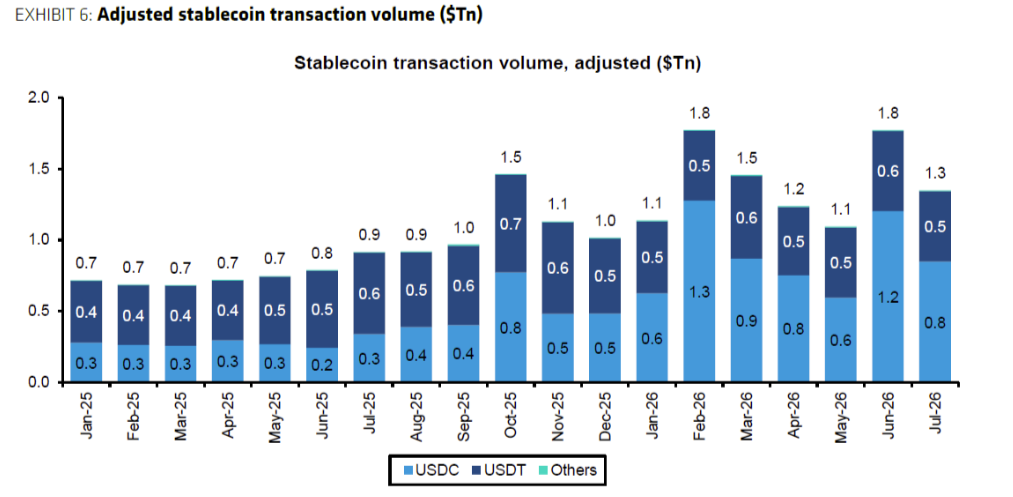
Notably, USDC’s share of adjusted transaction volume has seen a significant rise, climbing from roughly 40% in 2025 to over 60% so far in 2026, thereby surpassing Tether’s USDt on this particular metric. Circle’s stock has exhibited volatility since its Initial Public Offering (IPO) in June 2025, when shares were priced at $31. Following an initial post-IPO surge, the stock experienced a decline, returning close to its IPO price by November 2025 amidst the broader crypto market downturn. The chart illustrating USDC’s share of stablecoin transaction volume clearly depicts this sharp growth trajectory, as reported by Bernstein.
Strategy’s Primary Risk Identified as Capital Market Access, Not Bitcoin Price Volatility
A recent report from Regime Intelligence suggests that the principal vulnerability for Strategy is not a potential crash in Bitcoin’s price, but rather the risk of losing access to capital markets. Such an event could jeopardize its ability to service its substantial annual obligations, amounting to $1.76 billion, without being forced to liquidate its Bitcoin holdings.
The report indicates that Strategy holds 840,447 Bitcoin, which serves as collateral for approximately $22 billion in debt and preferred claims. Crucially, there are no margin calls directly tied to Bitcoin’s price, according to the findings. Stress tests conducted by the report suggest that Bitcoin would need to experience a precipitous decline of 96% for the company’s holdings to become insufficient to cover its convertible notes. Furthermore, Strategy maintains cash reserves equivalent to 2.6 times its annual obligations. Its Bitcoin holdings are currently valued at $66.7 billion, against a cost basis of $63.36 billion.
Kadan Stadelmann, co-founder of Komodo Platform, commented to Cointelegraph, stating that "Even if equities unraveled, Strategy’s Bitcoin holdings put it in a good situation to weather most any storm. The company is holding far more Bitcoin than its annual cash obligations."
However, the more significant risk emerges in a scenario of deteriorating financing conditions. A prolonged downturn in Bitcoin, coupled with a falling Strategy share price and a lower net asset value (mNAV), could make it increasingly challenging for the company to raise fresh capital. This situation could potentially compel Strategy to draw down its reserves or resort to selling Bitcoin to meet its financial commitments. Stadelmann further elaborated, "Strategy’s weakness lies in the need to issue capital to service the structure. If equity markets collapse, the company could have to part ways with Bitcoin as part of its operating structure."
Despite these concerns, Strategy has sold Bitcoin on four occasions since May. However, CEO Phong Le has indicated that the company has accumulated 25 times more Bitcoin over the same period and intends to resume its purchasing activities. Data from BitcoinTreasuries.NET confirms that Strategy remains the largest institutional holder of Bitcoin, even with these recent sales.
Solana Network Activity Reaches Record Highs Amidst SOL Price Surge
The Solana blockchain has experienced a remarkable surge in activity, processing a record 4.2 billion on-chain transactions in July. This significant increase in network usage preceded a substantial rally in its native cryptocurrency, SOL, which climbed by 40% to surpass the $100 mark for the first time since February. This data is derived from on-chain metrics compiled by The Kobeissi Letter.
Transaction counts on the Solana network saw a 13.5% increase from June and a remarkable 91% rise from December, adding approximately 2 billion transactions within this timeframe. The Kobeissi Letter also cited data from RWA.xyz, indicating that nearly $4 billion worth of real-world assets (RWAs) are now tokenized on the Solana platform, representing an 11.8% increase over the past month. Across all tracked networks, the total value of tokenized RWAs has now exceeded $38 billion.
The recent rally in SOL gained momentum following the U.S. Treasury Department’s announcement of plans to double certain long-dated bond buybacks to at least $4 billion per operation. This policy initiative has contributed to lower yields and a broader increase in risk appetite across cryptocurrency markets. While SOL’s gains are part of a wider market recovery, continued growth in network activity on Solana will likely depend on further adoption of tokenized real-world assets and prevailing macroeconomic conditions.
Crypto Biz is a weekly publication that provides a pulse on the business developments within the blockchain and crypto industries, delivered directly to subscribers every Thursday. Cointelegraph is committed to independent and transparent journalism, producing news articles in accordance with its Editorial Policy to provide accurate and timely information. Readers are encouraged to conduct their own independent verification of information.






