11


US spot Bitcoin exchange-traded funds (ETFs) experienced a significant surge in investor inflows last week, marking their strongest weekly performance in nearly a decade. Investors poured approximately $1.92 billion into these products during the week ending Friday, a substantial increase following months of more subdued and uneven flows. This renewed investor appetite coincided with a notable uptick in Bitcoin’s price, which saw a surge of over 20% within the same week.
According to data compiled by SoSoValue, the $1.92 billion in net inflows recorded by Bitcoin ETFs represents a significant turnaround. This robust performance is the strongest observed for these investment vehicles since October of the previous year. The positive trend extended beyond Bitcoin, with spot Ether ETFs also attracting considerable attention. ETF analyst Nate Geraci reported that spot Ether ETFs attracted approximately $700 million in inflows during the same week, also marking their strongest weekly inflow since October of the previous year. This dual surge in both Bitcoin and Ether ETF demand highlights a broader resurgence of investor interest in major cryptocurrency-backed financial products.

The catalyst for this renewed ETF demand appears to be directly linked to Bitcoin’s impressive price performance. The cryptocurrency began the week trading near the $63,000 mark and experienced a dramatic ascent, briefly surpassing the $79,000 threshold on Friday. This rally of over 20% within a single week provided a strong tailwind for the ETFs, encouraging investors to increase their exposure. Data from CoinGecko corroborated this price action, detailing the significant upward trajectory of Bitcoin’s value.
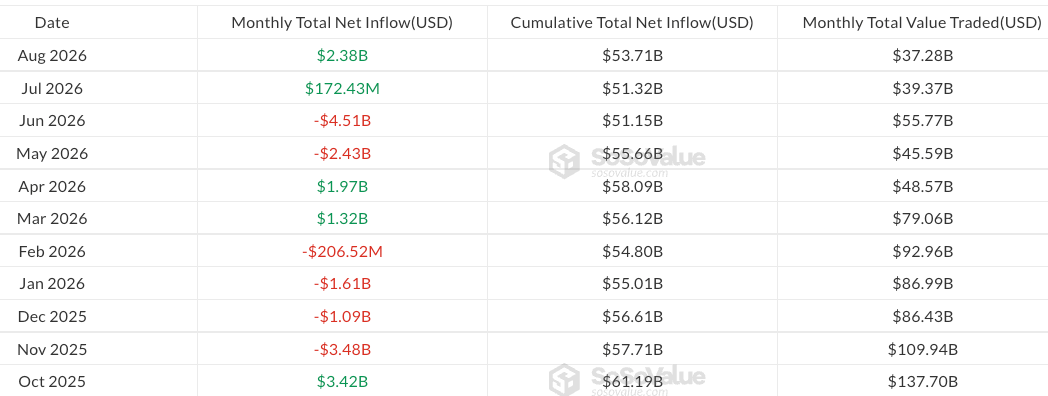
Despite the encouraging inflows observed last week, US spot Bitcoin ETFs continue to hold a net outflow position for the year 2026. Year-to-date, these funds have recorded approximately $2.91 billion in net outflows. The preceding months were characterized by substantial withdrawals, with June standing out as the worst month on record for outflows, totaling $4.51 billion. May also saw significant outflows, with $2.43 billion withdrawn from Bitcoin ETFs. August has, however, presented a positive shift, with $2.38 billion in net inflows recorded through Friday, positioning it as the strongest month for inflows thus far in 2026.
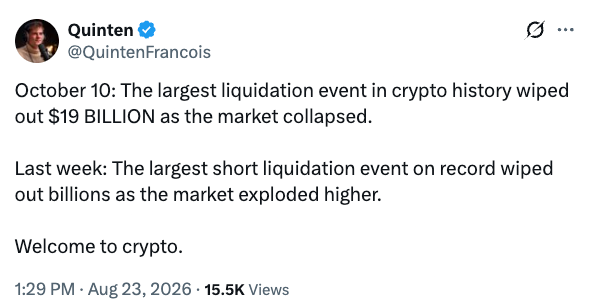
The historical data provided by SoSoValue illustrates the monthly spot Bitcoin ETF flows since October 2025. During the previous significant inflow wave in October 2025, these funds attracted $3.42 billion. This period of substantial inflows preceded the notable crypto market crash on October 10th. This crash, as detailed by CoinGecko, triggered the largest liquidation event in the industry’s history, resulting in the wiping out of approximately $19 billion in leveraged positions within a mere 24-hour span. The recent price action has seen Bitcoin fall roughly 38% from its trading price near $124,700 on October 6th, 2025.
Within the landscape of Bitcoin ETFs, BlackRock’s iShares Bitcoin Trust ETF (IBIT) emerged as a significant driver of last week’s resurgence. The fund attracted approximately $1.33 billion in net inflows, with this influx occurring over five consecutive trading days. Data from Farside Investors highlights the daily flow activity for IBIT, showing a consistent increase in inflows throughout the week. The daily inflows for IBIT escalated from $160.2 million on Monday to a peak of $503 million on Thursday, before moderating to $239.3 million on Friday.
Bloomberg ETF analyst Eric Balchunas took to the social media platform X to comment on IBIT’s trading patterns. He described the daily inflows as a "classic Flipping the Bird pattern," which he interpreted as a bullish signal for the ETF. This observation from a prominent analyst further fueled discussions about the positive momentum surrounding Bitcoin ETFs.
The context of these inflows is also important when considering broader market dynamics and historical precedents. The article references a previous surge in October 2025 that was followed by a significant market downturn. While the current inflows are a positive sign, the historical data suggests a need for continued observation of market trends and potential correlations with broader economic factors. The article also links to a "Hodler’s Digest" piece discussing Bitcoin’s recent rally in relation to US debt policy, indicating that macroeconomic influences continue to play a role in cryptocurrency market movements.
This report is produced in accordance with Cointelegraph’s Editorial Policy and is intended for informational purposes only. It does not constitute investment advice or recommendations. All investments and trades carry risk, and readers are encouraged to conduct independent research before making any financial decisions.