 11


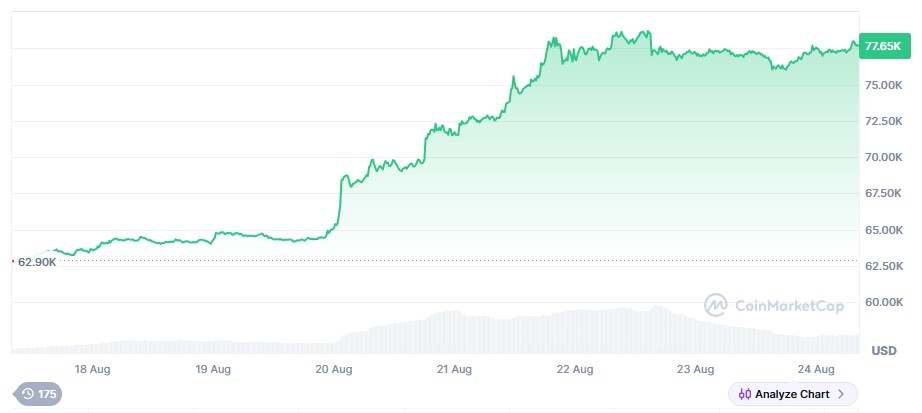
Confidence has returned to cryptocurrency markets with Bitcoin experiencing a significant rally, gaining over 23% this week to trade around $77,559 at the time of writing, and briefly touching $79,000 on Friday. This surge marks a crucial technical milestone, as Bitcoin’s price crossed above its 200-day moving average for the first time since November 2025, a widely recognized indicator of long-term bullish momentum. Many in the market now interpret this as a potential flip of the cycle to positive. The broader market has also seen substantial gains, with Ethereum rising 31%, Solana increasing by 28%, and XRP experiencing an impressive surge of 53%.
The recent influx into Bitcoin and Ether exchange-traded funds (ETFs) has been substantial, with the two products collectively attracting over $2.61 billion in inflows last week. Adding to the bullish sentiment, Michael Saylor’s MicroStrategy has seen its Bitcoin investments cross the breakeven point of $75,385, reinforcing his reputation as a visionary in the Bitcoin space. Market sentiment is further reflected in Polymarket odds, where the probability of Bitcoin reaching $90,000 before 2027 has climbed to 48%. The positive trend has also extended to publicly listed crypto-related companies, including Canaan, Metaplanet, Coinbase, and Robinhood, all of which reported double-digit gains in their share prices.
US Debt Policy Fuels Rush to Crypto and Precious Metals

The escalating US national debt, which surpassed $40 trillion this week, coupled with a perceived lack of concrete plans for fiscal consolidation, is increasingly driving investors towards alternative assets like cryptocurrencies and precious metals. The annual cost of servicing this debt has now exceeded that of Medicare and ranks as the second-largest government expense, trailing only Social Security. According to The Kobeissi Letter, the rapid appreciation in both crypto and precious metals can be attributed to a confluence of factors including persistent inflation, significant deficit spending, and the US Treasury’s policy decisions. The Treasury Department’s commitment to at least doubling the size of certain debt buyback operations to $4 billion has been cited as a contributing factor to this rally.
Prominent investors are advocating for increased allocation to these asset classes. Ray Dalio, founder of Bridgewater Associates, suggests that investors should consider allocating approximately 15% of their portfolios to gold and a portion to Bitcoin as a hedge against the potential fallout from the US’s mounting debt challenges. Dalio expressed his concern that without a significant change in current fiscal trajectory, a US debt crisis could materialize within the next three years, with a potential margin of error of two years.
White House Engages Crypto Leaders for Regulatory Clarity
In parallel with market movements, the White House has initiated discussions with key figures in the cryptocurrency industry. President Donald Trump has reiterated his call for the passage of the CLARITY Act, following a meeting with executives from prominent crypto firms, including Coinbase CEO Brian Armstrong and Gemini co-founders Cameron and Tyler Winklevoss. Trump urged members of Congress to pass a "fair version" of the bill, emphasizing its importance in maintaining US leadership in the digital asset space and staying ahead of China. The market structure bill, which passed the House of Representatives in July 2025, is scheduled for a procedural vote on September 15, requiring 60 votes for advancement. Trump characterized the bill as "very bipartisan," noting significant Democratic support. However, some Democratic senators have indicated reservations, with Senator Ruben Gallego suggesting that the President’s definition of "fair" might be self-serving and that the level of regulation should not be solely determined by him. During the meeting, Trump also indirectly influenced the market by mentioning that CFTC chair Mike Selig is working to bring Hyperliquid into the United States in a fully compliant manner, which reportedly led to a 20% price increase for the Hyperliquid token.
SEC Proposes New Rules, Potentially Sparking ICO Resurgence
The US Securities and Exchange Commission (SEC) has unveiled proposed new rules for the cryptocurrency sector that could either compel lawmakers to pass the CLARITY Act or trigger a revival of Initial Cryptocurrency Offerings (ICOs). These proposed rules, currently open for a 60-day public comment period, offer exemptions for crypto projects that allow for the issuance of up to $5 million in tokens over a four-year span, and up to $75 million within a 12-month period, subject to more stringent reporting and structural requirements. Furthermore, a safe harbor proposal aims to exempt certain cryptocurrencies from being classified as "investment contracts." Commissioner Hester M. Peirce acknowledged the long-standing challenges faced by the industry under the SEC’s existing framework, stating that a "whole generation has struggled" with the application of "a set of inapt rules to crypto." She characterized the new guidelines as a significant step towards establishing "clear, sensible, enforceable rules for crypto offerings."
CFTC Chair Vows to Develop Crypto Rules If Legislative Path Stalls
Michael Selig, the chairman of the US Commodity Futures Trading Commission (CFTC), has indicated that the commission is prepared to advance its own set of cryptocurrency regulations if the CLARITY Act does not successfully pass the Senate. Selig has already instructed CFTC staff to explore mechanisms for registered and non-registered entities to offer leveraged or margined crypto asset trading, and to investigate developer protections. Selig stated, "We’re going to give CLARITY its breathing room for a vote, but if the Democrats cannot support a bipartisan work product, which reflects compromises from both sides of the aisle, and ultimately send a fair version of the bill to the President’s desk, then rest assured, I will direct CFTC staff to move swiftly to propose these new rules for the industry."

Market Performance: Winners and Losers
At the close of the week, Bitcoin (BTC) demonstrated a gain of 23.5%, trading at $77,559. Ethereum (ETH) saw a 31.1% increase, reaching $2,456, and XRP surged by 53.3% to $1.52. The total cryptocurrency market capitalization stood at $2.63 trillion, according to CoinMarketCap. Among the top 100 cryptocurrencies, the leading altcoin performers this week were Pump.fun (PUMP) with a 98.9% gain, Ethena (ENA) up 98.3%, and Stacks (STX) with a 94.8% increase. On the downside, JUST (JST) experienced a 4.3% decrease, MemeCore (M) was down 2.9%, and Sun (SUN) fell by 1%.
Top Prediction of the Week
Standard Chartered’s global head of digital asset research, Geoff Kendrick, has revised his year-end Bitcoin forecast, suggesting that the cryptocurrency may surpass its previous all-time high of $126,000 before the end of the year. Kendrick indicated that the recent rally was primarily fueled by short liquidations, with renewed inflows into spot Bitcoin ETFs also contributing. He noted that low open interest could create further upside potential as more investors enter the market. Kendrick expressed that his previous year-end forecast of $100,000 might now be too conservative, acknowledging the risk of it being "too low."

Top FUD of the Week
A recent poll conducted by Reuters/Ipsos revealed that a majority of Americans (63%) believe it is inappropriate for President Donald Trump and his family to have profited billions through cryptocurrency investments while in office. The poll, which surveyed 1,166 individuals between August 14-17, indicated that 69% of Republicans polled found the investments appropriate, while a significantly larger proportion of Democrats (92%) held the opposite view.
Analyst Outlooks and Market Challenges
Gracy Chen, CEO of Bitget, anticipates that Bitcoin will likely trade around its current levels for the remainder of the year, despite its recent surge. She cited interest rates and broader macroeconomic conditions as critical factors influencing the cryptocurrency’s trajectory. Chen pointed to the possibility of higher interest rates as a potential pressure point on prices, noting Bitcoin’s increasing integration with traditional finance and its sensitivity to macroeconomic trends. She projected that Bitcoin could finish the year within a range of $10,000 to $20,000 above or below current levels.

Meanwhile, MANTRA’s native token experienced an 18% decline, reaching an all-time low of $0.004126 shortly before the MANTRA Chain halted block production due to an unexplained incident. The MANTRA team announced a precautionary halt while investigating the issue, stating they had no immediate root cause or timeline for resolution. The network halt prevented asset movement on the MANTRA Chain, leading affected exchanges to pause deposits and withdrawals. Subsequently, on August 22, MANTRA reported that a vulnerability in the Cosmos-EVM module had been fixed, the network had resumed operations, and no user funds were affected.






