 11

London-based AI laboratory, Inherent, founded by a cohort of Google DeepMind alumni, has announced a significant breakthrough: its newly developed AI agent has demonstrated superior performance compared to much larger, more established models from industry leaders Anthropic and OpenAI, all while operating at a fraction of their computational size. This achievement positions Inherent as a quiet disruptor in the fiercely competitive artificial intelligence landscape, garnering attention despite having previously maintained a low profile relative to other highly-funded startups emerging from similar prestigious backgrounds.
Weeks after officially emerging from stealth mode and securing a substantial $50 million seed funding round, the British startup unveiled its innovative AI agent, dubbed Faraday. This agent has notably surpassed the capabilities of more expansive and widely recognized models in a highly specific yet crucial task: the independent replication of findings from published scientific papers. Crucially, Faraday achieves this without any prior knowledge or pre-programmed answers, showcasing a genuine ability to reason and execute. The models it outcompeted include Anthropic’s Claude Opus 4.8 and OpenAI’s GPT-5.5, both considered frontier-scale systems in the AI domain.
While the ability to replicate scientific papers might, at first glance, appear to be a mere technical feat, Inherent’s co-founder and chief scientist, Edward Hughes, emphasizes its foundational importance. He notes that paper replication is a standard and essential training exercise for human scientists, particularly for those beginning their careers. "Many PhD students actually start by doing this," Hughes explained, underscoring the task’s role in developing critical scientific methodology and understanding. For Inherent, this initial step is a stepping stone towards a far more ambitious objective: building AI that can not only verify existing scientific results but actively discover new scientific knowledge, pushing the boundaries of human understanding.
Hughes clarified that the primary objective of developing Faraday was not merely to outperform existing AI systems, but rather the innovative methodology employed in its creation. "What was most interesting to us about this was not so much the result of beating those frontier agents — which of course we liked — but was actually the way we went about building this," he told TechCrunch. This philosophy points to a deeper focus on efficient, intelligent design and training paradigms.
A particularly compelling aspect for potential investors and the wider AI community lies in Faraday’s operational efficiency. In stark contrast to the massive, frontier-scale systems like Claude Opus 4.8 and GPT-5.5, Faraday operates on a comparatively tiny model known as Qwen 3.6, which possesses just 27 billion parameters. In the realm of AI, "parameters" serve as a crucial proxy for a model’s overall size, complexity, and, consequently, its training and operational costs. Achieving superior results with a significantly smaller parameter count implies a remarkable level of efficiency and potentially vastly reduced computational expenses, a critical factor in the resource-intensive field of AI development. Beyond mere accuracy in replication, Inherent set an even higher benchmark for Faraday: it aimed for the agent to demonstrate "research taste"—an intuitive understanding and discernment for which experiments are truly worthwhile and how to design them effectively. This intangible quality is often seen as a hallmark of experienced human scientists.
Teaching an AI system something as abstract and nuanced as "taste" presents a formidable challenge. Inherent’s innovative solution lies in its extensive use of reinforcement learning. This advanced training methodology differs from traditional supervised learning by rewarding an AI system for positive outcomes rather than providing explicit, pre-defined rules to follow. Instead of primarily training its agents on a codified study of how science itself is conducted, Inherent’s reward-based approach is a strategic bet that this method will foster a more generalized intelligence, enabling its agents to contribute meaningfully across a broad spectrum of scientific disciplines in the long term. "We’re always guided by that north star of building an AI scientist agent and imbuing our agents with taste," Hughes affirmed, highlighting the company’s unwavering focus.
This guiding principle also informs Inherent’s strategic decisions regarding its development toolkit. Rather than expending resources to develop its own proprietary coding tools, Faraday was designed to leverage existing, high-performance solutions, specifically OpenAI’s GPT-5.5 Codex. This pragmatic approach mirrors how human scientists often rely on a suite of established software and tools rather than attempting to build every component from scratch. Furthermore, Inherent is committed to fostering a collaborative dynamic with its AI agents. Hughes envisions an AI teammate that mirrors his ideal human collaborator—one who is driven by curiosity, independently explores avenues, conducts experiments, and then presents the findings for discussion: "I got curious about this, and I went off and I did these experiments. What do you think of these results?" This vision seeks to avoid creating agents that merely confirm user biases or provide expected answers, instead encouraging genuine inquiry and discovery.
Inherent’s collaborative ethos extends to its internal operations. The company’s tight-knit team of a dozen employees works exclusively in person from their office situated in King’s Cross, London. This district, once known for its more rundown character, has undergone a dramatic transformation into one of the world’s premier AI hubs, largely due to the influential presence of Google DeepMind. Hughes expressed strong confidence in London’s dense concentration of AI talent, affirming, "We believe that London is the place to be."
Despite his optimism about London’s talent pool, Hughes has also become a vocal advocate against the practice of "garden leave," a common clause in UK employment contracts. This practice typically bars departing employees from joining or establishing a rival company for several months after their resignation, creating significant hurdles for talent mobility. Hughes points out that American researchers generally do not face such restrictions, giving US startups a distinct advantage in recruiting top talent who have recently transitioned from previous roles. "This is a personal view rather than a company view, but I was affected by the garden leave problem," he candidly shared with TechCrunch, drawing from his own experience.
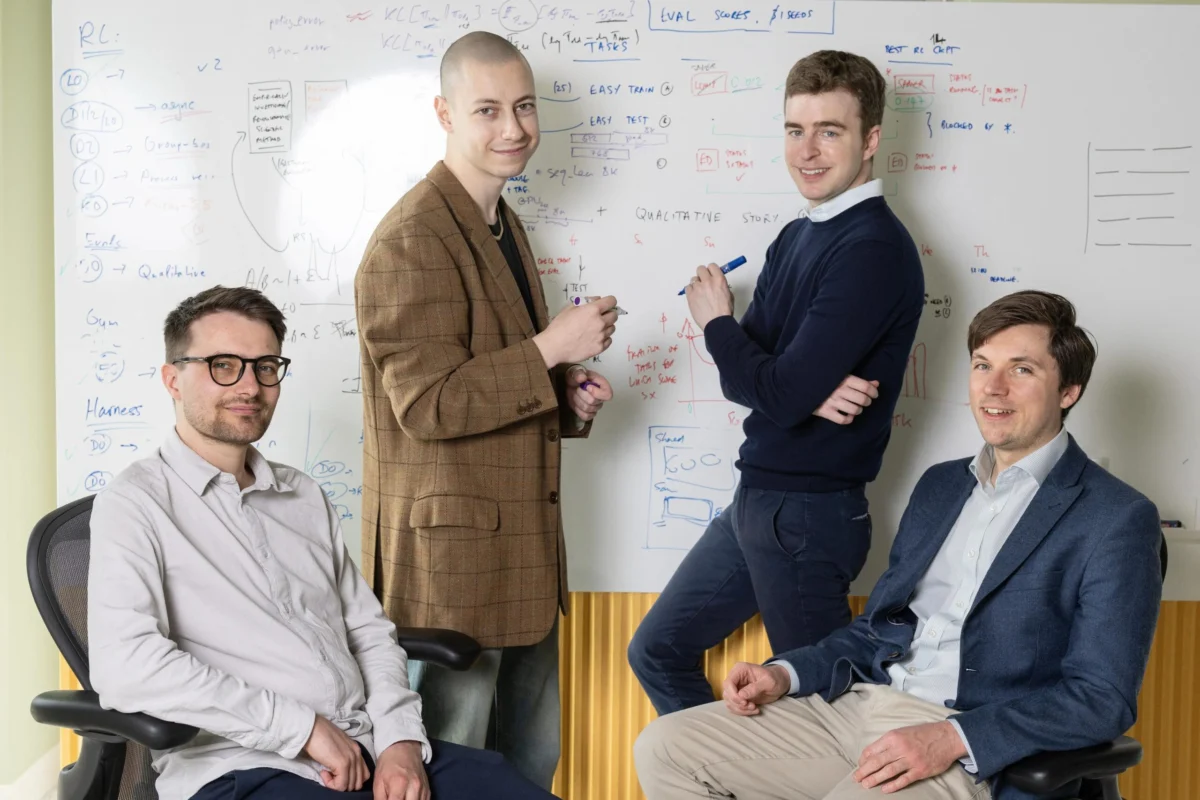
Despite these regulatory challenges, Hughes successfully navigated the constraints of garden leave to co-found Inherent alongside two other DeepMind alumni and a fourth co-founder. The startup is now poised for rapid expansion, with plans to grow its headcount to between "20 to 25" employees by the end of the year. Given its ambitious goals, which include exploration into "world models"—complex AI systems designed to simulate and predict real-world dynamics—and the reported unsettling effect of Demis Hassabis’s new role on some DeepMind staff, Inherent’s robust hiring drive could make it an exceptionally appealing destination for DeepMind employees contemplating their next career move. The company’s four co-founders, Louis Kirsch, Kaloyan Aleksiev, Tantum Collins, and Edward Hughes, are pictured from left to right, leading this promising venture.
About the Author
Anna Heim is an accomplished writer and editorial consultant. Serving as a freelance reporter for TechCrunch since 2021, she has extensively covered a diverse array of startup-related topics, including artificial intelligence, fintech and insurtech, SaaS and pricing strategies, and global venture capital trends. As of May 2025, her reporting for TechCrunch is primarily focused on highlighting Europe’s most compelling startup stories.
Beyond her writing, Anna has moderated numerous panels and conducted insightful onstage interviews at various industry events, ranging from major tech conferences such as TechCrunch Disrupt, 4YFN, South Summit, TNW Conference, and VivaTech, to many others. Her professional background also includes a tenure as LATAM & Media Editor at The Next Web, experience as a startup founder, and an alumna of Sciences Po Paris. Demonstrating a broad linguistic proficiency, she is fluent in multiple languages, including French, English, Spanish, and Brazilian Portuguese.






