 11

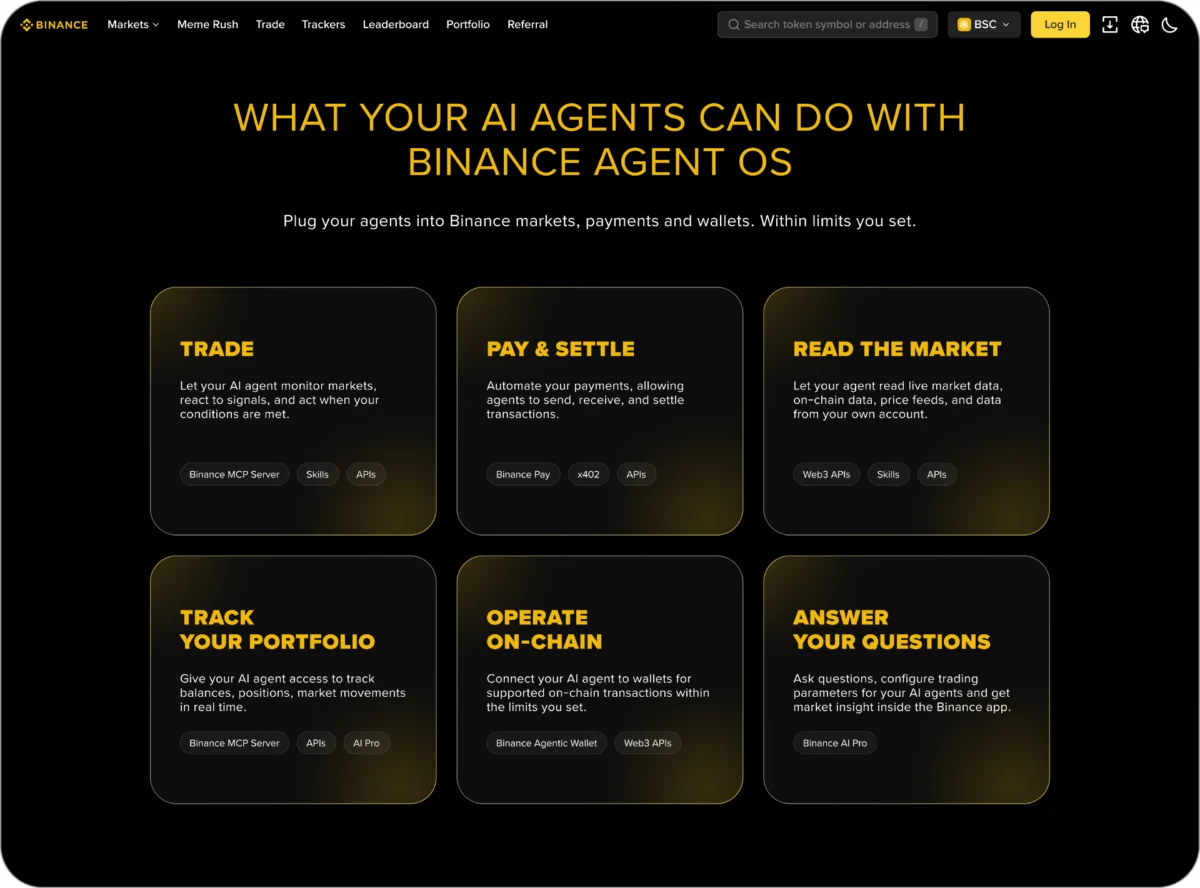
Binance, the world’s preeminent cryptocurrency exchange boasting a vast network of over 300 million registered users, marked a significant milestone on Thursday with the launch of Agent OS. This groundbreaking platform introduces a new era where artificial intelligence agents can autonomously analyze crypto markets and execute trades on behalf of users, seamlessly integrating sophisticated AI directly into the critical business of real-money financial management. The move positions Binance at the forefront of the evolving landscape where AI transitions from analytical tools to active participants in financial markets.
Dubbed Agent OS, the innovative platform is designed as a robust framework that enables developers to connect their AI applications and intelligent agents directly to Binance’s extensive financial infrastructure. This integration leverages the exchange’s existing suite of powerful tools and services, enhancing their utility with AI capabilities. Key components of this infrastructure include the well-established Binance APIs, which provide programmatic access to market data and trading functionalities; the Binance Wallet Agentic Hub, facilitating agent interaction with user wallets; the Binance x402 transaction verification and payment facilitator API, streamlining payment processes; and the Binance Skill Hub, which offers a repository of functionalities for AI agents to draw upon.
In addition to these existing robust tools, Agent OS introduces crucial support for Binance’s proprietary Model Context Protocol (MCP). The MCP is a vital innovation designed to standardize how AI models interact with complex financial data and execute actions within the Binance ecosystem, ensuring secure and efficient communication. Furthermore, Agent OS boasts broad compatibility with leading external AI development tools and large language models, including OpenAI’s renowned ChatGPT and Codex, Anthropic’s sophisticated Claude Code, and Cursor. This interoperability allows users to authorize a diverse range of AI agents to access essential market data, review their account information, and execute trades, thus offering unprecedented flexibility and power to the platform’s users.
The launch of Agent OS signifies a pivotal shift in the AI landscape, as the industry increasingly moves beyond conversational chatbots to develop intelligent agents capable of taking direct, actionable steps. In this new paradigm, Binance is strategically placing a substantial portion of the responsibility for maintaining control and oversight directly in the hands of its users. It is the users who ultimately bear the crucial task of determining precisely what information their AI agents can access, what trading activities they are permitted to undertake, and what explicit limits are placed on their operational scope. This user-centric control model underscores Binance’s commitment to empowering its users while navigating the complexities of autonomous AI.
Jeff Li, Vice President of Product at Binance, articulated this philosophy in an interview, stating, "Instead of total freedom, we put the power in users’ hands to give them the granular access control of what they can do through the agent." He further elaborated on the security measures, emphasizing, "We put [the control] at the account level to protect the users’ funds." This approach is designed to instill confidence and provide a strong safeguard against potential misuse or unforeseen actions by AI agents.
Binance implements this principle primarily through the use of dedicated "sub-accounts." Users can meticulously assign these sub-accounts to specific AI agents, configuring them for distinct financial activities, such as spot trading or futures trading. A critical security feature of these sub-accounts is that withdrawals are blocked by default, as confirmed by Li to TechCrunch. This creates an effective "sandbox" environment, isolating an agent’s activities and preventing unauthorized fund transfers, thereby significantly mitigating financial risk.
Users also retain granular control over the execution autonomy of their AI agents. They can choose whether an AI agent must seek explicit approval for every single order it proposes or if it can execute trades autonomously once its permissions and parameters have been initially configured. A Binance representative clarified that the exchange itself does not impose a separate, overarching cap on the total amount an AI agent can trade or potentially lose. Consequently, the funds a user deliberately transfers into a designated sub-account effectively serve as the ultimate financial limit for that agent’s activities, providing a clear and direct mechanism for risk management.
When questioned about the transparency of an agent’s decision-making process, Li acknowledged that the reasoning behind an agent’s particular trade decisions occurs outside of Binance’s core systems. This processing typically takes place either on the user’s personal computer or within their chosen AI application, meaning that Binance has limited visibility into the specific rationales. Li stated, "We really cannot see the reasoning of what the user’s action is."
This lack of internal visibility into an agent’s reasoning implies that while Binance can diligently monitor the resulting trading activity, its ability to discern whether a decision was influenced by faulty information, deliberate manipulation, or even a prompt-injection attack is inherently limited. In response to concerns regarding potential manipulation or compromise of an AI agent, Li reiterated that the sub-account mechanism remains the primary line of defense. Binance further emphasized that its existing, comprehensive security, risk-control, and anti-money-laundering (AML) policies, which are standard for all sub-account APIs, are fully applicable to Agent OS from its inception, providing a foundational layer of protection.
While trading is undeniably one of the primary and most immediate use cases Binance is targeting with Agent OS, Li highlighted the platform’s broader potential. He envisioned a future where AI agents could perform a diverse array of sophisticated financial tasks, including continuous market monitoring, in-depth research and risk analysis, proactive reactions to emerging market signals, and the autonomous placement of orders or execution of complex trading strategies such as arbitrage.
Beyond traditional exchange trading, Agent OS is also meticulously designed to connect AI agents to the broader ecosystem of payments and on-chain activity. Through its seamless integration with Binance’s x402 API, agents gain the capability to send and settle payments efficiently. Concurrently, the innovative Agentic Wallet feature empowers AI agents to interact directly with various digital tokens and engage with decentralized finance (DeFi) protocols, opening up a vast new realm of possibilities for automated financial interactions.

It is important to note that unlike the exchange trading environment, where Binance does not impose a separate cap on an agent’s trading or potential losses within its assigned sub-account, Agentic Wallet transactions are subject to Binance-set daily limits. For regular crypto swaps facilitated through the Agentic Wallet, a daily cap of $50,000 is applied. DeFi transactions, which often involve greater complexity and risk, have a default daily limit of $100,000. For x402 payments, a more conservative daily limit of $20 is currently set, reflecting varying risk profiles across different transaction types.
Li characterized Agent OS as Binance’s "first step" in a long-term vision to furnish developers with a powerful and versatile platform. This platform is intended to foster the creation of advanced, AI-powered applications that can operate autonomously and intelligently across both traditional financial markets and the burgeoning crypto landscape, hinting at a future of integrated, AI-driven financial services.
Binance’s foray into empowering AI agents is not an isolated development within the cryptocurrency industry. Rival crypto exchanges have also recognized the immense potential of AI and have been actively moving in a similar direction. These competitors are similarly leveraging the Model Context Protocol (MCP) and other advanced developer tools to grant AI applications direct and programmatic access to critical market data and sophisticated trading systems.
In March, Kraken, another prominent crypto exchange, notably launched an open-source command-line tool that includes a built-in MCP server. This tool allows AI agents to execute a range of actions, including spot and futures trades, showcasing a parallel commitment to agentic capabilities. Coinbase, a major player in the US market, followed suit in June with the introduction of "Coinbase for Agents." This platform directly connects AI agents to users’ accounts, enabling them to execute trades, facilitate payments, and manage other financial workflows, all while adhering to user-defined limits and safeguards. Similarly, OKX, a leading global exchange, enabled agentic trading on its platform earlier this year by integrating an open-source MCP toolkit, underscoring a growing industry-wide consensus on the transformative potential of AI agents in financial services. These parallel developments highlight a robust and competitive landscape where major crypto exchanges are racing to integrate autonomous AI capabilities, fundamentally reshaping how users interact with and manage their digital assets.






