11

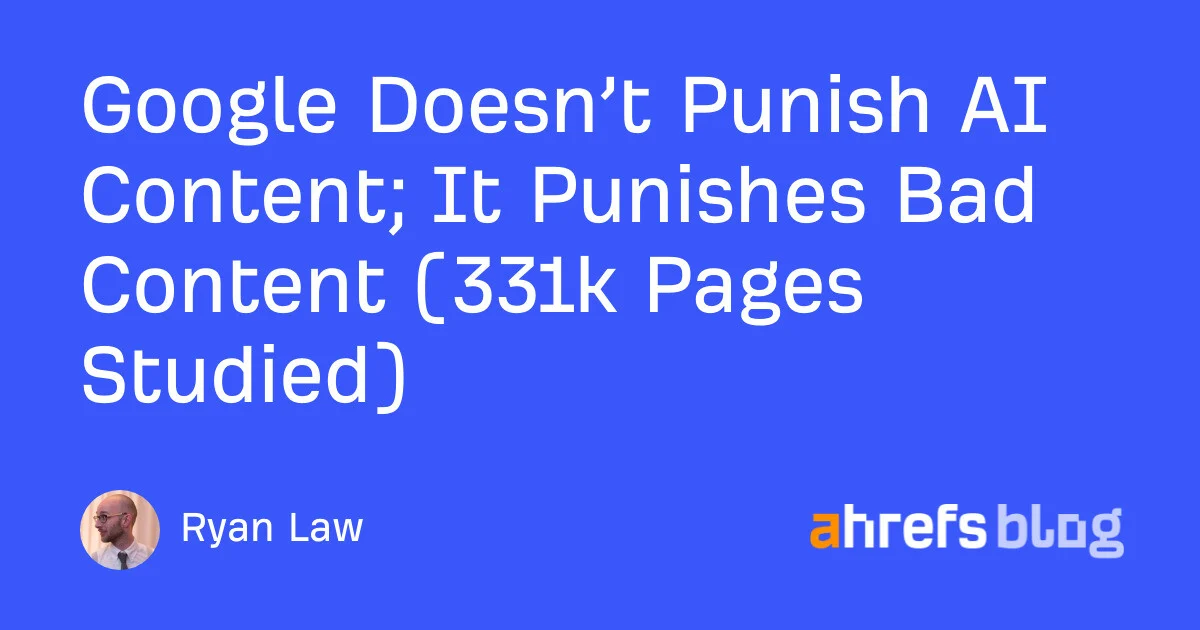
Recent analyses suggest that Google’s approach to artificial intelligence (AI)-generated content is not a blanket ban, but rather a continued adherence to its long-standing principles of content quality. While AI has long been a tool in publishing for automation, its increasing capacity to generate content has led to a surge of questions regarding its impact on search engine rankings and visibility. This has been particularly evident in the rise of what some in the SEO community refer to as "Mount AI" traffic graphs—websites that experienced significant traffic spikes after scaling content creation with AI, only to see their organic performance decline dramatically months later.
This phenomenon has led to a widespread hesitancy among marketers to employ generative AI in any capacity, fearing potential penalties from Google. However, the crucial question remains: is Google penalizing content simply for being AI-generated, or is the AI usage incidental to the underlying issue of producing low-quality, scaled content? To address this, a comprehensive research study was conducted to examine four key areas: the presence of 100% AI-generated pages in top search positions, the prevalence of AI-generated content across the top 10 search results, Google’s indexation rates for content with a high likelihood of being AI-generated, and the long-term traffic trends of such content.
The research utilized Ahrefs’ AI content detector, a tool available to customers through Site Audit and within Site Explorer’s Top Pages and Page Inspect reports. This detector estimates the percentage of AI-generated text on a page, with categories ranging from "low" (under 20%) to "very high" (80% or more). For accuracy, detection is only performed on pages with a minimum of 350 words. It is important to note that AI content detection is not infallible, and its methodology may differ from Google’s internal processes. The study emphasizes that the value of AI content detection lies in analyzing large-scale datasets and directional trends rather than fixating on individual articles.
Are There Any 100% AI-Generated Pages in Positions 1-3?
An analysis of one million pages occupying the top 10 positions across 100,000 search engine results pages (SERPs) in June 2026 revealed that the majority of top-ranking pages are predominantly human-written. Over half (54.7%) of these pages contained less than 20% AI-generated content, and pages with under 50% AI content accounted for a substantial 82.2% of top-three rankings. However, the data did indicate a correlation between higher AI usage and lower ranking positions, while also confirming that it is indeed possible for fully AI-generated content to achieve top-three rankings. A notable 9% of top-ranking pages were estimated to be 80% or more AI-generated, with 5.3% being 100% AI-generated.
How Common Is AI-Generated Content in the Top 10?
Examining the distribution of AI-generated content across the top 10 SERP positions revealed a trend where highly AI-generated content becomes progressively rarer as one moves higher in the rankings. Position 1 exhibited the highest proportion of pages with low AI content and the lowest proportion of pages with very high AI content. While a gentle gradient was observed, with the prevalence of AI-generated content gradually decreasing from position 10 to position 1, every ranking position, including the first, still contained a meaningful share of heavily AI-generated pages—between 8-12% contained 80% or more AI content. Further analysis of average and median AI content levels across 15,000 pages per position reinforced this trend, showing a gradual increase in AI content as rankings descended.
Does Google Index Content with a Very High Likelihood of Being AI?
To assess whether AI usage impacts a page’s indexability, the study examined indexation rates for pages categorized by their AI content levels. A sample of one million pages from the crawler database, with one page per domain and sufficient content for AI detection, was analyzed. Pages were considered indexed if they appeared in Google Search Console’s index, had a sitemap entry, or were linked from an indexed page. The results showed that higher AI content levels correlated with lower indexation rates. However, a significant 40% of pages with high or very high AI content levels were still indexed, a rate not drastically lower than the 49% indexation rate for low AI content pages.
Does Google Reduce Traffic to AI-Generated Pages After 3-6 Months?
The final phase of the research investigated the long-term organic performance of AI-generated pages compared to non-AI-generated pages. Using Google Search Console (GSC) data from live URLs, matched with the crawler database and filtered by AI content levels, the study plotted the change in impressions over time. While organic performance is influenced by numerous factors, and definitive conclusions from the limited timeframe were cautioned, the data provided interesting insights. No automatic suppression of AI-generated content was observed; impressions remained relatively stable over time across all AI content buckets. The research suggested that lower impression counts for AI-generated content might not be a direct penalty but rather a consequence of factors often associated with AI content creation, such as lower content quality, lack of originality, and a tendency towards spammy or scaled content strategies.
Conclusion: Quality Over Origin
The overarching takeaway from this research is that Google is not inherently against AI-generated content; rather, it is against low-quality content. The confusion arises because AI-generated content frequently overlaps with what is considered bad content. While AI use is correlated with lower search performance—including lower impressions, ranking positions, and indexation rates—it does not guarantee such outcomes. AI-generated content is present in significant amounts across all ranking positions, including the top 1-3.
The data indicates a gradual gradient where performance generally worsens with increasing AI use, likely because content quality often deteriorates with increased AI reliance. Websites that heavily employ AI content strategies often deviate from traditional content creation and SEO best practices, leading to issues such as lack of originality, superficiality, and a focus on quantity over quality. These factors, not the AI origin itself, are what typically impact organic performance negatively.
Ultimately, Google continues to rely on its established hallmarks of content quality. While AI-generated content is often of lower quality than human-generated content, this is not a guaranteed outcome. The research acknowledges the possibility of creating detailed, well-researched content using AI, though it notes that most users have not yet achieved this level of sophistication. Therefore, marketers and SEO professionals are advised to be wary of spam and scaled content rather than AI content creation itself, as the latter, when executed with a focus on quality, can still yield positive search results.