 11
11
The rapid advancements in artificial intelligence have brought with them an unprecedented wave of excitement and potential for enterprise transformation. However, beneath the surface of this innovation lies a significant paradox: the very technology designed to automate and streamline operations often creates new layers of complexity and demand for highly specialized human intervention. This challenge is particularly acute for large businesses attempting to integrate sophisticated AI tools into their deeply entrenched and often fragmented operational frameworks. The difficulty isn’t in developing the AI models themselves, but in making them reliably function within the intricate tapestry of existing corporate IT infrastructure.
This burgeoning need for specialized assistance has led to the rise of a new class of professionals: forward-deployed engineers, or FDEs. These highly skilled individuals are essentially AI implementation troubleshooters, dispatched to companies to bridge the gap between cutting-edge AI technology and the practical realities of enterprise deployment. They are tasked with the intricate work of configuring, customizing, and ensuring the stable operation of AI systems within diverse and often legacy environments. While indispensable in many scenarios, the reliance on such specialized external talent points to a fundamental friction in the current AI adoption landscape.
Efrat Rapoport, a former Salesforce executive, articulates this perplexing situation, stating, “AI, paradoxically, increases the demand for professional services.” She observes that the industry’s prevalent response to the complexities of AI implementation is to “hire more and more and more people.” This approach, while effective in some respects, is often costly, time-consuming, and not scalable enough to meet the widespread demand for robust AI integration across myriad business functions. It highlights a critical bottleneck where the promise of AI collides with the practical challenges of its real-world application.
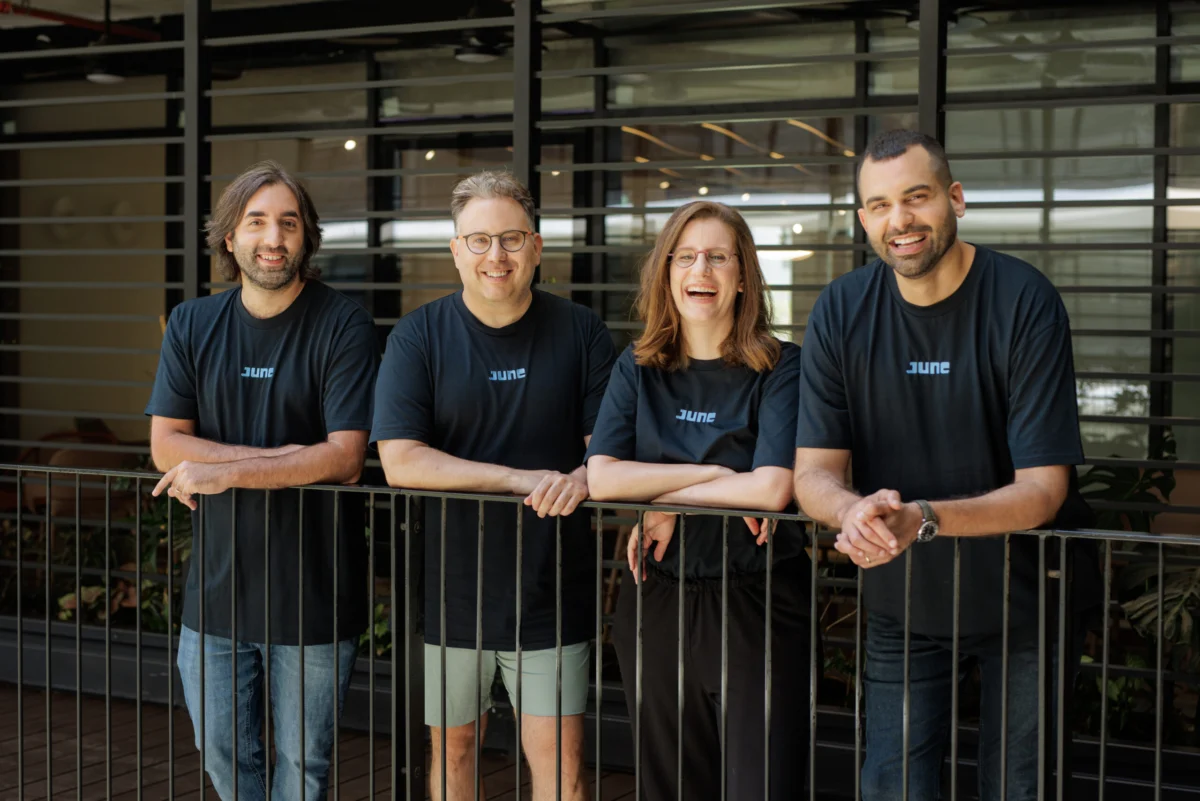
Rapoport and her three cofounders—Ohad Hen, Barak Goldstein, and Idan Tsitiat—are challenging this prevailing paradigm. They envision a different, more scalable approach to democratizing AI adoption within enterprises. Their new company, June, emerged from stealth mode with a clear mission to simplify and automate the complex process of integrating AI into broader business use. The founders’ innovative idea and proven track record quickly garnered significant investor confidence. June successfully raised an impressive $20 million in pre-seed funding, a testament to the perceived market need and the team’s potential. This substantial investment was led by Marc Benioff’s Time Ventures, with additional backing from a roster of highly influential tech luminaries including Michael Dell, Aaron Levie, and George Kurtz. Despite the significant funding, the company opted not to disclose its valuation, maintaining a strategic discretion regarding its early-stage market positioning.
The quartet of founders brings a wealth of relevant experience to June. Prior to this venture, they founded Bonobo AI, a company that operated in the nascent field of pre-transformer language models. Launched in 2017, Bonobo AI pioneered a voice-to-text service, a significant innovation at a time when large language models were not yet mainstream. Their expertise and technology were recognized and subsequently acquired by Salesforce two years later. Following the acquisition, the team dedicated several years to working on Salesforce’s internal AI initiatives, gaining invaluable insights into the challenges faced by enterprise customers attempting to integrate AI into their existing platforms. It was this direct observation of customer struggles—the friction between powerful AI capabilities and the practicalities of enterprise deployment—that spurred them to venture out on their own once again, giving birth to June.
The founders’ strong reputation and the compelling nature of their new solution were such that, as Rapoport recounts, "we didn’t even have a deck for this raise." This speaks volumes about the trust and conviction investors placed in the team and their vision, underscoring the acute pain point June aims to address in the enterprise AI market. The ability to secure such significant funding without a formal presentation deck is a rare occurrence and highlights the compelling narrative of a proven team tackling a clear and pressing industry problem.
In the contemporary software landscape, there’s been much discussion about a "SaaSpocalypse"—the fear that advanced AI might render existing software-as-a-service (SaaS) firms obsolete. However, this concern often overlooks a critical reality: AI, particularly in its current state, rarely replaces foundational enterprise software entirely. No AI model, however sophisticated, is currently "vibe-coding a CRM" for a Fortune 500 company from scratch. Instead, AI must seamlessly integrate with and enhance existing core platforms such such as Salesforce for customer relationship management, ServiceNow for IT service management, DataBricks for data processing, Workday for human capital management, or any of the myriad other specialized data-management and operational platforms that form the backbone of modern large enterprises.
This necessity for integration introduces the core challenge that June seeks to resolve. As Rapoport aptly puts it, “Before AI can create value, someone has to deal with legacy systems.” The enterprise IT environment is typically characterized by a complex web of interconnected, yet often disparate, systems. This leads to a multitude of integration hurdles, including fragmented data spread across various platforms, intricate and often inefficient workflows that have evolved over years, and significant technical debt accumulated from past implementations and customizations. These challenges are not trivial; they represent deeply embedded structural issues that impede the smooth adoption of new technologies like AI.
Rapoport further elaborates on the granular difficulties, highlighting that while "building an agent template is the easy part," the real struggle lies in getting that agent to effectively operate within "the mess underneath." This "mess" manifests in practical problems, such as a company having "10 duplicate [database] fields that say the same thing, and different teams are using them." Such inconsistencies create significant data integrity issues and make it exceedingly difficult for an AI agent to accurately interpret information, execute tasks, or learn effectively. An AI system relies on clean, consistent, and well-structured data to perform reliably, a condition rarely met in complex enterprise environments without substantial preparatory work.
June’s innovative platform is designed precisely to tackle these deep-seated integration problems. The system operates by intelligently scanning a company’s existing IT systems and data repositories. Through this comprehensive analysis, it gains a profound understanding of the business processes currently in place. It then leverages this understanding to identify bottlenecks, inefficiencies, and inconsistencies within these workflows. Crucially, June doesn’t just identify problems; it then proceeds to build more optimized, agent-powered processes that are designed to replace the problematic legacy workflows. These new processes are not only more efficient but also automatically notify relevant teams through the company’s existing communication channels, ensuring transparency and coordination.
Rapoport details the comprehensive guidance June provides: “We give you the full roadmap automatically of what needs to happen step by step for you to actually implement this agent successfully in an an enterprise environment, which is often very complex.” This roadmap is not merely a high-level overview but a precise, actionable guide. “We give you a step by step guide. ‘Remove these duplicates. Connect to this data source.’ And then you click on ‘build’ on each task, and June starts building it for you in the organization.” This hands-on, automated approach dramatically reduces the manual effort and specialized knowledge typically required for complex AI integrations, effectively transforming an daunting, multi-week project into a guided, executable process.
The efficacy of June’s approach is vividly illustrated by the experience of Paul Akinmade, Chief Strategy Officer at CMG, a prominent U.S. mortgage lender. Akinmade’s team had successfully migrated their software engineering operations to Claude Code, a significant step forward in their AI journey. However, they encountered severe roadblocks when attempting to integrate this new AI capability with their Salesforce platform. This was a critical issue for Akinmade, who had publicly committed at Salesforce’s annual conference the previous year to return with 100 AI agents actively running within CMG. As the deadline loomed, the integration challenges threatened to derail his promise.
Akinmade recounts how his team spent weeks grappling with the integration, hitting a metaphorical wall despite extensive efforts. They met with numerous architects, consulted with various forward-deployed engineers, and engaged with every expert they could find, yet progress remained elusive. The complexity of reconciling Claude Code with the intricacies of Salesforce’s environment, compounded by CMG’s own legacy data and workflows, proved an insurmountable barrier through conventional means. It was June that provided the breakthrough. Akinmade credits June with transforming their predicament by offering his team a clear, actionable perspective on where and how to deploy agents effectively. Furthermore, June allowed them to proceed with these deployments safely and confidently, even before the official kickoff call between the two companies. This immediate impact underscores June’s ability to cut through complexity and enable rapid, secure AI implementation where traditional methods falter.
Interestingly, while Rapoport views June as a complementary tool for FDEs and consultants, many of her customers are drawn to it for a different, almost opposite reason: it empowers them to bypass the need for FDEs altogether. This distinction highlights June’s potential to democratize AI implementation, making it accessible and manageable for internal teams without constant reliance on external specialists.
Akinmade’s initial skepticism and his clear expectations for June encapsulate this sentiment. He recounts telling Rapoport directly: “If your product requires FDEs, I don’t want your product. I’ve already done that and I’m getting annoyed by it. I don’t want a black box. I don’t want something only certain people can figure out. I want an easy-to-use tool.” This statement is a powerful indictment of the current state of enterprise AI integration, where proprietary knowledge and opaque systems often necessitate expensive and ongoing external support. Akinmade’s demand for an intuitive, self-service solution reflects a widespread desire among businesses to take control of their AI destiny without incurring perpetual dependency. Evidently, June successfully cleared this high bar, delivering the user-friendliness and autonomy that CMG and likely many other enterprises are actively seeking. The success story at CMG serves as a compelling validation of June’s core premise: simplifying the complex, making enterprise AI implementation not just possible, but genuinely accessible.
When you purchase through links in our articles, we may earn a small commission. This doesn’t affect our editorial independence.
Tim Fernholz is a journalist who writes about technology, finance and public policy. He has closely covered the rise of the private space industry and is the author of Rocket Billionaires: Elon Musk, Jeff Bezos and the New Space Race. Formerly, he was a senior reporter at Quartz, the global business news site, for more than a decade, and began his career as a political reporter in Washington, D.C.
You can contact or verify outreach from Tim by emailing [email protected] or via an encrypted message to tim_fernholz.21 on Signal.
View Bio