 11
11
When contemplating the vast, intricate puzzles of the cosmos, astrophysicist Charlotte Mason often finds clarity in a simple act: doodling. "I am quite a visual person," she explains, "I usually draw a lot of pictures trying to understand what’s going on." Mason, a researcher at the Cosmic Dawn Center in Copenhagen, has recently dedicated many pages to sketching "little red dots"—mysterious objects that have appeared by the hundreds in images captured by the James Webb Space Telescope (JWST). These enigmatic dots were entirely unseen before the JWST began its operations in 2022, yet we now understand they began to emerge in significant numbers approximately 650 million years after the Big Bang.
These "little red dots" represent just one of the profound mysteries unveiled by the JWST’s unprecedented observations of the early universe. Other startling discoveries include black holes that appear impossibly massive for their young age, and ancient galaxies whose characteristics defy established astrophysical models of the first billion years post-Big Bang. Initially, the scientific community was astounded; the universe revealed by JWST seemed fundamentally at odds with prevailing cosmological theories. However, a surge of new theories now offers intriguing potential solutions, though determining which accurately depict reality remains a monumental task.
Current hypotheses propose that these little red dots could be nascent black holes, deeply embedded and obscured within dense cocoons of gas. This concept has led to the speculative idea of a completely new class of celestial body, dubbed a "black hole star," where the surrounding, tightly bound gas emits light akin to a stellar atmosphere. Mason visualizes this by first drawing a small, filled-in circle for the black hole, then adding a disk, "because we think that’s where some of the emission comes from." She then sketches a larger circle around it, representing "this dense gas cloud around the black hole."

However, Mason suspects these cosmic enigmas hold deeper secrets. Her team recently conducted a spectral analysis of light from one such little red dot. If the model of a uniformly dense gas cloud were accurate, the light passing through it should have shown specific alterations. Yet, their observations did not match this expectation. "Now what do I do? Start again," Mason recounts, illustrating her revised thinking. By sketching a new diagram with a "clumpy" gas cloud, containing gaps or holes around the black hole, she found that "I should be able to get [a signal] that looks closer." Across the globe, researchers like Mason are diligently piecing together JWST’s groundbreaking glimpses of the ancient cosmos, striving to construct a more complete picture of our universe’s genesis. Like the photons that traverse billions of light-years to reach us, new fragments of understanding are continuously falling into place.
The narrative surrounding black holes has become significantly more complex due to JWST’s persistent detection of ancient black holes that are simply too large for existing theories to adequately explain. Jenny Greene, an astrophysicist at Princeton University, notes that just a few hundred million years after the Big Bang—a period when the universe was still largely uniform and featureless—astronomers are already observing "billion-sun black holes growing." She emphasizes that achieving such immense sizes so rapidly necessitates "some gymnastics" from current theoretical frameworks.
Scientists typically consider two primary factors influencing a black hole’s ultimate size: the initial mass of its "seed" when it first formed, and the subsequent rate at which this seed accumulated matter. The challenge lies in explaining how black holes either originated with sufficient mass or grew rapidly enough to reach a billion times the mass of our sun within the relatively short timescales of the early cosmos. In the contemporary universe, black holes primarily form from the gravitational collapse of the core of a massive star that has exhausted its nuclear fuel. Given the substantial mass of the universe’s first stars, they could have potentially left behind black hole seeds weighing up to approximately 100 solar masses, as Greene points out. However, she adds, "We know that happens, but it’s really, really hard to get them to a billion so quickly. You really have to force-feed them."
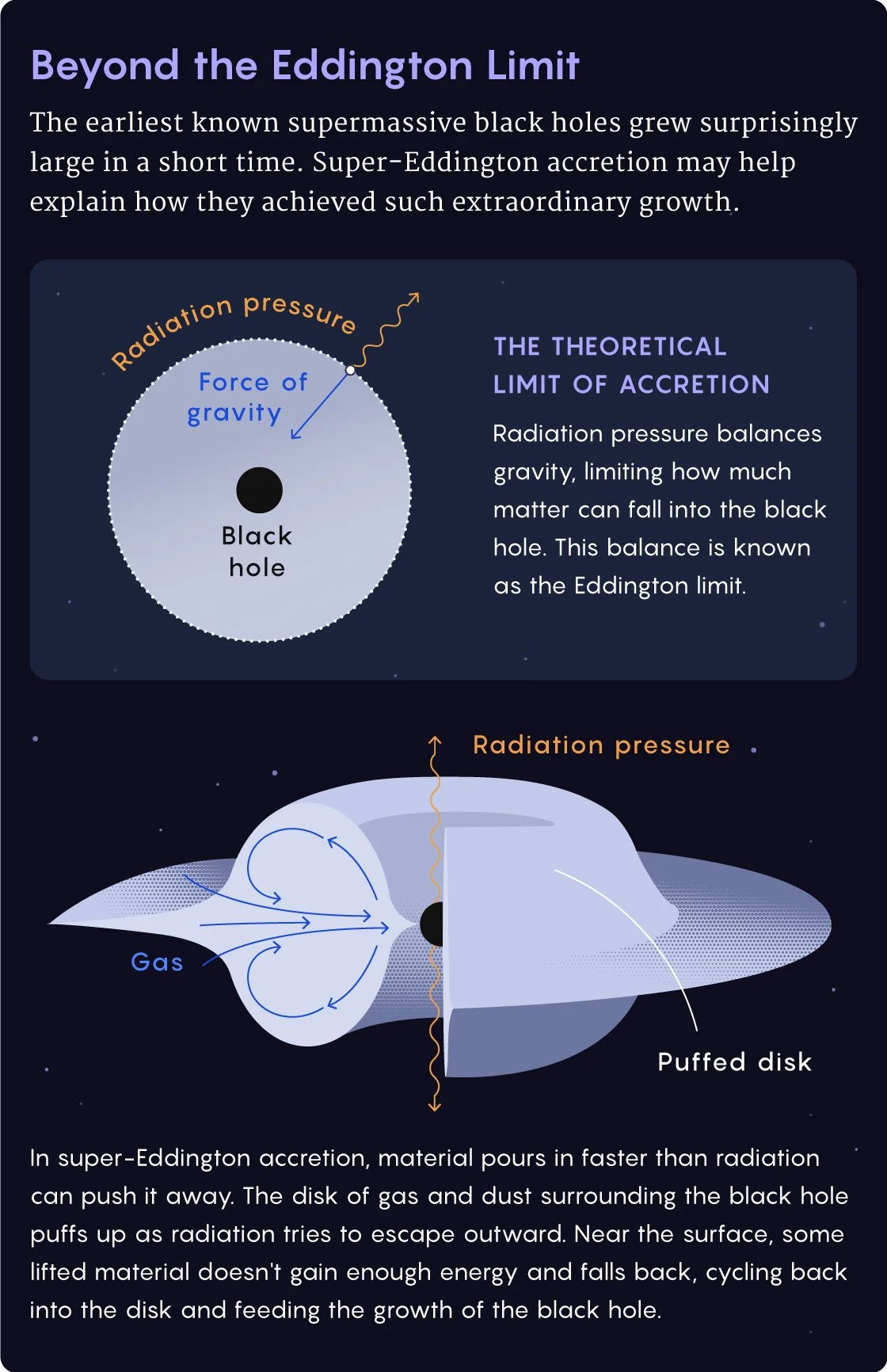
Historically, scientists believed there was a fundamental limit to how quickly black holes could grow, known as the Eddington limit. As matter spirals inward toward a black hole, it forms an intensely hot "accretion disk." This disk emits powerful radiation that exerts an outward pressure, counteracting the infalling material and effectively limiting the rate at which the black hole can consume matter. This theoretical intake cap should, in principle, prevent black holes from growing to tens of millions of times their initial mass within the available cosmic timeline.

However, recent computer simulations offer a potential bypass. If an accretion disk can "puff up" in a specific configuration, the sheer volume and momentum of incoming gas might overwhelm the outward radiation pressure. This "super-Eddington" accretion mechanism could allow gas to funnel into the black hole at extraordinary rates, far exceeding the conventional limit. Even with this mechanism, a crucial question remains: was there sufficient gas available in the early universe to fuel such prodigious growth and create the largest black holes? Some researchers hypothesize that dense clusters of ancient stars might have produced numerous black hole seeds that then rapidly merged, contributing to the observed massive objects.
An alternative theory suggests that some supermassive black holes might not have originated from stars at all. Instead, colossal clouds of gas could have collapsed directly into black holes, bypassing stellar formation entirely. This "direct collapse" mechanism is theorized to create initial black hole seeds of up to 10,000 solar masses. Greene notes a significant hurdle with the direct-collapse model: it demands "really Goldilocks conditions." For direct collapse to occur, an enormous gas cloud must compress into a black hole instantaneously, without first fragmenting into smaller clouds that would typically form stars. This requires very specific gas chemistries and a slow rotation rate for the cloud. "When people try to do this in a computer, they can make these direct-collapse black holes," Greene states, "but they can’t make enough of them to explain all the black holes that we see."
Despite these challenges, evidence supporting both super-Eddington accretion and large initial seeds is emerging. In 2024, JWST observed a black hole, active approximately 1.5 billion years after the Big Bang, consuming material at an astonishing rate—about 40 times the Eddington limit. If such extreme accretion was common in earlier cosmic times, it could explain how even relatively small initial seeds could have grown into colossal black holes. Conversely, researchers recently studied a little red dot, gravitationally lensed by a foreground galaxy cluster, which dates back to about 750 million years after the Big Bang. They concluded this object is a "naked" supermassive black hole, estimated to be 50 million times the mass of the sun, notably lacking any discernible surrounding stars. If this mass estimate holds, it implies the black hole might have formed as a large seed, possibly through direct collapse, preceding the formation of any galaxy in its vicinity. "There’s clearly differences in how the black holes are growing that we don’t fully understand yet," Greene concludes, expressing the prevailing excitement in the field: "So for me, the most exciting thing to do right now is try to understand, physically, what’s different?"
Similar to the conundrum of overly massive early black holes, many nascent galaxies observed by JWST appear unexpectedly bright. To unravel this mystery, scientists are re-evaluating their foundational theories regarding galaxy formation. Roughly 200 million years after the Big Bang, the infant universe was a compact, hot, and dense environment. As it expanded and cooled, dark matter began to coalesce into vast, invisible structures known as halos. The immense gravitational pull of these halos then drew in primordial hydrogen and helium gas, channeling it along cosmic filaments into the dense cores of these dark orbs. Once sufficient gas accumulated and pressures intensified, nuclear fusion ignited, giving birth to the first stars, which in turn aggregated to form the universe’s first galaxies.

Astronomers track the chronology of these cosmic events using redshift—a measure of how much the light from distant, early objects has been stretched toward the red end of the spectrum by the universe’s ongoing expansion. Rachel Somerville, a senior research scientist specializing in galaxy formation at the Flatiron Institute in New York, presented new computer simulations at a conference in April 2026 in Helsingør, Denmark. Addressing over 100 international researchers gathered in a room overlooking the strait between the Baltic and North seas, she illustrated the cosmic timeline. "Not too much happens until about a redshift of 15 [corresponding to 270 million years after the Big Bang]," she explained, "and then lots of gas starts pouring in along these filaments." Continuing her presentation, accompanied by vibrant visualizations of dark matter, gas, and starlight, Somerville added, "By about a redshift of 11 [420 million years], the star formation rate starts to really pick up. At redshift 9 [550 million years], we make a nice galaxy."
While the galaxy displayed in her simulation represented an early stellar population, JWST’s most ancient galactic discovery to date existed a mere 280 million years after the Big Bang. The telescope’s initial, bewildering findings of such bright, early galaxies prompted some scientists to question the very foundations of cosmology—the fundamental laws governing energy and matter in the early universe. However, after several years of intensive study of these primitive objects, theorists have now developed multiple models to account for their observed brightness and abundance. "We almost have gone from having too many early galaxies to having too many theories to explain them," Somerville remarked to the assembled scientists.
Among the proposed explanations are ideas that the first galaxies converted gas into stars with far greater efficiency than previously assumed. Alternatively, they might have undergone periodic, intense bursts of star formation, driven by turbulent conditions within their environments. Another possibility suggests that early star-forming regions preferentially generated exceptionally massive and luminous stars. Many astrophysicists now believe that a combination of these factors, potentially alongside others, contributed to the rapid and brilliant development of these early galaxies.
To rigorously test these emerging ideas, researchers are increasingly relying on simulations of the infant universe. Somerville highlighted the "really remarkable progress since Webb launched, really in the last year or so, on numerical simulations," emphasizing that these advanced models "perhaps are more appropriate and more informative for interpreting observations in the high-redshift universe." As these computational models continue to improve, JWST systematically documents an increasing number of distant galaxies. By meticulously comparing the telescope’s observations of the early universe with simulations designed to explain them, scientists are steadily closing in on uncovering the true nature of cosmic dawn. Hakim Atek, an astrophysicist at the Paris Institute of Astrophysics at Sorbonne University, elaborates on this approach: "We can try to match the best analogue of the observed galaxy to the simulated. Once you have this best match, you can look at the star-formation history, because in the simulations you have access to the whole history of the galaxy."

An intriguing new clue has recently emerged from JWST’s Mid-Infrared Instrument (MIRI), a supercooled device capable of precisely splitting the light from distant cosmic objects. MIRI’s data has surprisingly revealed that early galaxies do not exhibit uniform characteristics, as scientists had initially anticipated. "The main surprise is the diversity of the properties of galaxies we are seeing at early epochs," Atek noted, underscoring that "You’re expecting that they would look the same." This unexpected diversity might indicate that star formation in the early universe occurred in powerful bursts. Galaxies would cycle through intense periods of star creation, followed by the explosive deaths of these stars, which would expel vast clouds of gas and temporarily halt further stellar birth. Eventually, the gas would re-accumulate, triggering a new wave of stellar ignition. "Some of them, it looks like they cleared all the interstellar medium that is present there, the gas and the dust. It’s like you’re looking only at naked stars," Atek explained, contrasting them with "Another galaxy [that] is the