 11
11
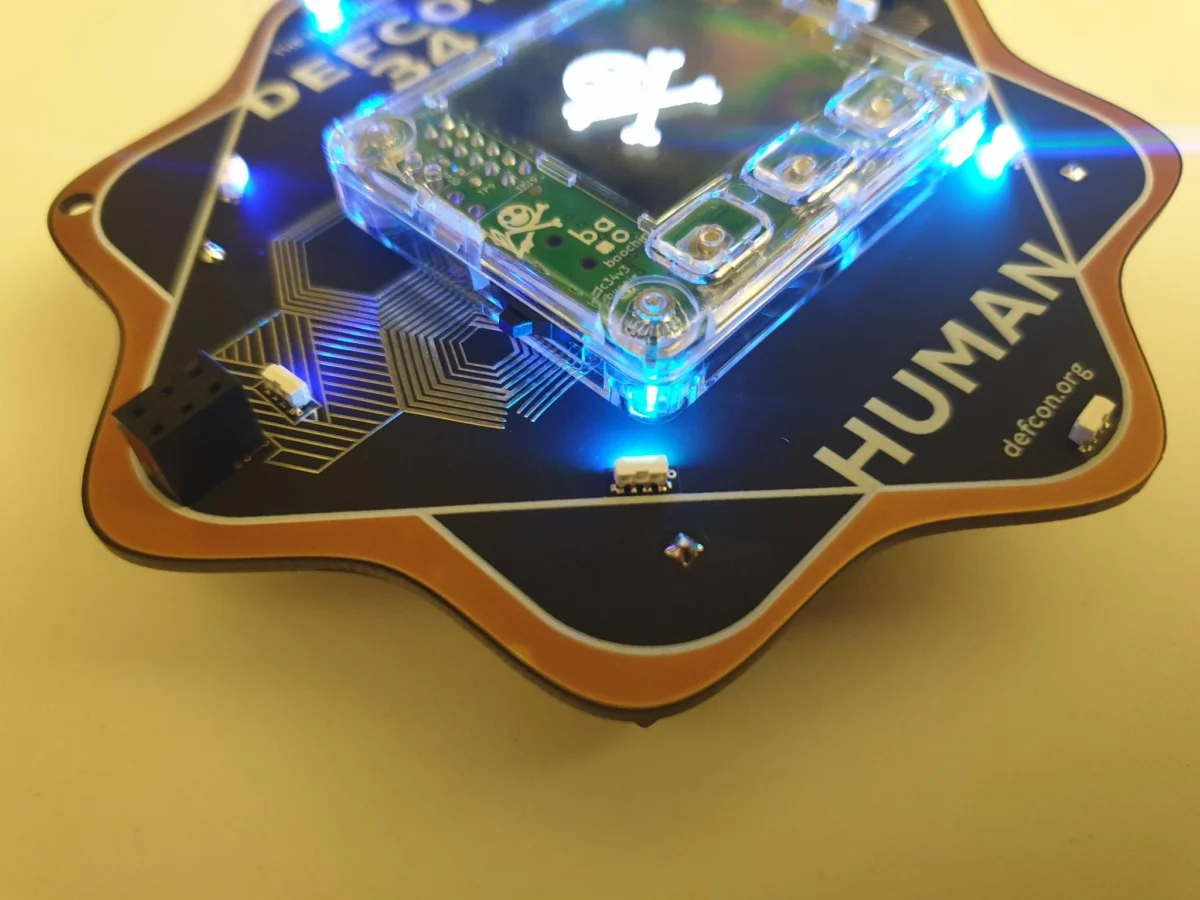
The annual Defcon hacker conference has long been renowned not only for its revelations of new software vulnerabilities and hacking techniques but also for its exceptionally crafted conference badges. These badges are often regarded as electronic masterpieces, frequently incorporating intricate puzzles, complex cryptographic challenges, hidden Easter eggs, and even mechanical gear trains akin to those found in watches. Each year, the badge creator strives to surpass previous designs, aiming to impress even the most discerning hackers with their ingenuity and technical prowess. However, this year marks a significant departure from tradition, as the focus shifts from the badge’s aesthetic and interactive design to the revolutionary technology embedded within its hardware.
For Defcon 34, the organizers enlisted the expertise of legendary hardware hacker Andrew "bunnie" Huang to design the badges. Revealed for the first time, these badges are distinguished by an innovative, open-source chip that Huang developed. This groundbreaking component, named the Baochip-1x, is poised to redefine the standards of security, transparency, and trustworthiness in computing. More than just a conference keepsake, the Baochip-1x is designed with a secondary purpose: its core module is detachable, allowing attendees to remove and utilize it as a versatile hardware security token long after the conference concludes, thus extending the badge’s utility beyond its initial role.
The Baochip-1x represents the culmination of three years of dedicated development, fulfilling Huang’s long-standing aspiration to create a chip whose security is genuinely verifiable. Described as a "mostly" open-source microcontroller, Huang has made a significant portion of its internal workings publicly available. The source code for the Baochip’s operating system, firmware, processor core, cryptographic engines, and input-output system has been published on GitHub. This unprecedented level of transparency ensures that these critical components are open for rigorous inspection and independent use by the global security community.
Crucially, the Baochip’s innovative packaging allows researchers to physically examine the silicon itself. Unlike conventional computer chips, which are encased in opaque plastic, obscuring their intricate circuitry, the Baochip is designed to permit infrared light to be shone through the back of the silicon. This unique feature enables visual inspection of the chip’s internal structures, allowing researchers to directly compare the physical layout against the published design specifications. This addresses a fundamental problem in the supply chain of traditional chips, where even open-source designs, once manufactured, still required users to implicitly trust that no malicious backdoors or alterations were introduced during the production phase. With the Baochip, this trust is replaced by verifiable transparency.
Huang plans to demonstrate this novel inspection technique at the conference, inviting attendees to peer into the chip’s inner workings under an infrared light. Speaking to WIRED, Huang articulated his long-term vision: "I’ve been doing a bunch of stuff along the lines of trust and silicon and verification transparency for years. It’s all… this kind of story arc I’ve been on… to try and get a chip that we can trust down to the very core, down to the transistor… You can actually… see the RAM arrays… on the chip." This commitment to foundational transparency underscores the significance of the Baochip’s design.

The creation of a new computer chip is an extraordinarily expensive undertaking, often costing millions of dollars for fabrication alone. Huang’s ambitious project received a crucial boost three years ago when Crossbar, a company interested in developing a new open-source and secure chip but lacking the expertise in its implementation, approached him. Huang agreed to collaborate under a pivotal condition: that he be allowed to "piggyback" on Crossbar’s manufacturing run. This arrangement meant his CPU design could be placed on the same chip wafer as Crossbar’s, allowing both designs to share the manufacturing costs rather than Huang needing to fund an entirely separate, prohibitively expensive run. Huang noted that this "piggybacking" practice, while not widely discussed, is not uncommon in the industry, explaining that Crossbar viewed it as "two products for the price of one."
The result of this collaboration is a Crossbar chip that integrates both Crossbar’s proprietary microprocessor and Huang’s design. The Baochip-1x is essentially the same physical chip, but with the Crossbar microprocessor disabled, as Huang does not possess the rights to distribute it. While Crossbar’s version of the chip utilizes a proprietary ARM core, Huang’s Baochip incorporates an open-source RISC-V core. The RISC-V instruction set itself is also open and publicly documented, providing another layer of transparency. Both versions benefit from the same underlying infrastructure and peripherals, with the flexibility to activate different CPU cores.
Despite its emphasis on openness, Huang acknowledges that some elements of the Baochip remain closed-source. These typically include low-level physical-design and manufacturing elements, particularly those associated with TSMC’s 22-nanometer fabrication process, which are proprietary to the foundry. However, Huang stresses that "if you look on the spectrum of how open you can get things, this is… very, very far beyond any [other] security-oriented chip." This contextualizes the Baochip as an unparalleled step forward in hardware transparency, even with some unavoidable proprietary components.
In previous years, Defcon badges relied on commercial off-the-shelf chips, but the genesis of the Baochip badge began late last year when Huang updated Defcon founder Jeff Moss on his progress in developing the open-source chip. Huang informed Moss of his plan to release the chip through his company, Baochip, in the summer. Moss immediately recognized the perfect alignment between the chip’s core philosophy and Defcon 34’s theme: "agency." Defcon defines agency as the technologies we employ and the choices we make that empower self-determination. Moss and Huang quickly realized that integrating the Baochip into the conference badges would serve as an exceptional opportunity to bootstrap the chip’s adoption. Until now, the Baochip had only been available in a limited development release; the 27,000 Defcon badges represent its inaugural major distribution.
Moss had one crucial stipulation for the badges: he wanted them to possess enduring utility beyond the conference, to avoid becoming mere forgotten novelties or contributions to a landfill. Having long expressed frustration with the design limitations and inherent vulnerabilities of existing hardware security tokens and crypto wallets, which can often be cracked at the hardware level, Moss envisioned Huang’s chip as a potentially more secure and robust alternative for authentication and digital asset management. "I’ve always kind of dreamed of this idea where you can take your secrets, put them in hardware, and then if an attacker gets in, they can’t quite get your secrets," Moss shared with WIRED, highlighting the aspiration for truly resilient hardware-based security.
The detachable module of the Defcon badge is engineered to function as a FIDO hardware security token, providing a tangible, inspectable layer of security. Its integrated software supports time-based, one-time password (TOTP) systems and comprehensive password management capabilities. Huang confidently asserts that it is "probably the world’s first open source security token that you can fully inspect all the way down to the bootloader [and] transistors." The removable module also incorporates a camera, primarily for scanning QR codes to register with authentication systems. However, in strict adherence to Defcon’s long-standing privacy practices and its prohibition of surreptitious photography at the conference, the camera is intentionally designed with very low resolution, is nearsighted, and by default, only utilizes black and white data, explicitly not supporting photo storage. Huang humorously describes its functionality: "It’s… great at scanning QR codes and pretty much bad at everything else."

Beyond its security functions, the badge also retains elements designed to foster social interaction among attendees, a traditional aspect of Defcon culture. The badges feature LED lights that display various color palettes and flashing patterns. These patterns differ based on the type of badge—distinguishing general attendees, speakers, "goons" (the dedicated volunteers who manage the conference), and the exclusive black "Uber" badges awarded to contest winners and special VIPs, which grant lifetime free Defcon attendance. While each badge type begins with a specific color and flashing sequence, users can expand their color options and construct more complex flashing patterns when their badges establish communication with other attendees’ badges, encouraging engagement.
From a security standpoint, the Baochip runs an operating system meticulously written in Rust, a programming language renowned for its memory safety and security features. It incorporates secure boot capabilities, a true random number generator (TRNG), and various hardware features specifically designed to harden it against potential attacks. Huang expresses confidence that the chip will be particularly resilient to remote, nonphysical attacks. Furthermore, the chip utilizes resistive RAM, or RRAM, a type of nonvolatile memory that Huang explains is designed to make physical extraction of stored data significantly more challenging compared to conventional flash memory. With traditional flash, he notes, "if you de-layer it down to the actual flash cells… you can just see the ones and zeros literally on these chips," a vulnerability RRAM aims to mitigate.
Despite the chip’s advanced security features, Huang maintains a cautious perspective, avoiding overhyping its capabilities. He estimates that the Baochip could withstand attacks involving tens of thousands of dollars in resources. However, he candidly acknowledges that a determined adversary with millions of dollars and access to a sophisticated hardware-analysis laboratory would likely be able to defeat it. "I actually think it’s one of the most secure chips you can get out there, but I [also] think most chips have been oversold in terms of security," he stated, emphasizing a realistic approach to hardware security.
Huang welcomes the intensive stress-testing that the Baochip will inevitably undergo at the hands of Defcon attendees. He fully anticipates that hackers will likely uncover flaws and "zero-days" in the code, which he views not as a setback, but as an invaluable opportunity to further enhance the chip’s security and robustness. "I fully expect there will be zero-days [that people find in the code]. It’s actually… one of the features… of launching at Defcon," he explained, embracing the open-source ethos of collaborative security improvement.
Currently, the Baochip can function as a YubiKey-like security token. Looking ahead, Huang envisions its evolution into a Hardware Security Module (HSM) or its capability to run more complex software, such as Linux. The hardware specifications include a 350 MHz RISC-V processor, complemented by 2 megabytes of SRAM and 4 megabytes of RRAM. Huang notes that these specifications place it "on the edge of being able to run Linux." Additionally, it features four 700MHz PicoRV32 cores dedicated to input-output operations. The chip already supports MicroPython and offers comprehensive C and Rust development kits, empowering developers. While Huang plans to expand the chip’s features himself, he also eagerly anticipates that Defcon participants will build upon his foundation, customize the chips, and make them truly their own, fostering innovation within the community.