 11
11
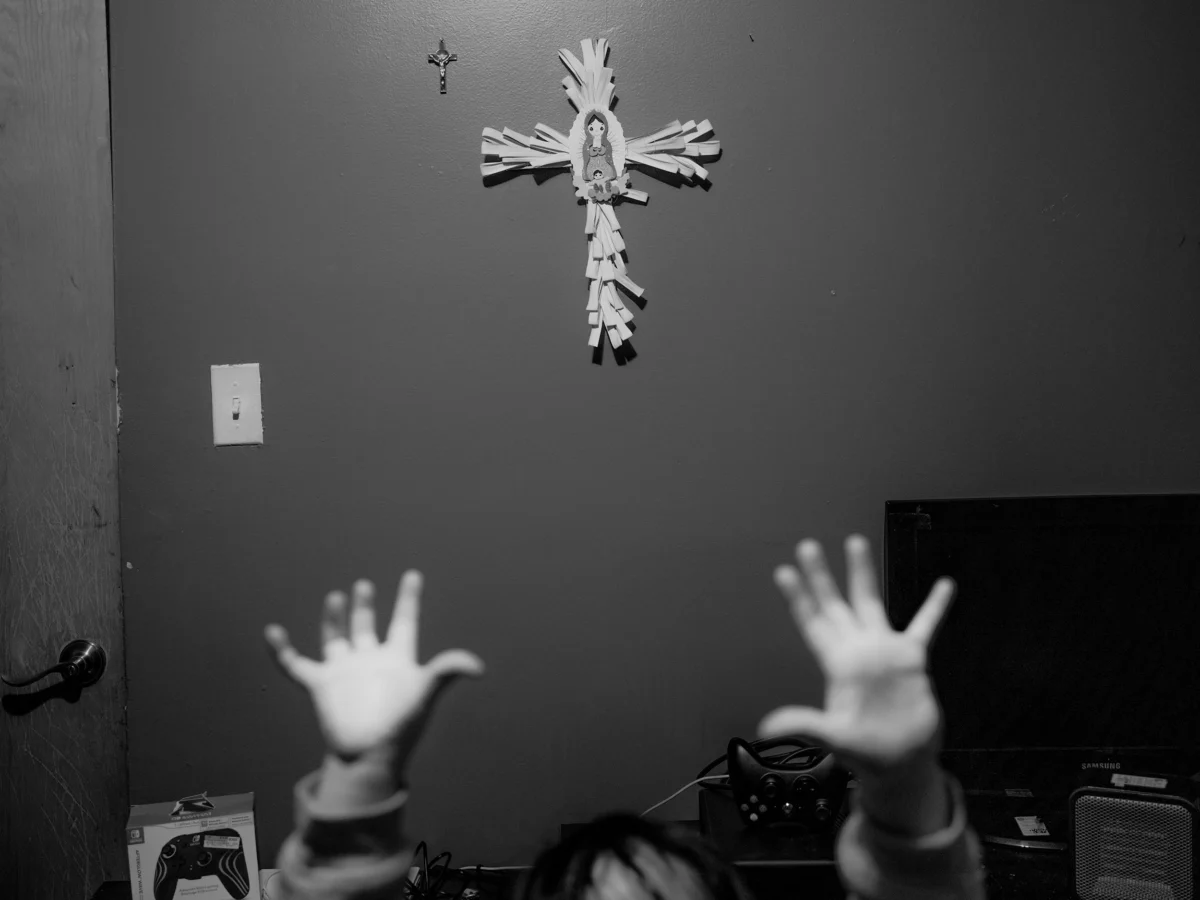
On a Halloween morning at approximately 7:30 am, Ava and Sam were preparing to take their two children to school when their upstairs neighbor frantically approached them on the street. "You shouldn’t be out right now," she warned, explaining that Immigration and Customs Enforcement (ICE) vans were just around the corner. A chilling numbness enveloped Ava’s body, a visceral reaction to the sudden, stark reality of her deepest fears materializing on her own street. The previous day, a coworker—another undocumented woman who cleaned houses alongside Ava—had recounted seeing an ICE van parked behind her car during her lunch break. All the unsettling images Ava and Sam had been witnessing on TikTok, depicting ICE agents arresting people in public places like Home Depot and Walmart, and the fragmented warnings from her husband’s coworkers, their caseworker, and their children’s schoolteachers about what to do if ICE appeared—it was now a tangible threat at their doorstep.
Accepting a ride from their neighbor, Ava spent the entire day consumed by paranoia, convinced that ICE was watching her. The overwhelming question of who would care for her young children if she or her husband were taken haunted her thoughts. She immediately informed her boss, who ran a housekeeping business, that cleaning properties felt too risky; her boss concurred. At the end of the day, her boss dropped her off at home, navigating through side streets and alleys to avoid main thoroughfares. From that moment, Ava’s world grew more isolated and solitary than she had ever known.
The ICE raids that have terrorized Chicago’s immigrant neighborhoods, including Ava and Sam’s, have been characterized by both their performative nature and their unsettling randomness. Six weeks prior to the Halloween incident, on September 9, Greg Bovino—a figure described as a "G.I. Joe look-alike" who previously served as ICE’s "commander-at-large"—arrived in Chicago. His presence was marked by a caravan of unmarked, black-tinted vans that began patrolling the city’s immigrant-heavy communities. Just three days later, on September 12, ICE agents shot and killed Silverio Villegas González, an undocumented father of two from Mexico who worked as a line cook and had no prior criminal record, after he attempted to drive away from them. Following these events, ICE officers became an omnipresent threat, lurking on sidewalks, downtown streets, in grocery stores, at Cook County courthouses, in parking lots, at intersections, within alleys, and throughout neighborhoods like Ava and Sam’s.
By the end of September, acting on an alleged "tip" about reported gang activity—which was later discovered to be merely a complaint about squatters—ICE agents swarmed a South Side apartment building in the dead of night. The operation involved agents rappelling down from a Black Hawk helicopter, patrolling the sidewalk outside with masks and rifles, and ultimately arresting 37 individuals. They violently kicked down doors, ransacked bookshelves, and upturned mattresses. In November, the escalating aggression continued when agents forcibly removed a Colombian teacher from the daycare center where she worked, even while school was in session. The pervasive feeling among residents was that anyone could be apprehended at any time. Sam began to hear about arrests and deportations through his coworkers and Facebook groups, while Ava’s phone became a conduit for a constant stream of TikTok videos depicting more ICE encounters; the more she watched, the more such content appeared.
Ava, whose name has been changed to protect her identity, had crossed the border before what she feared would be Donald Trump’s potential second term. Her husband, Sam (also a pseudonym), had arrived in America in 2022, having borrowed $12,000 from family members to pay coyotes for a grueling seven-day journey on foot. "It’s a very heavy, heavy decision to make the choice to abandon your children and your family," Sam confided, reflecting on the profound uncertainty of ever seeing loved ones again. After his perilous journey, he settled in Chicago, securing a demanding construction job. He worked grueling nine-hour shifts, six days a week, earning approximately $600 weekly, sending as much money as possible back to Ava. During his rare time off, exhausted and lonely, he would video call his wife and children. Their daughter, a baby at the time, would throw a tantrum during every call. He used to put her to bed nightly, and now, when her mother did, the child would instinctively reach up, searching for her father’s beard. Realizing he wasn’t there, she would cry inconsolably. It took a month for her to learn how to sleep again. Their older son struggled even more profoundly. One day, he came home from school sobbing, explaining to Ava that he had seen his friend’s father pick him up on a motorbike—just like his own father used to do. "When will we see him again?" he asked repeatedly, his voice filled with longing.
The family weighed their limited options: it was too perilous for Ava to cross the border alone with such young children, and they simply couldn’t afford to pay another coyote. However, remaining in Mexico felt equally dangerous. Drug cartels patrolled their hometown, actively recruiting children as young as 13, while local police offered little protection. One day, Ava received a panicked call from her brother; his two children had been subjected to secuestro exprés, or "express-kidnapping"—a common occurrence in their region of Mexico where gang members lure young children with candy or threats, then hold them hostage until parents pay for their release. Ava’s brother frantically scrounged together $3,000, selling everything he owned, including his small home, to secure his children’s freedom.
Driven by the desperate hope for a better future for their children, Ava and Sam heard from friends about Temporary Protected Status (TPS), a Department of Homeland Security program offering emergency asylum to individuals from countries facing armed conflict, environmental disasters, or extraordinary conditions. For many, TPS often serves as a crucial first step toward full asylum status, though the Trump administration had moved to revoke it for 11 countries and did not consider Mexico a qualifying nation. Ava applied during the Biden presidency, and after approximately a year of anxious waiting, she was notified that she had been granted an interview in the United States, with a strict 15-day expiration window. Frantically, she packed what she could into a large suitcase, gathered her children for their first airplane ride, and then took a taxi to El Paso. There, quite suddenly, she found herself before a phalanx of U.S. Border Patrol officers.
Border Patrol agents took Ava’s DNA and biometrics, and confiscated her passport. They conducted a thorough body exam, requiring the family to strip down to their innermost layers. Despite the invasive procedures, Ava felt that the Border Patrol agents treated them warmly. "I didn’t think they were rude or cold or harsh," she recalled. She had heard the interview could take all day, but by noon, she was free to walk out of the building and into Texas. She immediately called Sam, who booked the family plane tickets to Chicago. He gave her detailed instructions on navigating the airport, where everything was in English—a language she had yet to grasp. She navigated the complex environment in a maze of confusion, periodically pulling out her boarding pass so someone could point her in the right direction. After the plane descended onto the misty ground at Chicago’s Midway Airport, they cleared customs and found Sam waiting for them, an emotional reunion after two long years apart. "I was so happy," Ava recounted, "After you don’t see your family for two years, it was thrilling." Sam added, "We hugged each other very, very tightly."
Chicago was cold, and initially a little overwhelming, but undeniably beautiful. They took a drive by Lake Michigan. "It’s so big!" their daughter squealed with delight. The children were full of questions: What was the lake’s temperature? Could they swim in it? When? Soon after Ava’s arrival, the family splurged on an Uber ride to Chicago’s sprawling downtown, where they marveled at their reflections in "The Bean," the iconic, life-size lima-bean-shaped public art installation that mirrored the city skyline. Their daughter had been diagnosed with a developmental condition, and they successfully found a clinic to assist with her special needs. They began taking English classes, embracing their new life. Chicago’s harsh winter eventually yielded to a beautiful spring, followed by a memorable summer. "We still felt comfortable enough to go out, go for walks, go to the store, get groceries," Ava told the interviewer during a meeting at her home last December. And then, nearly a year into her new life in America, the ICE raids began. "Right now, frankly, we’re just really scared," she admitted.
The family resides in one of Chicago’s many Spanish-speaking neighborhoods, historically known for their welcoming stance towards immigrants. The vibrant pulse that once characterized this community had been replaced by an eerie stillness, its streets now eerily barren. When the interviewer arrived at Ava’s front steps last December, the doorbell went unanswered despite a scheduled appointment. Every shade in the house was drawn, giving the impression that no one lived there at all. After confirming through her caseworker that it was safe to let the interviewer in, Ava opened the door. She wore a soft pink sweater with a bow in her hair and smiled warmly, offering instant coffee and biscuits as they sat at her dining table. The bedrooms in their apartment were simply separated by a sheet hanging from the ceiling. It was a week before Christmas, and they had draped a stream of tinsel over the windows, a small gesture of normalcy. Sam, who briefly appeared to shake hands on his way to work, had resorted to biking there as fast as he possibly could, even in below-zero temperatures with a freezing windchill, to minimize the amount of time he was visible outside. The rest of the time, they hid indoors. "I just feel a sense of despair," Ava confessed, fighting back tears, "And stir-crazy."
In today’s interconnected world, the feeling of being watched is pervasive. Digital footprints are vast: every email, text, or social media account can be tracked and monitored. Cameras at intersections record license plates, and CCTV footage inside stores captures faces. The digital technology at ICE’s disposal, bolstered by the $85 billion budget allocated to the agency by the Trump administration under his "One Big Beautiful Bill," is even more extensive. ICE has nearly tripled its spending on digital surveillance technology since 2015. The agency utilizes license-plate-reader applications that can pull up a driver’s entire bio and employs face-recognition technology capable of identifying individuals from several feet away. Last year, a $2 million Department of Homeland Security contract with an Israeli spyware company, Paragon Solutions, granted ICE access to Graphite, software designed to gain unauthorized access to mobile phones. "ICE is really in this moment where it’s pooling as much data together as it can to create a broad surveillance network," explained Will Owen of the Surveillance Technology Oversight Project. "And it’s increasing exponentially, because they have the resources to invest in broader surveillance." Among the most prominent of these technologies is Palantir’s ELITE system, which creates a visual map of so-called "targets"—suspected undocumented immigrants whose data is mined from sources like the Department of Health and Human Services, U.S. Citizenship and Immigration Services, license-plate-reader logs, arrest records, jail bookings, financial records, and even social media.
Yet, despite these Orwellian levels of surveillance, the apparent randomness of many immigration raids suggests an agency not fully harnessing its advanced technologies. ICE officers have stormed farms, construction sites, apartments, offices, grocery stores, cafés, and intersections, conducting crude, sweeping dragnet operations for undocumented workers. They have stopped people on the streets—many of whom are American citizens—based solely on the color of their skin. They have mistakenly identified mothers as gang leaders and a Hmong refugee as a sex offender, accidentally detaining U.S. citizens at gunpoint. These indiscriminate actions have forced countless families like Sam and Ava into hiding. "Now we’re inside all the time," Sam stated. They were even afraid to take out their trash. "You don’t know if you’ll see them along the way or encounter them on a walk. You don’t know if you’ll be able to come back."
Ava was unaware that the government could monitor her phone. She now spends most of her day glued to it within her small apartment, communicating with her mother back in Mexico and watching more videos of ICE arrests on TikTok while Sam is at work. In the months since Halloween, she has lost her income and her freedom. When absolutely necessary, she ventures to the grocery store. Sometimes, volunteers drop groceries off for the family, minimizing the risks of being seen outside. "I was just trying to do honest work, and it just feels really scary," she explained. Living in this state of constant fear had begun to take a severe physical toll. One morning, a few weeks into the news about the raids, Ava woke up to find her right arm numb. Then she and Sam noticed that when she blinked, only her left eye would move. For weeks, the right side of her body was half-paralyzed. Sam was panicked by her condition but maintained a calm exterior, viewing challenges as hidden blessings. "My method is always to try to stay as calm as possible and reassure her, like, you’ll get better," Sam said. A month and a half later, slowly, Ava regained movement on her right side.
Since ICE first appeared in Chicago last fall, the mood in immigrant communities had grown tense and paranoid. However, a strong resistance also emerged. Signs appeared in windows, much like during a political election, proclaiming: "HANDS OFF CHICAGO." Restaurants in Hispanic neighborhoods began locking their doors during business hours, with some posting signs banning anyone wearing a balaclava or mask. Chicagoans started wearing whistles around their necks, ready to alert the public if an ICE officer was spotted. Residents honked horns and pulled out their phones if an ICE van was seen. Protesters appeared across the city and outside the ICE facility in Broadview, a suburb. ICE agents responded with a force typically seen in authoritarian countries: deploying tear gas and body-slamming people to the ground. One woman, U.S. citizen Marimar Martinez, was shot five times by a Border Patrol agent for driving "aggressively" during a protest. ("Five shots, seven holes. I take pride in my shooting skills," the agent allegedly texted his colleagues after news of the shooting broke.) Ava and Sam heard about all of this in trickles from their apartment, primarily through social media. Sometimes, Ava felt a crushing sense of responsibility. One day, at the end of January, she woke up to news on TikTok that agents had shot a man—an American man—in Minneapolis. "I’m seeing they killed another man, and I feel terrible," she told the interviewer.
After Ava stopped working, the family began to worry desperately about money. Sam reduced his lunch hour to just 30 minutes, bringing in a little extra cash each week. However, their daughter’s special-needs appointments incurred costs, as did rent, groceries, and laundry. Ava realized she would need to try to work again. "I’m afraid," Ava admitted, "But we have necessities." She created handwritten résumés detailing her name, number, and experience, and began dropping them off at Spanish-speaking stores nearby: the local laundromat, a bakery, a taqueria. On the forms, she explained that she didn’t speak English but was a fast learner. "I know it’s a risk," she said, "I feel unsure if I’m safe, but we have to go out." The alternative felt even riskier.
One day in January, Sam was at work when a sharp piece of plastic flew from a machine and lodged in his eye. When he returned home that night, his eye was swollen, and he had a lump on his eyeball, with a white dot obstructing his vision. Ava urged him to go to the hospital, but he refused; he was too scared. What if ICE was lurking in the parking lot or the lobby? If he were deported, what would become of his family? For two days, he didn’t go to work, lying in bed, hoping it would heal. But the pain in his eye was excruciating and had begun to extend deep into his skull. They started to fear he might lose his sight. Finally, he relented and sought medical care while Ava waited nervously at home, glued to her phone, anxiously anticipating an update. A few hours later, to her immense relief, Sam returned home with medicine. Their joy was immediately supplanted by fear over how they would pay the hospital bill, which she had heard could be wildly expensive, especially without insurance.
By the end of January, the relentless stress of the situation was starting to feel untenable. They discussed returning to Mexico, but that felt even more dangerous for their children. Ava suffered frequent headaches and felt constantly nervous and lonely. In Mexico, she was accustomed to living with her mother—this was the first time in her life she’d ever been alone for such an extended period. She and Sam took virtual training courses at a local nonprofit, learning what to do if one of them was arrested by ICE: Never let anybody in unless they have a warrant signed by a judge. Ask the agents to leave the warrant in the mailbox or put it up against the window. Never open the door. If you are detained in public, remain silent and request an attorney. Together, they formulated a contingency plan, filling out emergency paperwork with their families’ contact information back home in Mexico.
Since September, when the raids began, they had stopped doing anything outside as a family. If one of their children had a performance or presentation at school that was open to parents, one of them always stayed behind. Their daughter was still too young to grasp the gravity of the situation, but they observed how the stress was overwhelming their son. He had grown withdrawn and increasingly sought refuge in his phone. He struggled to understand the English in his classes and started having nightmares. One evening, in the middle of the night, they awoke to the sound of their son screaming as he ran into the kitchen and hid in a corner. "Get down! Get down! They’re gonna see us!" he yelled. Confused, they realized he had been sleepwalking, a terrifying manifestation of his subconscious fears.
As signs of spring began to emerge through a brutally cold winter, Ava and Sam watched as the world’s attention turned to other global events: the strange kidnapping of Nicolás Maduro, the killing of Mexican drug lord "El Mencho," and now, a new war in Iran. ICE, at least ostensibly, had shifted its focus to other cities. But Ava and Sam were cautioned not to become cavalier. ICE was still lurking. So they remained cautious, yet cautiously optimistic. Their children were beginning to adjust better to life in America—bringing homework and artwork from school, talking about their dreams for the future. "When we’re home, honestly, it’s all joy," Ava shared. "We play with the kids; we spend a lot of time together."
Every morning, they wake as a family around 7 am. Ava prepares toast and Choco Milk for the kids, and instant coffee for herself and Sam. She styles her daughter’s hair and gets her dressed for the day. Then Sam walks their son to school. When he returns, they have a couple of precious hours together before he has to leave for work. In those brief hours, everything about their life feels normal and calm, mundane even, as if there was no border between the comforting walls of their house and the ever-watchful, threatening eye of the world outside.