11
11
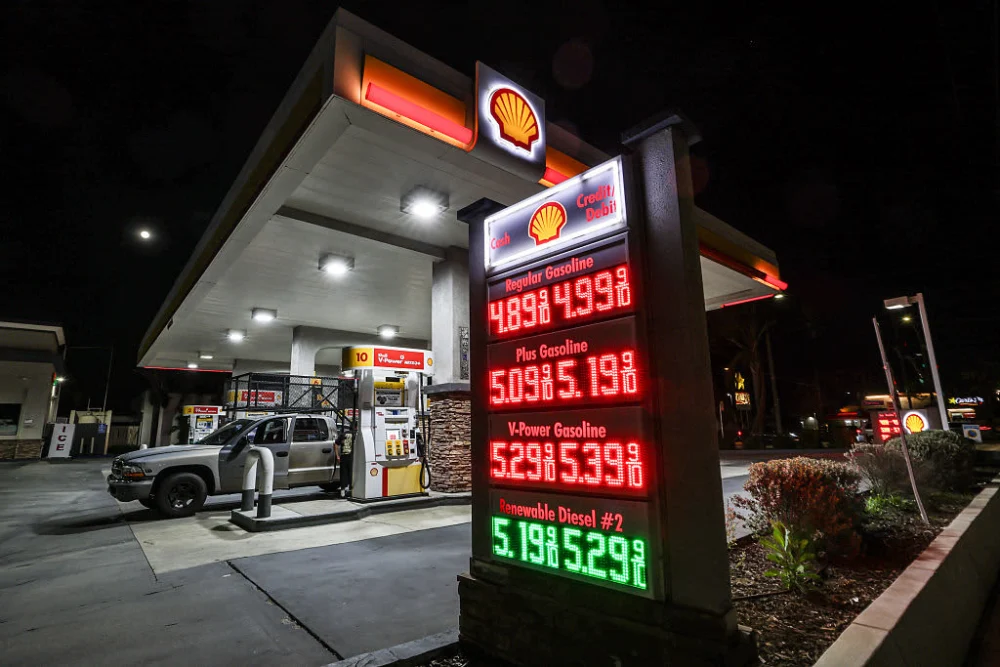
Gas prices are displayed at a Shell station in Azusa, California. Robert Gauthier | Los Angeles Times | Getty Images
Rising oil prices pose a significant threat not only to President Donald Trump’s efforts to combat inflation but also to his signature legislative achievement, the "big beautiful bill." According to analysis by Raymond James, the economic benefits derived from the individual tax cuts, stemming from both reduced withholdings and enhanced tax refunds, could be entirely negated if oil prices remain elevated by more than $20 compared to pre-war levels.
Strategist Tavis McCourt of Raymond James noted in a recent advisory that the recent $25 surge in oil prices, if sustained, "essentially offsets the fiscal benefit from the [One Big Beautiful Bill Act]." McCourt’s assessment is based on the projected impact of increased oil prices on the more than $420 billion consumers spent on gasoline in the fourth quarter of 2025. His calculations incorporate potential reductions in demand due to higher prices, as well as the likelihood of companies increasing profit margins.
McCourt estimates that a $20 increase in oil prices could translate to consumers spending an additional $150 billion at the pump. This figure significantly erodes the estimated $129 billion in individual tax cuts for 2025 projected by the Tax Foundation, the majority of which is expected to be distributed through tax refunds during the upcoming filing season.
As of Tuesday morning, U.S. oil prices were trading at $88.20 per barrel, more than $20 higher than the $67.02 closing price on February 27, prior to the escalation of the U.S.-Iran conflict. This significant price jump followed considerable volatility in the market on Monday.
Stephanie Roth, chief economist at Wolfe Research, echoed concerns about the impact of elevated oil prices. She stated in an interview that her projections for the consumer hit from higher oil prices are comparable to the increased spending anticipated from the tax legislation. However, Wolfe Research cautioned that oil prices would need to sustain levels above $100 for an extended period to realize such a significant impact. "In all these scenarios, it has to last longer than it is now," Roth said. "The impact on gas prices so far has been short-lived, and modest compared to how it may ultimately play out."

The resolution of the conflict will be a key factor in oil price stabilization. While President Trump declared the conflict "very complete" in a Monday interview, he did not provide a specific timeline for its conclusion. Historically, following major geopolitical events such as the Gulf War in 1990 and Russia’s invasion of Ukraine in 2022, it has taken approximately six months for oil prices to revert to pre-conflict levels, according to McCourt.
Consequences of Weaker Stimulus
The fiscal stimulus provided by the tax law was anticipated to invigorate the economy in 2026, with some economists predicting a reacceleration of U.S. growth, partly attributed to the legislation. The current surge in oil prices arrives precisely as consumers are poised to receive their tax refunds. Citadel Securities estimated last week that as of March 1, only 30% of refunds had been distributed, with that figure projected to reach around 75% by May 1.
Gabriel Shahin, CEO of Falcon Wealth Planning, expressed in an email to CNBC that the higher oil prices are effectively redirecting the anticipated boost from tax refunds toward energy costs. "The bottom line is that if we were expecting those tax refunds to lift consumer spending, these higher oil prices are just redirecting all that cash toward energy costs," he wrote. "It’s essentially voiding out the economic boost we were set to see."
Conversely, Dan Niles, portfolio manager at Niles Investment Management, offered a different perspective, suggesting that the tax refunds might help the economy absorb higher oil prices. He drew a parallel to 2022 and 2023, when oil prices reached similar levels amidst widespread predictions of a recession driven by rising interest rates. "You already had that stress tested a bit," Niles remarked. "So if that’s the case back then, and coming off of inflation surging in 2021, and you still didn’t get a recession, why would you think inflation down at 3% and oil at $100 would cause a recession now?"
Many market observers have noted similarities between the current price surge and the period following Russia’s invasion of Ukraine four years ago. However, Roth cautioned against overreliance on this comparison, highlighting significant differences in the economic backdrop. "The economic backdrop is not a mirror image of where we are today," she stated. "Core inflation was running at 5.5% compared to 3% today. Job growth was running at around 500,000, now we’re at 37,000 over the past couple of months. So it’s just an entirely different backdrop."
McCourt believes that a less potent stimulus from the tax bill than initially projected is unlikely to significantly alter market outlooks, particularly for stocks, which he contends never fully priced in a substantial surge in consumer spending. He pointed out that consumer discretionary stocks have underperformed the S&P 500 in 2026. Nonetheless, he suggested that the economy, and not just the stock market, could withstand elevated oil prices and weaker-than-expected stimulus, provided the labor market remains robust. "We just have never had a sustained pullback in consumer spending without substantial job losses," McCourt asserted. "We’ll have some shifts in spending … But it’s probably not going to impact the overall consumer spending levels."