 11
11
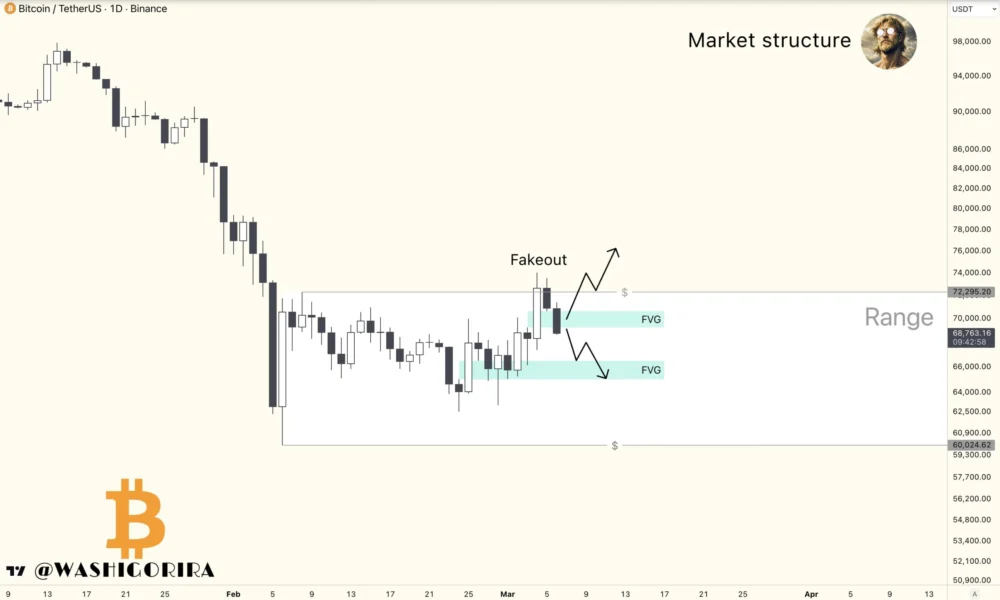
Bitcoin (BTC) has slipped back into its monthly trading range, trading below the significant $70,000 mark, following a notable 5% decline over the past two days. Market data indicates robust resistance building near the $70,000 level, with several on-chain indicators, futures market activity, and a slowdown in spot trading volumes all pointing to renewed selling pressure. This confluence of factors is limiting Bitcoin’s ability to sustain its recent range highs achieved earlier in the week.

Analysis of short-term holder (STH) behavior reveals an acceleration in profit-taking as Bitcoin’s price surged above $74,000. Crypto analyst Darkfost highlighted that in the 24 hours preceding the analysis, over 27,000 BTC in realized profits were transferred to exchanges from STH wallets. This volume of profit-taking is among the largest observed from this cohort since November 2025. Darkfost’s findings suggest that these sellers were primarily capitalizing on gains accumulated over the past week to a month, with their realized price point hovering around $68,000.
Further corroboration of aggressive selling activity comes from Bitcoin futures data. Market analyst IT Tech observed that both the spot and perpetual futures markets have recently shown negative cumulative volume delta (CVD) readings. The CVD metric, which measures the difference between buy volume and sell volume, indicates dominant selling pressure when it registers negative. Specifically, the spot CVD fell to -$202.49 million, while the perpetual futures CVD dropped to -$185.60 million. This period of increased selling coincided with Bitcoin’s retreat below $70,000 as bid liquidity in the market contracted.

The demand from US-based traders, as measured by the Coinbase Premium Index, has also shown signs of weakening around key price inflection points. This index, which tracks the difference between Bitcoin’s price on Coinbase and offshore exchanges, has repeatedly faded as BTC approached the $74,000 resistance level. Historically, positive readings on the Coinbase Premium Index have signaled strong spot demand from the US market. During Bitcoin’s ascent towards the $73,000-$74,000 range on March 4th, the premium briefly rose above 0.08, indicating robust buying from entities utilizing Coinbase. However, this surge in demand was short-lived, as the price reversed from $74,000, and the premium subsequently turned negative.
Michaël van de Poppe, founder of MN Capital, commented on the broader market sentiment, noting that recent Friday US trading sessions have been characterized by widespread selling pressure across risk assets, including the Nasdaq. He suggested that Bitcoin finding support and holding the $67,000-$68,000 range could stabilize the short-term trend and potentially pave the way for a continued upward movement.

Adding to the technical analysis, crypto trader Titan of Crypto pointed to a nearby fair value gap (FVG) that could offer support for price consolidation. An FVG occurs when rapid price movements create areas of low liquidity, where minimal trading activity took place during a breakout. Technically, the price may revisit these zones to rebalance liquidity. The lower boundary of this identified FVG is situated near $66,500, a level that the trader is monitoring as a deeper liquidity zone.
The recent price action underscores the challenges Bitcoin faces in breaking through significant resistance levels, especially when accompanied by shifts in investor sentiment and on-chain metrics. The profit-taking by short-term holders, coupled with reduced demand from key markets and negative futures delta, suggests that the upward momentum has temporarily stalled. Market participants will be closely watching whether Bitcoin can maintain support at the identified levels or if further downside is likely as selling pressure persists. The interplay between these technical and on-chain factors will be crucial in determining Bitcoin’s trajectory in the short term.