 11
11
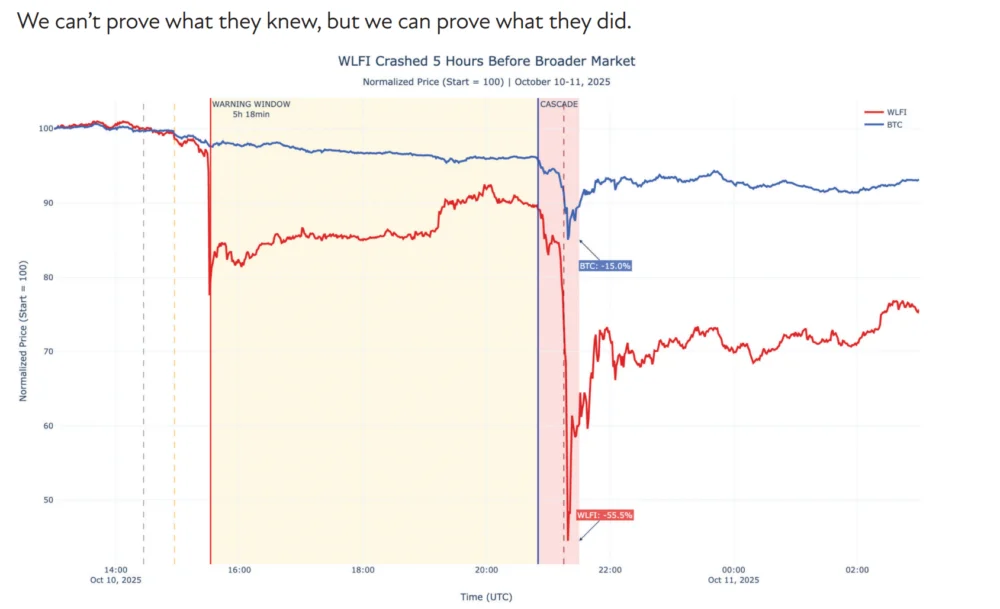
A recent analysis by data provider Amberdata suggests that the World Liberty Financial Token (WLFI), a DeFi governance token reportedly affiliated with the Trump family, may have provided a significant market warning hours before a substantial cryptocurrency downturn on October 10, 2025. This event saw approximately $6.93 billion in leveraged crypto positions liquidated in under an hour, with Bitcoin (BTC) experiencing a roughly 15% drop, Ether (ETH) falling around 20%, and smaller altcoins plummeting by as much as 70%.
According to Amberdata’s report, which meticulously examined trading activity on that pivotal day, WLFI began a sharp decline more than five hours before the broader market experienced its significant sell-off. At the time WLFI’s downward trend commenced, Bitcoin was trading near $121,000 and showed no immediate signs of the impending stress.
Mike Marshall, the author of the Amberdata report, emphasized the significance of this temporal discrepancy in his statement to Cointelegraph. "A five-hour lead time is hard to dismiss as coincidence," Marshall stated. He further elaborated, "That duration is what separates a genuinely actionable warning from a statistical artifact." This extended lead time suggests that the WLFI’s movements were not merely a random fluctuation but potentially a precursor to wider market instability.
Anomalous WLFI Trading Activity Precedes Broader Market Sell-off
To ascertain whether WLFI acted as a bellwether for the impending market sell-off, researchers delved into three distinct anomalous patterns observed in its trading activity. These included a dramatic surge in trading volume, a significant divergence in price movement compared to Bitcoin, and an indication of extreme leverage within its market.

Within minutes of news related to tariffs becoming public, WLFI’s hourly trading volume escalated to approximately $474 million. This represented a staggering increase of about 21.7 times its normal trading volume. Concurrently, the funding rates for WLFI perpetual futures reached an extraordinary level of around 2.87% every eight hours. This translates to an annualized borrowing cost nearing 131%, indicating intense demand for leveraged positions and potentially speculative trading.
The study explicitly clarifies that it does not allege insider trading. Instead, it posits that the inherent structure of cryptocurrency markets can amplify the influence of certain assets, regardless of their overall market capitalization. The report highlights that WLFI’s holder base is notably concentrated among participants with political connections, a stark contrast to the widely distributed ownership of Bitcoin. Marshall noted that the observed trading pattern appeared "instrument-specific," meaning the heightened activity was confined to WLFI and did not reflect across the broader cryptocurrency market.
"If this were superior analysis (sophisticated participants reading the tariff headlines faster and drawing better conclusions) you’d expect to see that reflected more broadly," Marshall explained. "What we actually saw was concentrated activity in WLFI first." This concentration of activity on a single, politically linked token before a widespread market reaction further supports the hypothesis of a leading signal.
The timing of this accelerated trading volume is particularly noteworthy. It began approximately three minutes after public dissemination of tariff-related news. Marshall suggested that such rapid execution implies a degree of preparedness rather than organic, real-time interpretation of headlines by retail traders.
The mechanism linking WLFI’s sharp decline to the broader market crash appears to be rooted in leverage. Many cryptocurrency trading platforms permit traders to utilize various assets as collateral to secure borrowed positions. When WLFI experienced a precipitous drop in value, the collateral backing these leveraged positions depreciated. This forced traders to liquidate their holdings in more liquid assets, such as Bitcoin and Ether, to meet margin calls and cover their outstanding positions. These forced sales, in turn, exerted downward pressure on prices, triggering a cascade of further liquidations across the wider market.
WLFI Demonstrated Enhanced Sensitivity to Market Stress Compared to Bitcoin

Amberdata’s data analysis revealed that during the period of market stress, WLFI’s realized volatility reached nearly eight times that of Bitcoin. This stark difference underscores WLFI’s heightened sensitivity to market pressures. The researchers argue that assets that are structurally fragile and highly leveraged are more likely to move first during periods of market shock.
Marshall cautioned against interpreting these findings as definitive proof that WLFI can reliably predict future market downturns. He emphasized that the analysis is based on a single event, and more data would be required to establish any statistical consistency or predictive power. Nevertheless, he believes the observed behavior is highly significant.
"So the useful life of this signal is finite. It’s valuable now because it’s under-monitored," Marshall commented. "The moment it becomes consensus, the alpha gets arbitraged away. That’s how all market signals work. The ones that persist are the ones nobody’s paying attention to." This suggests that as market participants become aware of such potential leading indicators, their predictive efficacy may diminish over time.
The report’s findings also emerge amidst ongoing scrutiny of WLFI. Previously, U.S. senators had urged the Committee on Foreign Investment in the United States (CFIUS) to investigate a significant stake in the Trump-linked token held by entities in the United Arab Emirates. Reports have also indicated that the Trump family’s WLFI token plans to develop foreign exchange and remittance platforms.
Cointelegraph remains committed to independent and transparent journalism, producing news articles in accordance with its Editorial Policy, aiming for accuracy and timeliness. Readers are encouraged to independently verify information.