11
11
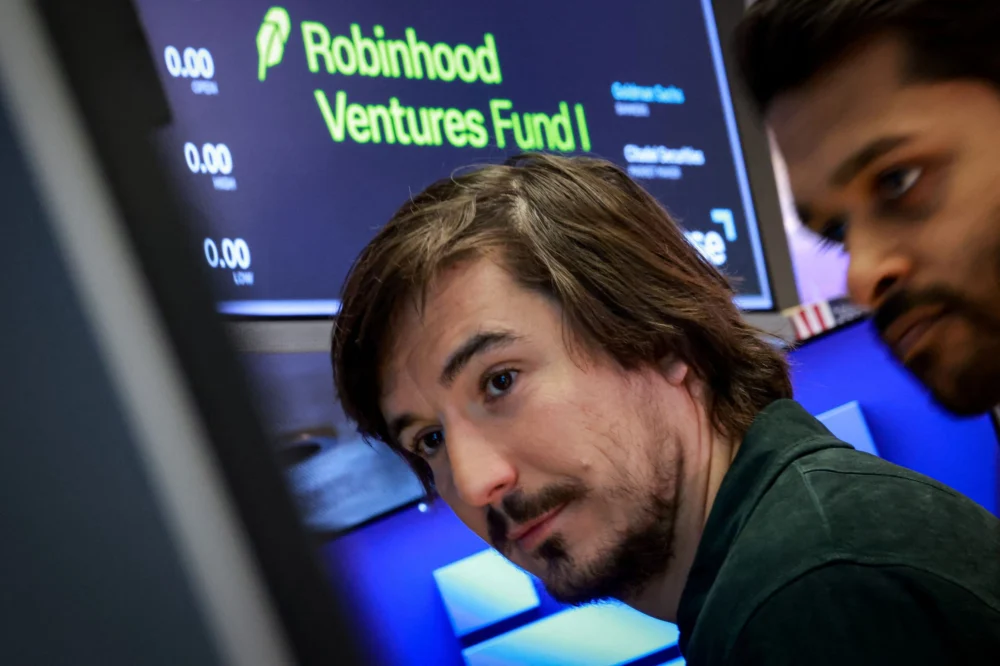
Robinhood’s Venture Fund I experienced a significant drop of 11% in its initial public market debut on the New York Stock Exchange on Friday, March 6, 2026. This sharp decline raises questions about the appetite for riskier investments among the broader market, particularly in the current climate of escalating geopolitical tensions. The fund, which trades under the ticker RVI, offers investors exposure to a curated selection of prominent private companies, including the rapidly growing financial services firm Revolut and the cutting-edge software company Databricks.
The stated objective of Robinhood Ventures Fund I, as articulated by Robinhood CEO Vlad Tenev in an interview with CNBC’s "Squawk on the Street" on Friday, is to democratize access to a segment of the capital markets that has historically been largely inaccessible to retail investors. Tenev emphasized the growing trend of companies reaching substantial valuations, often in the hundreds of billions and even approaching trillions of dollars, within the private markets before retail investors have any opportunity to participate.
"You have companies that are out there at valuations in the hundreds of billions, even getting into the trillions in private markets before retail investors get a chance to come in at all, and this is happening more and more," Tenev stated. He further elaborated on Robinhood’s mission to address this disparity, asserting, "We’re trying to solve this by not just opening the door to private markets but completely blowing them off the hinges so that they can never be closed."
The structure of Robinhood Ventures Fund I allows retail investors to engage with the fund in a manner similar to trading shares of publicly traded companies. They can buy and sell shares of this closed-end fund, which operates akin to an investment firm, through standard brokerage accounts. This approach aims to simplify the process and lower the barriers to entry for individuals seeking to invest in pre-public market companies.
However, the timing of RVI’s launch is proving to be a significant hurdle. The fund’s debut coincides with a particularly turbulent period for public markets. Major U.S. stock averages are currently on track for weekly declines, a trend attributed to investor apprehension and the liquidation of equities. This sell-off is largely driven by fears that the ongoing conflict between the U.S. and Iran could persist for an extended duration, thereby exacerbating global economic and political instability.
The initial public offering (IPO) for Robinhood Ventures Fund I was priced at $25 per share. Upon commencing trading on Friday, the fund opened at $22 per share. It subsequently experienced a dip, reaching a low of $21 before partially recovering to trade around $22.12. By the close of trading on Friday, RVI settled at $21 per share, reflecting the substantial 11% depreciation from its IPO price.
The performance of RVI on its first day of trading underscores the current market sentiment, where investors appear to be prioritizing safety and stability over potentially higher-risk, higher-reward opportunities. The fund’s exposure to private companies, while offering the promise of significant future growth, also inherently carries greater volatility and less transparency compared to established public companies. The prevailing geopolitical anxieties appear to be amplifying these concerns among investors.
The venture fund model itself is designed to pool capital from investors to invest in a portfolio of private companies. These companies are typically in their growth stages and have not yet gone public. The aim is to generate returns through the eventual sale of these companies, either through an IPO or an acquisition. Historically, access to such investment opportunities has been limited to institutional investors and high-net-worth individuals due to regulatory requirements and the substantial capital needed.
Robinhood’s initiative with RVI represents a significant attempt to bridge this gap and democratize access to the lucrative private equity landscape. By creating a publicly traded fund that holds stakes in these private entities, Robinhood seeks to empower a broader range of investors to participate in the growth stories of innovative and potentially disruptive companies. The fund’s prospectus would typically outline its investment strategy, the types of companies it targets, and the associated risks.
The companies within the RVI portfolio, such as Revolut and Databricks, are themselves significant players in their respective industries. Revolut, a digital banking and financial services company, has experienced rapid expansion and offers a wide array of services, including currency exchange, stock trading, and cryptocurrency services. Databricks, on the other hand, is a prominent data analytics and artificial intelligence company, known for its unified data analytics platform. Investments in such companies are often viewed as bets on future technological advancements and market disruption.
The success of RVI’s debut was evidently hampered by factors external to its intrinsic value or investment strategy. The broader market downturn, driven by geopolitical fears, created an environment where even promising new investment vehicles struggled to gain traction. The 11% drop on the first day is a stark indicator of the prevailing risk aversion.
Analysts and market observers will be closely monitoring RVI’s performance in the coming weeks and months. Its trajectory will likely serve as a bellwether for the broader appetite for venture capital-backed assets in the public markets, especially during periods of heightened global uncertainty. The ability of RVI to weather these challenging market conditions and demonstrate its long-term potential will be crucial for its future success and for the broader initiative of democratizing access to private markets.
The narrative surrounding RVI’s launch highlights a fundamental tension in the current financial landscape: the desire for access to high-growth private companies versus the inherent risks associated with such investments, particularly when amplified by macroeconomic and geopolitical headwinds. Robinhood’s commitment to opening up these markets is a significant undertaking, and its initial public offering’s performance will undoubtedly be a subject of intense scrutiny. The company’s ability to effectively manage investor expectations and navigate these volatile market conditions will be key to realizing its ambitious goals.