 11
11
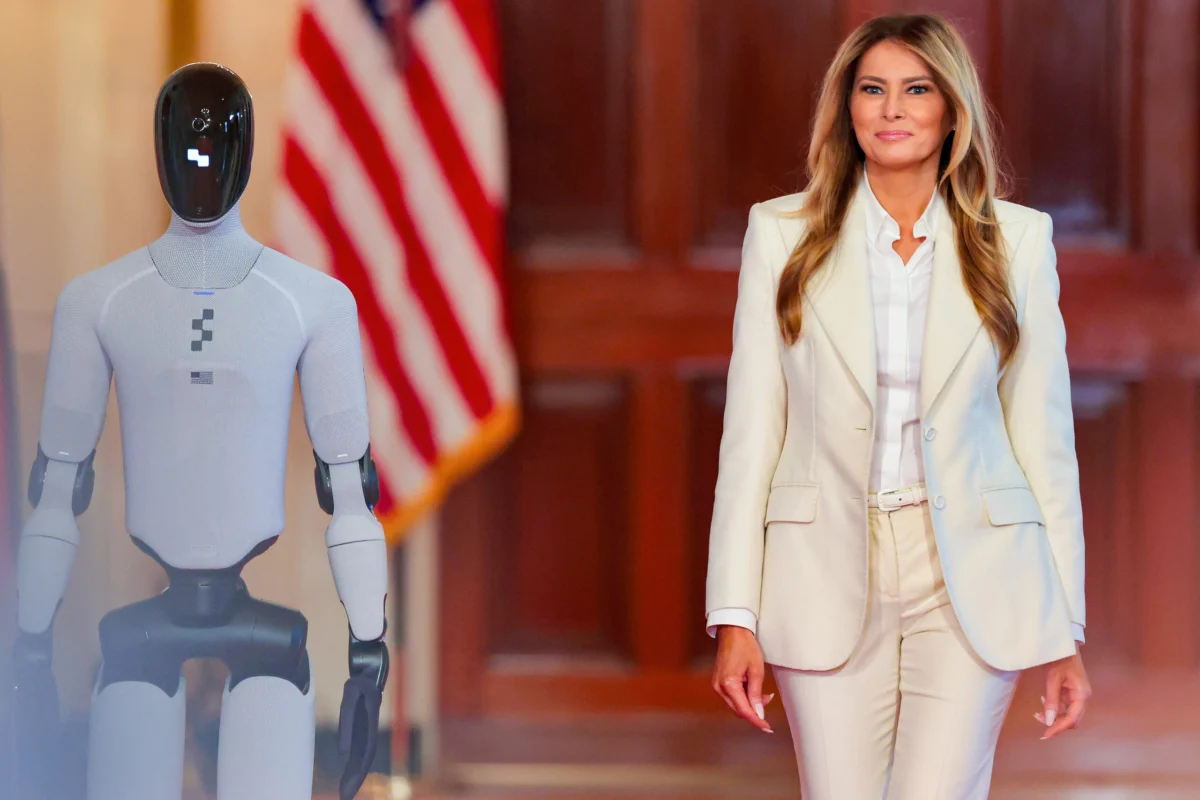
The White House became the stage for a futuristic spectacle on Wednesday as First Lady Melania Trump introduced a humanoid robot from robotics firm Figure AI during a press conference. This unusual appearance marked the launch of her "Fostering the Future Together" global summit, an initiative dedicated to exploring the integration of educational technology, particularly artificial intelligence, into children’s learning experiences worldwide. The event, which drew international leaders, offered a glimpse into the Trump administration’s bold vision for a tech-driven educational landscape, simultaneously igniting discussions about the profound implications for human educators and traditional schooling.
The scene unfolded with the First Lady making her entrance alongside the advanced humanoid robot. As they glided down a red carpet together, the collaboration between human and machine immediately captured attention, setting an unconventional tone for a White House briefing. The Figure AI robot, a testament to contemporary advancements in robotics, then delivered a brief, synthesized speech. Its chirping voice conveyed a message of optimism and purpose, stating, "I am grateful to be part of this historic movement to empower children with technology and education." This concise declaration underscored the core message of the First Lady’s initiative: leveraging cutting-edge technology to revolutionize the way children learn. Following its remarks, the machine quietly exited the room, disappearing from view and leaving attendees to ponder the implications of its brief, yet impactful, appearance.
This bizarre spectacle served as the dramatic opening for the First Lady’s newly launched global summit, "Fostering the Future Together." Hosted at the White House, the summit brought together international leaders from a record 45 member nations, all convened to deliberate on strategies for empowering children through the transformative potential of educational technology, with a particular emphasis on artificial intelligence. The initiative aims to forge a global coalition dedicated to integrating innovative digital tools into learning environments, fostering a future where technology serves as a cornerstone of accessible and personalized education. The White House explicitly recognized "the participation of leading American technology companies, whose engagement reflects the growing role of the private sector in supporting safe and effective educational innovation." This statement highlighted the administration’s belief in a strong partnership between government and the tech industry to drive educational reform.
During her address, the First Lady articulated a sweeping vision for the future of education, one in which humanoid robots could assume the role of ultimate educators for children across the globe. She invited attendees to "envision a future in which a humanoid robot would act as the ultimate educator for the world’s children," proposing a hypothetical AI entity, "imagine a humanoid educator named Plato." This advanced AI, she explained, would democratize access to knowledge in an unprecedented way. "Access to the classical studies is now instantaneous," she proclaimed, detailing how "literature, science, art, philosophy, mathematics, and history — Humanity’s entire corpus of information is available in the comfort of your home."
The concept of "Plato" extended beyond mere information delivery. The First Lady elaborated on its personalized and adaptive capabilities: "Plato will provide a personalized experience, adaptive to the needs of each student. Plato is always patient, and always available." She asserted that such a system would predictably lead to profound cognitive development, stating, "Predictably, our children will develop deeper critical thinking and independent reasoning abilities." This vision painted a picture of an endlessly patient, infinitely knowledgeable, and perfectly tailored learning companion, capable of guiding each child through a vast curriculum at their own pace and according to their individual learning style.
While the First Lady’s vision was presented with an air of progress and optimism, the event easily evoked "dystopian dreams of the future." The idea of advanced humanoid robots taking on the primary role of educators immediately sparked concerns, notably "ones in which the humble (human) school teacher has been replaced by a Terminator-shaped server stack that can walk and speak Latin." This imagery captures a widespread anxiety about job displacement, the potential loss of human connection in education, and the ethical implications of entrusting the intellectual and emotional development of children to machines. The swift and silent departure of the Figure AI robot after its speech only added to the surreal and somewhat unsettling atmosphere, prompting questions about the balance between technological advancement and human values in society.
The White House event was not an isolated incident but rather a significant piece of a larger puzzle reflecting the Trump administration’s concerted push to integrate advanced technology, particularly AI, across various sectors. The summit took place concurrently with a separate, high-profile announcement by the Trump administration regarding the formation of a new tech council. This council was slated to include prominent Silicon Valley executives such as Mark Zuckerberg, Larry Ellison, and Jensen Huang, signaling a direct engagement with industry leaders to shape national technology policy. This parallel initiative underscored the administration’s strategic embrace of the tech industry, viewing it as a crucial partner in shaping the nation’s future, from economic development to educational reform. The Figure AI X account also publicly acknowledged its participation, posting, "Honored to be invited to the White House by the First Lady Melania Trump," further solidifying the collaboration between the administration and leading tech firms.
The First Lady’s forward-looking comments, while not reflective of the immediate state of robotics and edtech, align with a burgeoning trend within the tech industry itself. The notion that AI and technology can streamline or even "automate learning" – and in many instances, "replace human educators" – has been steadily "gaining in popularity" among tech innovators and entrepreneurs. The White House has consistently championed such ideas, actively promoting experimental educational models. Over the past year, educational experiments like the Alpha School, a network of private schools that "use AI to teach children at rapid speed," have gained significant traction and media attention. Reports indicate that Alpha Schools operate on a model that charges approximately $55,000 per child, challenging the traditional classroom structure by largely removing the human teacher from the equation. This experimental approach has been embraced by the Trump administration, which has simultaneously maintained a critical stance towards the traditional public education system.
Further illustrating the administration’s commitment to these new educational paradigms is the involvement of Secretary of Education Linda E. McMahon. Remarkably, Secretary McMahon is currently engaged in efforts to "abolish the very agency she is tasked with running," the Department of Education. Despite this overarching objective, she has found the time to personally "visit an Alpha School campus." During her visit, she publicly lauded the "opportunity" promised by the educational chain, signaling strong governmental endorsement for its AI-centric model. The administration subsequently reinforced this praise, stating, "Alpha School is reimagining K–12 education by equipping students with practical AI skills and preparing them for a rapidly evolving technology-driven workforce." This statement encapsulates the administration’s belief that these innovative, tech-driven schools are crucial for preparing the next generation for a future dominated by technology, thereby justifying their promotion even as the traditional educational infrastructure faces scrutiny.
Melania Trump’s event on Wednesday, much like the broader actions of the administration, unequivocally highlighted the pivotal role that the tech industry is expected to play in the future of American education. The First Lady explicitly acknowledged "the participation of leading American technology companies, whose engagement reflects the growing role of the private sector in supporting safe and effective educational innovation." This emphasis on private sector involvement underscores a strategic shift, suggesting that the administration sees technology companies not just as vendors but as essential partners and drivers of educational transformation. This approach favors market-driven solutions and technological disruption over traditional, publicly funded educational structures. The ongoing discourse around AI in education is a frequent topic at industry gatherings, including events like the upcoming TechCrunch conference in San Francisco in October 2026, further cementing the private sector’s influence in shaping these debates.
The White House press conference and the "Fostering the Future Together" summit represent a significant moment in the national conversation surrounding education and technology. By showcasing a humanoid robot and articulating a vision of AI-powered "Plato" educators, the First Lady and the Trump administration have laid out an ambitious, albeit controversial, blueprint for the future of learning. While the proposals are "forward-looking and don’t reflect where robotics and edtech are today, or will be anytime soon," they unequivocally signal a governmental preference for technological solutions and private sector innovation to address educational challenges. This trajectory, championed by figures like Secretary McMahon and exemplified by initiatives like the Alpha School, promises to reshape the educational landscape, inviting both excitement for unprecedented learning opportunities and critical examination of the societal and pedagogical implications of entrusting children’s futures to artificial intelligence.