 11

As voting commenced across the United States, with polls having been open for mere hours and some parts of the country yet to begin casting ballots, a familiar narrative quickly emerged. Republican strategist and prominent pro-Trump influencer Joey Mannarino wasted no time in asserting widespread irregularities. At 9:02 am EST, Mannarino declared on X (formerly Twitter), "MASSIVE AMOUNTS OF VOTER FRAUD BEING REPORTED ALL OVER THE COUNTRY!" He offered no supporting evidence for his claim, adding, "The Democrats are stealing our country right out from under us!" This swift accusation set the tone for a day characterized by the amplification of routine electoral hiccups into allegations of systemic malfeasance by a network of MAGA influencers, Republican lawmakers, and pro-Trump figures.
The immediate leap to fraud claims, even in the early hours of Election Day, underscores a deeply entrenched distrust in the electoral process, significantly cultivated since the 2020 presidential election. The Trump administration and its allies have consistently laid the groundwork, priming their electorate to believe that the American voting system is inherently rigged against them. This pre-existing skepticism means that commonplace operational challenges, which are a predictable feature of any large-scale election, are now almost instantly weaponized as evidence of deliberate wrongdoing.
Indeed, as polling places opened, voters arrived, and machines began their work, several jurisdictions encountered problems typical of an election day. In Florida’s Space Coast, severe flooding necessitated the relocation of approximately 20 polling places, a logistical challenge caused by natural events. Across the country in Arizona, Maricopa County, a region that has been ground zero for election conspiracy theories in recent cycles, experienced brief power outages. These were likely caused by bad storms over the weekend, leading to the temporary closure of several voting centers. In Pennsylvania’s Luzerne County, an administrative oversight meant a scanner box was missing. These incidents, while inconvenient and requiring prompt resolution from election officials, are generally attributed to mundane issues like adverse weather, human error, or aging infrastructure.
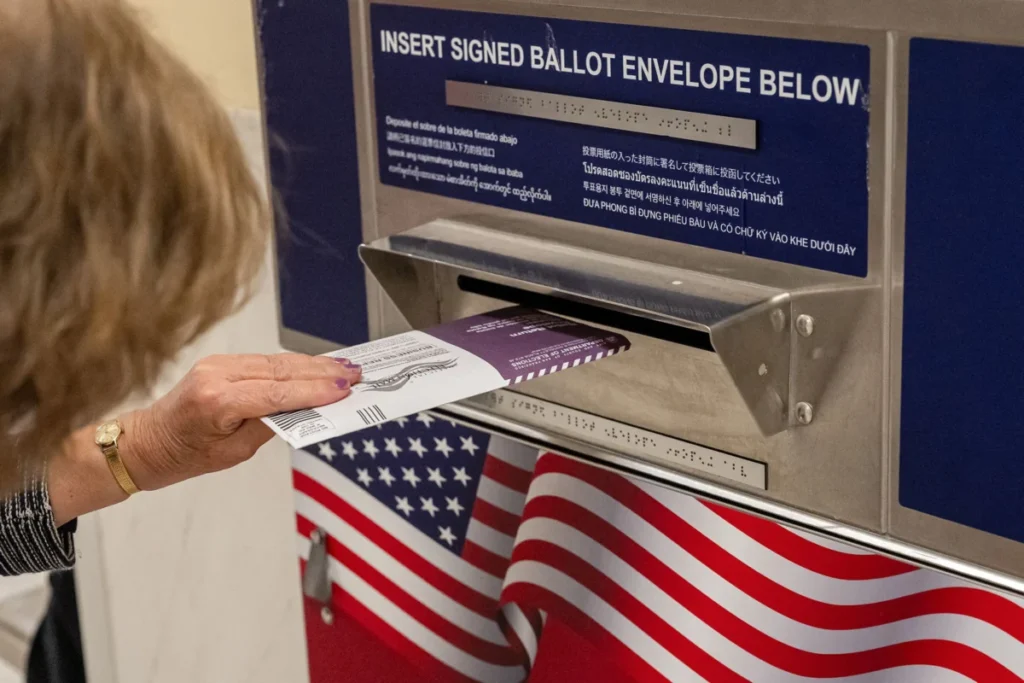
However, it was the situation in Westchester County, New York, that quickly became the focal point for claims of Democratic sabotage. Early on Tuesday morning, voting in the hotly contested House race between incumbent Republican representative Mike Lawler and his Democratic challenger, Cait Conley, hit a significant roadblock. Ballot machines across the county reportedly stopped accepting paper ballots. Voting machine malfunctions, much like inclement weather and power outages, are fairly common during elections, often stemming from simple problems with ageing components or programming. Yet, in the current political climate, such glitches are rarely seen as innocent and instead frequently become the genesis of rumors and elaborate conspiracy theories.
Within minutes of reports detailing the non-functioning ballot scanners in Westchester, prominent proponents of election conspiracy theories seized upon the county-wide glitch. They quickly spun the technical issue into an accusation that Democrats were intentionally sabotaging equipment to prevent Lawler from winning, framing it as a deliberate act of election interference.
The Westchester County Board of Elections initially responded to the growing concern with a statement issued two hours after polls opened, blaming the fault on "the thickness of the paper ballots." However, just 20 minutes later, county officials updated their statement, removing the specific reference to paper thickness and instead attributing the problem to a general "issue involving paper ballots." This shifting explanation, though likely reflecting an evolving understanding of the technical fault, inadvertently provided fodder for those seeking to sow doubt.
Westchester County Executive Ken Jenkins issued a separate, more forceful statement online, acknowledging the "unacceptable" situation. He pledged that once the ballot machine issues were resolved, he would "convene a bipartisan team to conduct a thorough review of the decisions and failures that led to this debacle, determine where accountability lies and ensure that this never happens again." Later in the day, New York State officials provided a more definitive explanation. Their additional statement clarified that the core problem was outdated programming in most machines across the county, which rendered them unable to recognize and process Election Day ballots. Importantly, officials stressed that this programming issue had only caused ballots to be rejected, not tabulated incorrectly. They reassured voters, stating, "The immediate priority is to restore scanning capability to at least one voting machine at every polling location, with additional machines being brought online as the day progresses." They emphasized that voters should have full confidence that "every valid vote will be counted."
Despite these official explanations and assurances, the narrative of fraud had already taken root and spread rapidly across social media platforms. The Republican National Committee (RNC), via its RNCVoteProtect account on X, posted that it was working with Democrats, "seeking a joint court order to require central tabulation of ballots at the County Board of Elections." While this indicated a bipartisan effort to ensure accurate counting, other Republican figures framed the situation far differently.
New York representative Claudia Tenney, who has a history of backing efforts to challenge the results of the 2020 election, quickly jumped into the fray. "No surprise," Tenney wrote, "The Democrats in NY will do anything and everything to cheat." Her sentiment was amplified by conservative broadcaster Mark Levin, who shared Tenney’s post with his massive audience of 5 million followers, further cementing the conspiratorial framing.
The chorus of accusations was joined by a wide array of MAGA-world influencers, each contributing to the narrative of a stolen election. Katie Miller, wife of former White House deputy chief of staff for policy and homeland security adviser Stephen Miller, wrote, "This is how the Left steals elections." Liz Harrington, former spokesperson for President Donald Trump, went further, advocating for extreme measures: "Ban voting machines and prosecute those who’ve used them to cheat." Laura Loomer, another prominent MAGA influencer, asserted, "Democrats are already trying to steal the election in New York today." Loomer also weighed in on the polling location problems elsewhere, declaring on her "Loomer Unleashed" account, in response to the Maricopa County power outages, "The Democrats are already cheating."
The speed and volume of these conspiratorial posts were remarkable. The Center for an Informed Public at the University of Washington, which actively tracks online rumors about elections, reported that posts on X concerning the malfunctioning machines in Westchester—"often with a conspiratorial framing"—were appearing at a rate of approximately 150 times per minute just after 10:00 am EST. This rapid dissemination highlights the challenge election officials face in combating misinformation in real-time.
Even as Lawler, the Republican candidate directly impacted by the Westchester issues, urged voters to "stay in line" and cast their ballots despite the scanner problems, other pro-Trump influencers continued to amplify fraud narratives. Phillip Buchanan, known online as "Catturd," shared Lawler’s post with the cynical comment: "Every. Single. Election. It’s always somthing [sic]." Catturd also boosted unrelated conspiracies about "Democrat shenanigans" in Florida’s Broward County, despite technical difficulties there having been quickly resolved. MJ Ultra, a prominent pro-Trump QAnon account on X, echoed these sentiments, stating, "Broward County Florida is corrupted as hell." Rogan O’Handley, known online as DC Draino, described the events in Westchester as "the Maricopa Method of stealing," linking it to past controversies in Arizona, while also fueling Broward County conspiracy theories. Kari Lake, Trump’s nominee for ambassador to Jamaica, a vocal proponent of election denial who has baselessly claimed her 2022 Arizona gubernatorial race and her 2024 Senate race were rigged, likewise shared conspiracy theories about the Westchester issues and called out alleged "liberal shenanigans" in Maricopa County.
Amidst this flurry of accusations and election-related drama from his allies, Donald Trump himself was initially preoccupied with other matters. He spent the better part of the morning on Truth Social complaining that people had taken him seriously when he announced—jokingly, he insisted—his plans to rename the Lincoln Memorial Reflecting Pool to "The Trump Reflecting Pool." He eventually turned his attention to Lawler’s race, but notably, his post did not mention the specific issues with the ballot scanners, instead focusing on general support for the candidate.
The early hours of Election Day served as a stark reminder of the fragile state of public trust in democratic institutions. Routine technical issues and logistical challenges, inherent to the complex process of a national election, are no longer seen as isolated incidents. Instead, they are immediately interpreted through a highly politicized lens, often amplified by influential figures with vast online audiences, to reinforce a narrative of systemic fraud. This environment not only makes it harder for election officials to manage and communicate about legitimate issues but also deepens partisan divisions and erodes faith in the integrity of the electoral process itself.