 11
11
BEIJING – China’s paramount policymakers are poised to reveal their economic roadmap for the upcoming year at the nation’s annual legislative gatherings, colloquially known as the "Two Sessions," which commenced on Wednesday, March 5, 2025. The consultative congress, a key advisory body, began its proceedings later on Wednesday, with the National People’s Congress (NPC), the country’s top legislative body, scheduled to open on Thursday. At the NPC, Chinese Premier Li Qiang is expected to formally announce a series of economic targets, many of which were reportedly finalized during a pivotal December meeting.
This year’s parliamentary sessions hold particular significance as they are anticipated to outline the details of China’s 15th five-year development plan, a crucial blueprint for the nation’s progress. Investors will be keenly observing these announcements for insights into Beijing’s strategies for achieving its ambitious domestic technological goals, with a stated objective of fostering technological self-sufficiency. These goals represent a significant step towards China’s broader 2035 objectives.
Senior Chinese leadership, including top diplomat Wang Yi and the heads of key economic and financial ministries, typically engage with the press during the Two Sessions, offering further commentary and clarification. The annual gathering is expected to conclude on March 11, 2025, after approximately a week of deliberations. Analysts from the Asia Society have noted a potential reduction in the number of delegates participating in this year’s Two Sessions, attributing this to the ongoing anti-corruption campaign.
Economists are forecasting several key announcements from Premier Li’s address on Thursday, with particular attention being paid to the following projections:
GDP Growth Target of Around 4.5% to 5%

Several Chinese local governments have already signaled a recalibration of their growth ambitions for 2026, suggesting that Beijing may adopt a more modest national growth target. According to The Asia Society, a growth target below 5% would represent the lowest on record, a decrease from the "around 5%" target maintained over the past three years. It is worth noting that China did not set a GDP growth target in 2020, a decision prompted by the economic disruption caused by the global pandemic.
Economists at the Economist Intelligence Unit suggested in a recent note that a slightly lower growth target would provide policymakers with greater flexibility to prioritize structural reforms and enhance the quality of economic data. They have penciled in a growth prediction of 4.6% for the year. Conversely, analysts at Morgan Stanley view a reduction in the growth target as having a "low probability." They point out that policymakers have historically opted for GDP growth ranges rather than single-figure targets during periods of significant economic stress. Furthermore, 2026 marks the commencement of China’s "15th five-year plan," a period that necessitates a higher growth trajectory to bolster economic confidence.
Inflation Target of Around 2%
Budget Deficit Target of 4%
This projected budget deficit target would align with the figure set for the previous year, which marked a notable expansion of government spending relative to GDP. Data accessed via Wind Information indicates that the 4% deficit established in 2025 was the highest on record dating back to 2010, surpassing the previous high of 3.6% recorded in 2020.
Deeper Challenges Loom

Beyond the headline figures, China’s policy announcements will be meticulously scrutinized for concrete details on measures to stimulate domestic consumption. This includes potential expansions of trade-in subsidies and any incremental support mechanisms for the beleaguered property market. The Two Sessions are also expected to provide insight into Beijing’s strategic considerations regarding the ongoing impact of U.S. trade tensions and the evolving conflict in the Middle East.
The world’s second-largest economy is grappling with a complex array of domestic challenges. Logan Wright, a partner at the U.S.-based research firm Rhodium Group, articulated in a report released on Tuesday that "There is a widening gap between Beijing’s targets (and data measuring economic performance) and the actual capacity of China’s policymakers to support domestic demand with the tools at their disposal."
Wright further elaborated that China’s financial system has been channeling substantial lending towards unproductive local government entities and state-owned enterprises in an effort to avert their collapse. He noted that fiscal spending is largely being executed by these same institutions. "The net result is a declining payoff in terms of investment and economic activity for the same volume of lending or fiscal spending, while private sector investment remains weak," he concluded.
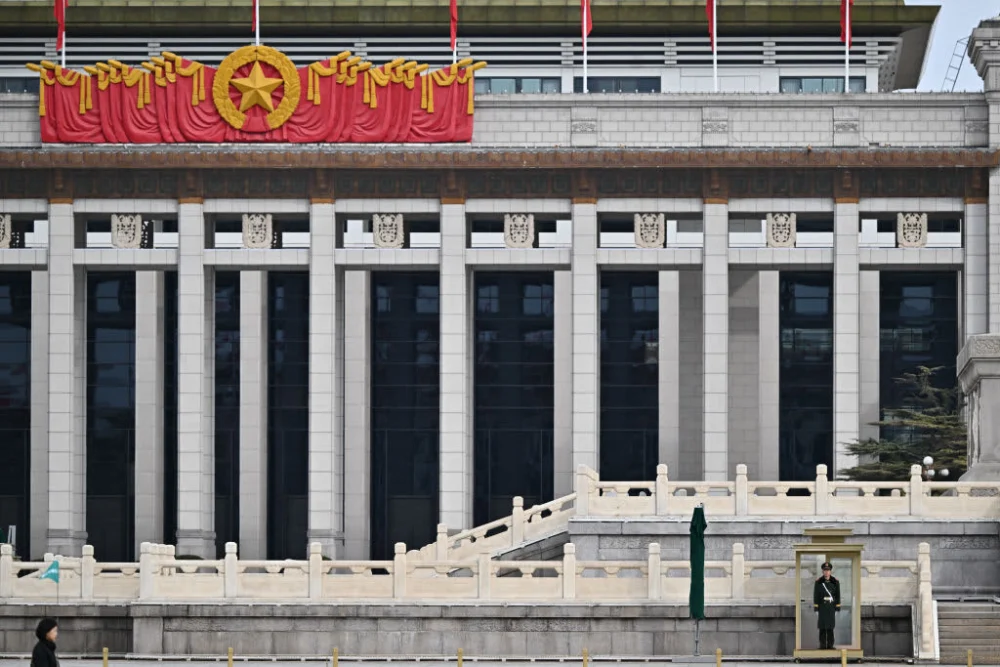
A PLA soldier was observed standing guard in front of the National Museum of China in Beijing on March 3, 2025, in anticipation of the nation’s annual legislative meetings. The image, captured by Pedro Pardo for Afp and Getty Images, underscores the security and ceremonial importance of these pivotal political events.