11
11
China’s economy has begun 2026 with a robust performance, as both consumption and production indicators surpassed expectations, driven by holiday spending and resilient foreign demand. The National Statistics Bureau reported on Monday that retail sales for the first two months of the year increased by 2.8% compared to the same period in 2025. This figure exceeded economists’ forecasts of 2.5% growth, though it represents a deceleration from the 4% rise observed in January-February 2025.
The Lunar New Year holiday, which fell in mid-February, provided a significant impetus to consumption. Yuhan Zhang, principal economist at The Conference Board’s China center, highlighted growth in categories such as tobacco and alcohol, as well as gold and jewelry sales, as key contributors to this surge. The extended holiday period saw a consistent uptick in spending across various sectors nationwide, including hotel bookings and duty-free shopping. This broad-based consumption increase has tempered expectations for immediate, large-scale stimulus measures from policymakers.
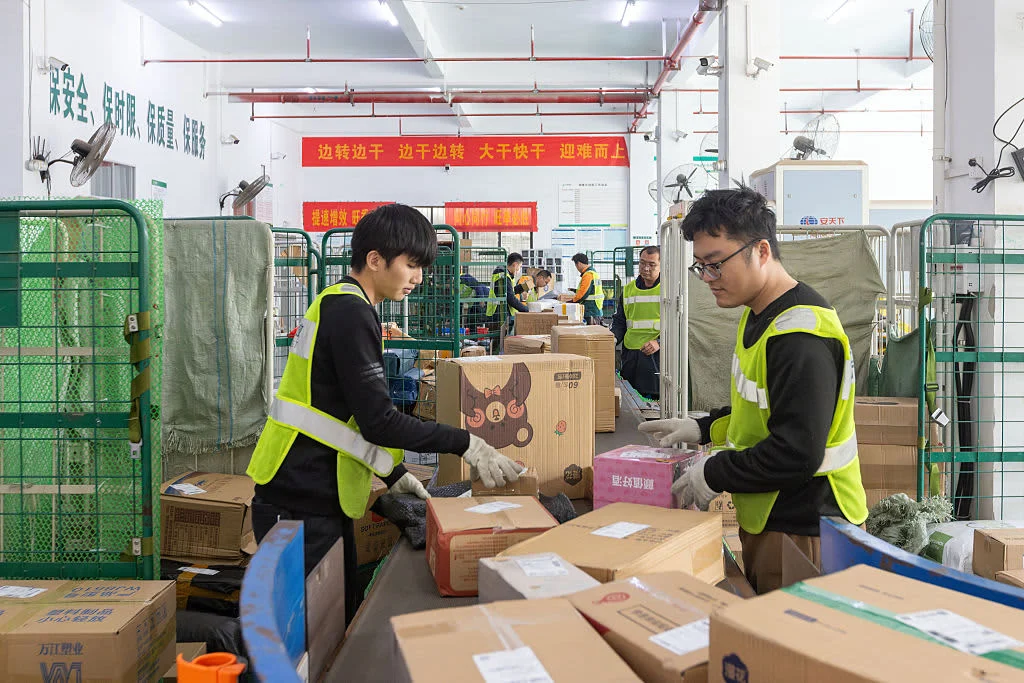
Industrial output also demonstrated strong momentum, climbing 6.3%, which was notably higher than the 5% jump anticipated by a Reuters poll. Industrial production has been a relative bright spot for the world’s second-largest economy, largely benefiting from sustained external demand, particularly from European and Southeast Asian markets. China’s export performance continued its upward trend into 2026, with outbound shipments rising by nearly 22% in the first two months of the year. This growth occurred despite increasing criticism from trade partners concerning China’s production capacity.
Investment in fixed assets, which encompasses property and infrastructure, grew by 1.8% year-on-year, contrasting with an estimated drop of 2.1%. However, investment within real estate development continued its downward trajectory, reflecting the ongoing property sector crisis. This segment saw a decline of 11.1% in January and February, a moderation from the 17.2% contraction recorded in 2025. Further underscoring the property market’s challenges, separate data revealed a worsening decline in home prices across 70 major Chinese cities in February. New-home prices fell by 3.2% year-on-year, marking the steepest decline in eight months, according to Reuters.
Excluding property development, investment expanded by 5.2% year-on-year, supported by increased inflows into infrastructure and manufacturing projects. This growth offers a positive counterpoint to the significant slump in fixed asset investment experienced in 2025, which contracted by 3.8% year-on-year. That downturn was attributed to the deepening property crisis and stricter borrowing constraints on local governments, impacting a traditional driver of China’s economic growth.

Despite the generally positive economic data, government officials have acknowledged growing headwinds, citing geopolitical tensions and structural issues within the economic model that have affected corporate profitability. The Statistics Bureau noted that the evolving external environment is significantly impacting China, with geopolitical risks continuing to escalate. Fu Linghui, a spokesperson for the bureau, stated on Monday that China’s energy supply capacity remains sufficient to manage heightened volatility in global oil prices and that Beijing will closely monitor its impact on inflation.
Data suggests that Beijing may be relatively insulated from potential disruptions to energy supply routes, such as the Strait of Hormuz, due to its strategic efforts over the past two decades to diversify energy sources and build substantial strategic reserves. As of January, China held an estimated 1.2 billion barrels of onshore crude oil stockpiles, sufficient to cover three to four months of demand. Analysts estimate that oil imports flowing through the Strait of Hormuz now account for less than half of China’s total oil shipments. Nomura, for instance, calculated that oil flows through Hormuz represent only about 6.6% of China’s total energy consumption.
Nevertheless, the escalating crisis in the Middle East could still trigger a demand shock for China’s export-reliant economy. Higher energy costs could translate into inflationary pressures, disrupt global supply chains, and dampen consumer and business spending among its key trading partners in Europe and Asia. Zhiwei Zhang, president and chief economist at Pinpoint Asset Management, anticipates that the turmoil in the Middle East will impact the global economy in the coming months and expects Chinese policymakers to monitor developments closely and respond with fiscal policy if necessary.
Goldman Sachs recently revised its China real GDP growth forecast downwards by 0.1 percentage point due to anticipated higher energy costs. This adjustment is less significant than the 0.3 to 0.5 percentage point reductions forecast for other regional economies. The investment bank also raised its annual consumer inflation outlook for China to 0.9% from an earlier forecast of 0.6%, and expects factory-gate prices to rebound by 0.8% this year as higher oil prices filter through the supply chain.
The Chinese leadership recently announced its annual economic goals for 2026, setting a GDP growth target of 4.5% to 5%, which is the least ambitious target set since the early 1990s. The urban unemployment rate stood at 5.3% in the first two months of 2026, a slight increase from the average rate of 5.2% observed in 2025.