11
11
BEIJING – China has announced a planned increase in its defense spending of 7% for the current year, marking the slowest rise in its annual military expenditure since 2021. This proposed budget, unveiled by the Ministry of Finance on Thursday, comes against a backdrop of escalating conflict in the Middle East and persistent tensions surrounding Taiwan, reflecting broader global geopolitical fault lines.
For the past three years, China had consistently budgeted a 7.2% annual increase in its defense spending. Prior to that, in 2022, the nation saw a 7.1% rise, and in 2021, an increase of 6.8%, according to official data.
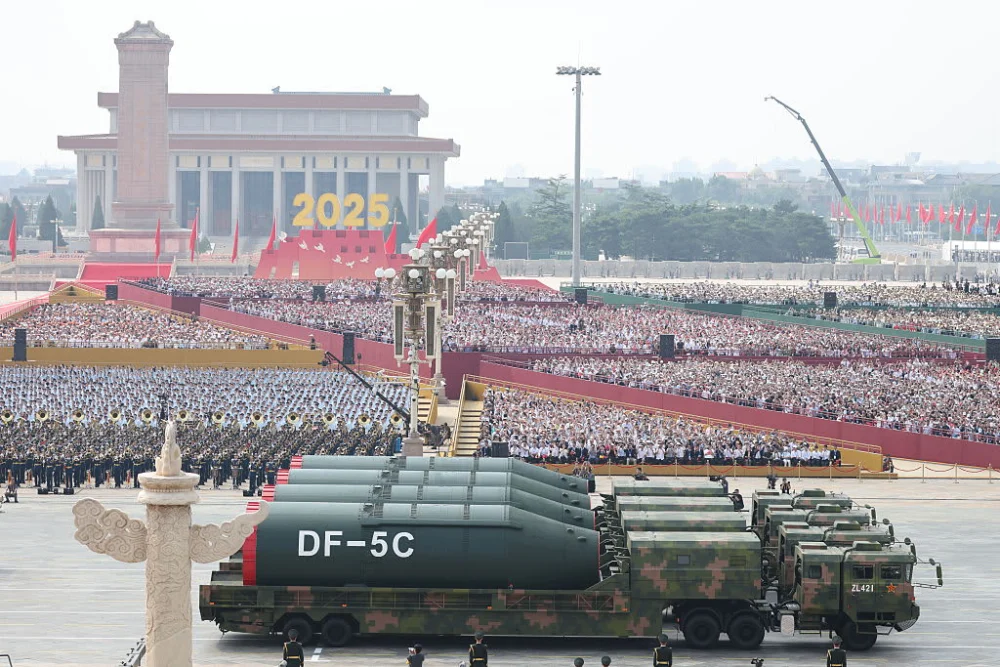
A government work report released concurrently with the budget proposal highlighted Beijing’s commitment to accelerating the development of advanced combat capabilities and pursuing the "high-quality" modernization of its national defense and armed forces. The report also drew attention to China’s first domestically built aircraft carrier, the Fujian, which was commissioned in November 2025. Demonstrations of some of China’s most advanced weapon systems, including long-range missiles, were showcased during a significant military parade held in September, an event attended by leaders such as Vladimir Putin and Kim Jong Un, underscoring the nation’s growing military prowess.
In its foreign policy assertions, Beijing reiterated its stance, stating it would "resolutely fight against separatist forces aimed at ‘Taiwan independence,’ and oppose external interference." This declaration underscores the ongoing strategic importance China places on the Taiwan Strait and its territorial claims.
The announcement coincides with the commencement of China’s eight-day National People’s Congress, an annual parliamentary gathering that formally ratifies the national budget and outlines the country’s development objectives for the year.
Last year, China’s proposed national defense budget stood at 1.78 trillion yuan, equivalent to approximately $244.99 billion at the time. However, defense analysts have consistently suggested that official figures may understate the true extent of China’s military expenditures, often excluding significant "off-budget" allocations.
Further insights into China’s defense spending are provided by the U.S. Department of Defense’s 2025 report to Congress on military and security developments involving the People’s Republic of China. This report estimates that Beijing spent between $304 billion and $377 billion on defense in 2024, representing a figure 32% to 63% higher than its officially announced budget of $231 billion for that year.
Globally, China’s military spending has a significant regional impact. According to the International Institute for Strategic Studies, Beijing accounted for nearly 44% of Asia’s total defense spending in 2025, a notable increase from 39% in 2017. This positions China as the second-largest military spender globally, trailing only the United States.
In comparison, the U.S. allocated $849.77 billion for defense during its 2025 fiscal year, as per its budget request. Estimates from the non-profit organization USAFacts indicate that the U.S. ultimately spent approximately $919.2 billion during this period, representing a 2% increase from the preceding year and constituting 13% of the total federal budget.
The display of advanced military hardware, such as the liquid-fueled intercontinental strategic nuclear missile DongFeng-5C, capable of global strikes, during the September military parade through Tian’anmen Square in Beijing, served as a potent visual representation of China’s evolving military capabilities. The strategic implications of these advancements, coupled with the planned increase in defense spending, are being closely monitored by the international community, particularly in the context of ongoing geopolitical uncertainties and regional security concerns. The emphasis on "high-quality" modernization suggests a strategic shift towards developing more sophisticated and technologically advanced military assets, rather than solely focusing on quantitative expansion. This approach is consistent with China’s broader ambition to achieve military parity with, and in certain domains, surpass leading global powers. The sustained investment in defense, even at a slightly moderated growth rate, signals China’s unwavering commitment to strengthening its military power and safeguarding its perceived national interests in an increasingly complex global landscape.