 11


ChatGPT, the widely adopted AI chatbot, derives its responses from a multifaceted information ecosystem comprising four primary sources: its extensive training data, live web searches, licensed publisher content, and the immediate context provided by the user. The specific source utilized by ChatGPT for any given query is dictated by the nature of the question asked.
1. Training Data: The Foundation of General Knowledge
The bedrock of ChatGPT’s understanding lies in its vast training data. This comprehensive dataset, assembled over time through a rigorous multi-stage process, imbues the model with its fundamental knowledge of language, facts about the world, coding capabilities, and general comprehension. The training methodology involves data preparation, pre-training on a colossal mix of information, and subsequent post-training phases where human trainers and researchers refine the model’s instruction-following, reasoning, and safety protocols. Increasingly, synthetic data, generated by the AI itself, is also incorporated into this process.
OpenAI states that its models are developed using public web content, partner data, human trainers, and synthetic data. While OpenAI previously provided a detailed breakdown for GPT-3 in 2020, revealing a mix including Common Crawl, WebText2, Books1, Books2, and Wikipedia, their latest system card for newer models simply mentions "diverse datasets," leaving the precise composition of current training data outside OpenAI’s internal knowledge.
For website owners, this means that publicly accessible content, if not blocked by OpenAI’s training crawler (GPTBot), has a high probability of being integrated into future model iterations. This integration is a long-term, indirect process, with content appearing in subsequent model releases, not in real-time. OpenAI actively filters its training data, intentionally excluding information from paywalled sources and the dark web, and removing hate speech, adult content, sites aggregating personal information, and spam.
Site owners concerned about their content being used for AI training have the option to block GPTBot. However, this opt-out may limit the AI’s knowledge of their brand in future models. OpenAI offers two methods for opting out: through the robots.txt file or by configuring API access. The "knowledge cutoff" signifies the point in time when a model’s training data ceases to be updated. For current ChatGPT models, this cutoff is spring 2026, with variations depending on the user’s plan. Information beyond this date is only accessible through live web searches.
2. Live Web Search: Accessing Real-Time Information
Given the static nature of training data, ChatGPT employs live web search to address queries requiring current information. This capability is activated automatically when a question is deemed to benefit from up-to-date data, such as for prices, news, or product recommendations, or can be manually triggered by the user. Web search has become a significant component of ChatGPT’s utility, with user messages seeking information comprising approximately 20.2% of consumer interactions in September 2026.
ChatGPT’s search process is sophisticated. Instead of directly inputting user prompts, the AI rewrites them into one or more targeted searches, a technique known as "query fan-out." These refined searches are then dispatched to search providers to gather relevant results. Studies indicate that ChatGPT generates an average of 1.6 fan-out queries per response that involves searching. Common search patterns include broad queries, the inclusion of years in queries, and specific product-related searches. Academic research suggests that these generated searches often differ from the user’s original wording, and that even combined results from Google and OpenAI’s search API may not fully align with the pages ChatGPT ultimately cites.
Personalized context can also influence search results. ChatGPT can integrate information from user memories, such as dietary preferences or location, into its searches. For instance, a request for restaurants might be refined with previously provided location data. The AI’s selection of sources is also dynamic; due to its non-deterministic nature, the same prompt can yield different results and cited pages over time.
OpenAI states that ChatGPT ranks search results using multiple undisclosed factors. Analysis of prompts reveals that the type of query significantly impacts source selection, with news sites and review sites frequently appearing. While the specific search engines used are not explicitly detailed, OpenAI acknowledges utilizing Bing and other providers, alongside its own index and partner content. However, evidence suggests that ChatGPT’s citations do not directly mirror Google or Bing rankings, indicating that the AI makes its own determinations about which pages to cite from the search results it receives. For shopping-related queries, ChatGPT can display product cards featuring images, prices, and purchase links, sourced from structured metadata and third-party content, distinct from advertising.
3. Licensed Publisher Content: Curated Insights
Since 2023, OpenAI has established content agreements with over 20 publishers, including major entities like the Associated Press, Axel Springer, Condé Nast, and News Corp. These partnerships enable ChatGPT to display summaries of articles from these publishers, complete with attribution and links back to the original content. Licensed Getty Images photos also appear in ChatGPT’s search results under a display agreement.
These licensed content integrations have led to a significant increase in citations from partner domains. Notably, review and lifestyle sites, such as Vogue and TechRadar, often achieve greater visibility within ChatGPT than traditional news outlets. While a partnership makes a publisher eligible for inclusion, it does not guarantee consistent citation. Furthermore, there is some indication that partner content may be integrated into ChatGPT through a separate retrieval source, distinct from general web searches. Data analysis shows that partner sites are cited more frequently than direct site-specific searches by ChatGPT would suggest.
4. User Context: The Immediate Input
The immediate context provided by the user is a crucial source of information for ChatGPT. This encompasses the user’s prompt, any uploaded files, saved memories, chat history, and connected applications. This contextual information is leveraged whenever available, personalizing the AI’s responses. For example, a user’s account type can influence the results; a business account might prompt ChatGPT to mention affiliated services.
When a user pastes a link into ChatGPT, the AI visits that page on their behalf using a specific agent, ChatGPT-User, distinct from its general search and training crawlers. This direct interaction allows the AI to process and reference the provided content immediately.
Implications for Brands Seeking Visibility in ChatGPT
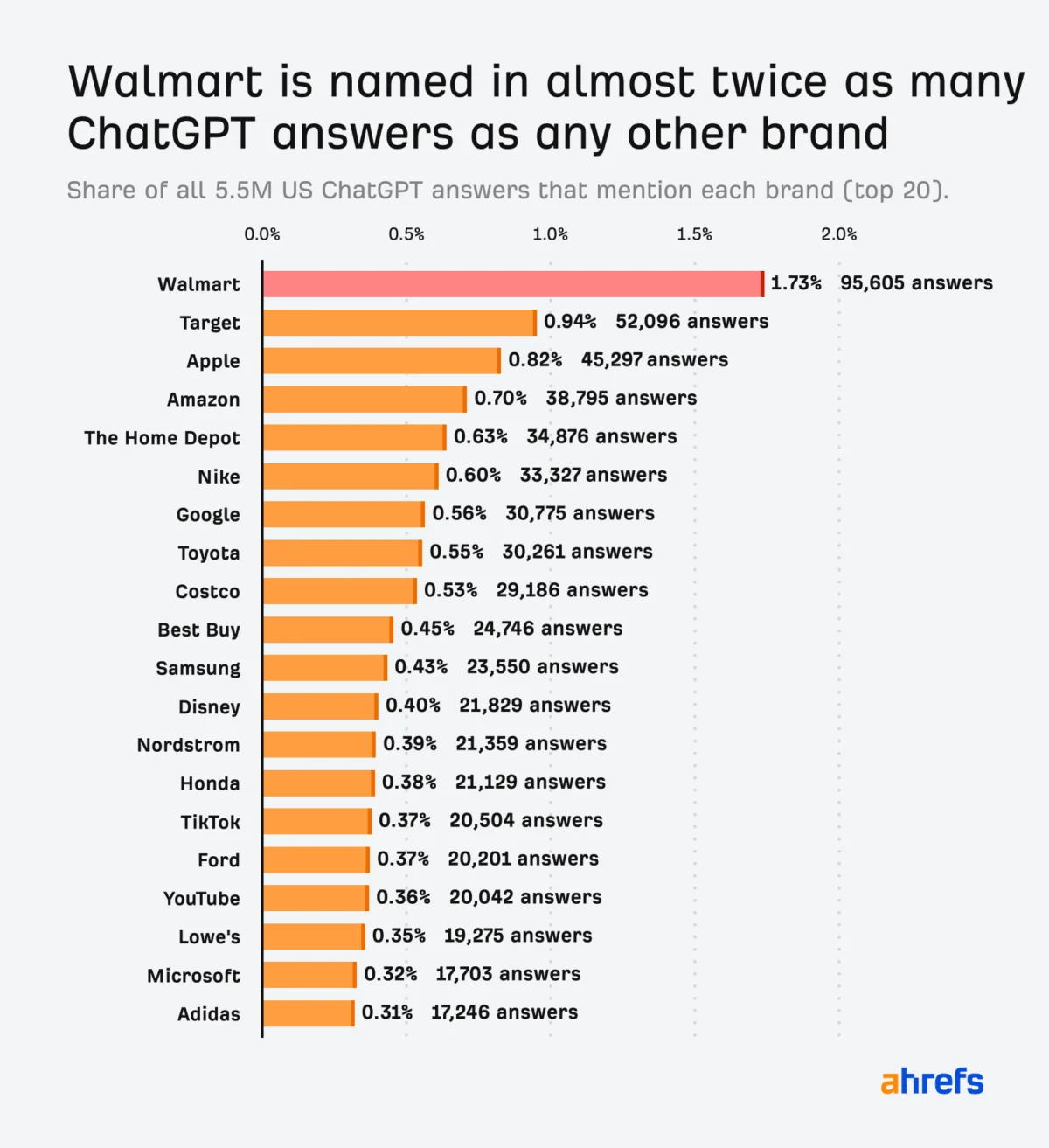
The multi-sourced nature of ChatGPT’s information gathering means that any mention of a brand is inherently indirect, stemming from training data, web searches, or partner publications. A brand’s website serves as one potential information source, but its inclusion depends on its presence in training data or its selection during a web search.
To enhance brand visibility within ChatGPT, strategic actions include:
Tools like Ahrefs’ Brand Radar can help brands track their mentions and citations across various AI search engines, providing insights into their AI share of voice relative to competitors.