 11

A groundbreaking biological computing startup, The Biological Computing Company (TBC), which harnesses neural patterns derived from rat brain cells to develop advanced artificial intelligence, has secured a significant endorsement and partnership with Amazon. This collaboration marks a pivotal moment for the nascent field of biologically-inspired AI, pushing its capabilities closer to mainstream enterprise adoption.
Beginning Tuesday, a select group of Amazon Web Services (AWS) customers will gain exclusive access to TBC’s innovative "rat brain" AI model through a limited preview program. The startup’s cutting-edge technology is meticulously engineered to substantially enhance the performance and efficiency of AI models specifically designed for generating videos. Both Amazon, through its cloud computing arm AWS, and The Biological Computing Company (TBC) have indicated their intention to roll out this technology to all AWS enterprise customers in the near future, signaling a strong belief in its potential.
At the core of TBC’s methodology is a unique approach to information processing. Alexander Ksendzovsky, cofounder and CEO of TBC, elaborated on this intricate process: "We figured out a way to code information, like images for example, to the biological material. We then observe how the biology processes that information, and then we build a tool that mimics that process." This statement encapsulates the company’s ambition to translate the inherent processing power of biological neural networks into computational advantages for artificial intelligence.
This venture into biologically-derived computing platforms is not an isolated incident for Amazon. Deap Ubhi, global director of technology for startups at Amazon Web Services, confirmed that the cloud-computing behemoth has previously integrated similar innovations into its marketplace. Ubhi highlighted Amazon’s existing collaboration with Cortical Labs, an Australia-based enterprise that fuses lab-grown neurons with conventional silicon chips to facilitate data processing for various companies. Cortical Labs aptly terms its offerings "WAAS," or "wetware as a service," and also provides a multi-thousand dollar "biological computer"—a low-power device primarily designed for laboratory use, capable of sustaining live neurons for up to six months.

Ubhi characterized TBC’s strategy as a "pragmatic approach," a key factor that made the company particularly appealing to Amazon. Unlike some ventures that aim for radical overhauls or attempt to reinvent fundamental AI architectural units, such as the transformer models prevalent in large language models, TBC operates within established frameworks. "They’re working within existing standards of the generative AI space and saying, ‘How can we make the current visual models more efficient?’" Ubhi explained, underscoring TBC’s focused objective of improving efficiency rather than disrupting foundational AI paradigms.
As the artificial intelligence industry experiences an accelerated race to develop more efficient models capable of handling complex tasks with less computational overhead, the once-niche field of biological computing has begun to gain significant traction. For decades, researchers have envisioned a future where computer software could emulate the sophisticated, adaptive, and highly efficient neural networks found within human brains, moving beyond reliance solely on traditional math-based algorithms. This aspiration drives companies like TBC to bridge the gap between biological intelligence and artificial computation.
However, venturing into biological computing presents a unique set of formidable challenges. This specialized field necessitates the establishment and operation of fully equipped biology laboratories, a stark contrast to conventional computer labs. In these facilities, delicate biological materials—whether brain cells, stem cells, or synthetic biomaterials—must be meticulously kept alive or preserved, carefully monitored for viability and activity, and then painstakingly translated into meaningful, actionable digital information. While several startups have made commendable progress in this highly interdisciplinary domain, the intricate task of seamlessly bridging the divide between living biological systems and digital code remains a complex scientific and engineering endeavor.
The Biological Computing Company was founded four years ago in Baltimore, Maryland, by two accomplished neuroscientists and neurosurgeons: Alexander Ksendzovsky, who now serves as the company’s Chief Executive Officer, and Jon Pomeraniec, who holds the positions of President and Chief Operating Officer. Their combined expertise in neuroscience and surgery provides a unique foundation for their biologically-inspired computing innovations. Earlier this year, in a significant financial milestone, TBC successfully raised $25 million in a funding round spearheaded by Primary Venture Partners, marking its initial substantial capital injection.
Following closely on the heels of that initial round, which closed in March, the company secured an additional $25 million in capital. This previously unreported funding brings TBC’s total investment to more than $50 million, underscoring strong investor confidence in its technology and market potential. This substantial capital influx is expected to fuel further research, development, and expansion efforts.

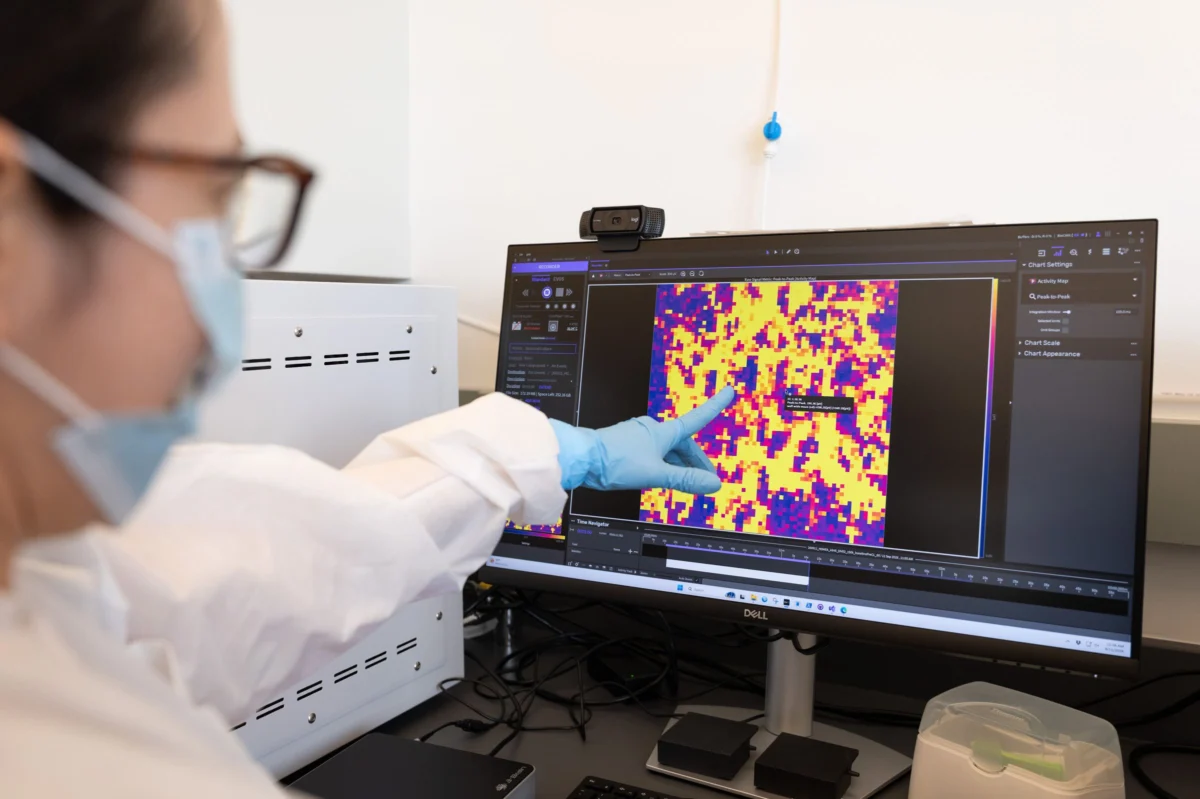
Last year, in a strategic move to broaden its operational footprint and enhance its research capabilities, TBC established new offices and a dedicated, compact research and development laboratory in San Francisco. Within this facility, a team of 35 employees works directly with both rat brain cells and human stem cells. These living cells are carefully cultured and placed onto multi-electrode silicon arrays, specialized devices manufactured by the Swiss biotech company 3Brain. Researchers at TBC utilize these advanced arrays to deliver precisely controlled electrical stimulation patterns to the neurons, simultaneously recording their complex electrical responses. This neural activity is then rigorously analyzed to identify underlying computational patterns, which are subsequently translated into software. This software is then leveraged to refine and improve existing artificial intelligence models, with a particular emphasis on video generation applications.
The strategic decision to initially concentrate on video generation was rooted in both scientific rationale and practical considerations, according to Ksendzovsky. One key factor was the physical configuration of the multi-electrode silicon arrays employed by The Biological Computing Company. The specific placement of each electrode on the array profoundly influences its interaction with the neurons. The team recognized that visual information provided a natural starting point, as images could be mapped onto the grid more intuitively and effectively than abstract text or language.
From this scientific insight, a compelling business use case quickly materialized. The startup theorized that by accurately modeling how neurons intrinsically process images, these profound biological insights could be directly applied to enhance the capabilities and efficiency of AI models designed for generating video content. This targeted application allows TBC to demonstrate tangible improvements in a high-demand area of generative AI.
Jon Pomeraniec revealed that Jeff Dean, a highly prominent and influential AI researcher and an investor in TBC, was instrumental in advising the company to initially focus on fine-tuning video generation models before attempting to apply its neural technology more broadly. Dean’s strategic guidance highlighted the advantage of tackling a well-defined problem with established industry benchmarks.
Pomeraniec further explained Dean’s reasoning: by demonstrating improved performance on problems that have already been largely solved within the AI community, TBC could concretely prove whether its technology represented a meaningful scientific advancement. "Jeff said if we could do that, there’s the promise of doing more complex, interesting things with our AI models down the line," Pomeraniec recounted, indicating that early success in a measurable domain paves the way for future, more ambitious applications of their unique AI.

Prior to its integration with AWS, TBC’s proprietary technology was exclusively accessible through Bluesky Compute, a neocloud provider. The startup makes compelling claims regarding the performance of its AI model: when benchmarked against the open-source AI model it builds upon, TBC asserts that its solution is up to five times faster at video generation. Furthermore, it significantly reduces the cost associated with inference—the "thinking" or processing phase of an AI model, as distinct from its training phase. While the company has not disclosed the specific open-source AI model used for this comparison, it maintains that it is one of the leading "frontier" video generation models currently available.
Now, with Amazon’s formidable distribution network behind TBC’s software, the ambitious startup is poised to potentially reach a substantially larger customer base, accelerating its market penetration and impact. Despite the palpable excitement surrounding The Biological Computing Company, Amazon’s Ubhi also raised pertinent questions regarding the long-term scalability and robustness of its technology.
"I think with any model like this, the one thing you have to ask is, if you push it to the extremes, will you still see improvements? If you have customers who want to generate longer-form videos, ten minutes, an hour, what’s the potential loss in fidelity over the course of time?" Ubhi probed. This critical inquiry underscores a fundamental challenge for advanced generative AI models: the ability to maintain contextual consistency, track prior events, and preserve overall coherence as the duration of a generated video extends. As TBC transitions into this crucial next phase of wider deployment and increased customer demands, the company will face the ultimate test of whether its innovative biological computing technology can consistently perform and hold up under the most demanding conditions and varied applications from its new enterprise customers.