 11


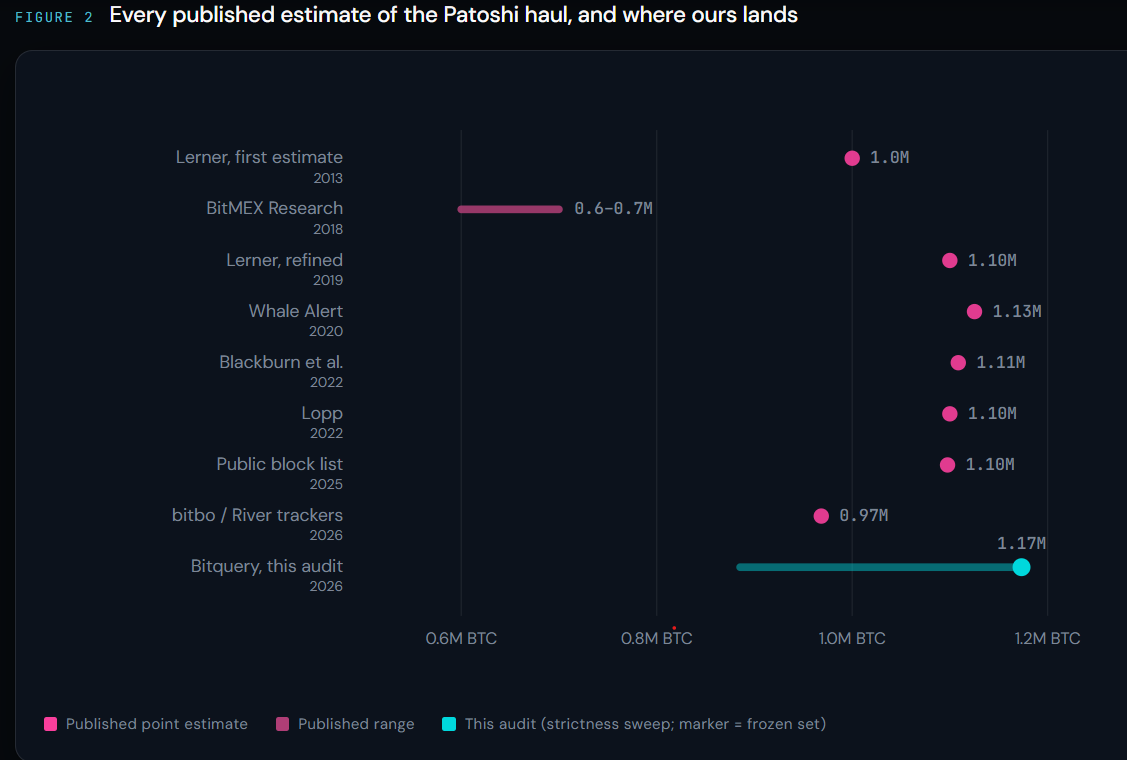
One of the foundational tenets of Bitcoin lore is the existence of its pseudonymous creator, Satoshi Nakamoto, a figure widely believed to have amassed a fortune exceeding billions of dollars. This vast wealth is attributed to approximately 1.1 million Bitcoin, a figure derived from forensic analysis of an early mining operation rather than direct identification of an individual. However, the precise quantity is subject to interpretation, with estimates fluctuating by over 200,000 BTC depending on the stringency of specific "fingerprint" tests. The recent movement of 600 BTC, mined in 2010 and dormant for 16 years, reignited speculation about "Satoshi’s coins" awakening, amplifying the importance of distinguishing between early mining activity and the creator himself.
These 600 BTC originated from 12 block rewards mined over a four-day period in March 2010. They remained untouched until September 5th of the current year, when an individual controlling the private keys spent them sequentially within a half-hour span, representing a transaction valued at $46 million. Crucially, this expenditure does not definitively confirm the spender as Satoshi Nakamoto.
Blockchain Traces Coins, Not Individuals
Onchain analytics platform Whale Alert, tasked with tracing the movement of these coins, found no direct link between the 600 BTC and the estimated holdings of the mysterious Bitcoin creator. Further investigation by blockchain research firm Bitquery revealed that 10 of the 12 blocks from which these coins originated did not exhibit the distinct mining pattern historically associated with Satoshi’s early mining operation, often referred to as "Patoshi." The remaining two blocks showed only weak correlations to this pattern, with Bitquery researcher Gaurav Agrawal suggesting these could potentially arise by chance.

While the 600 BTC were mined by a single machine, and the current holder possesses the private keys, Agrawal pointed out the inherent limitation of blockchain analysis: "What the chain cannot say is whether the hand in 2026 belongs to the person who ran the machine in 2010." This uncertainty stems from the fact that private keys can be inherited, sold, stolen, or even recovered from discarded hardware. The blockchain’s record is limited to the fact that someone had control of the keys, not their original identity. Moreover, the transactions utilized modern wallet software, incompatible with the 2010 Bitcoin client, indicating that the keys were transferred to a more contemporary environment.
The Patoshi Pattern: A Clue to the Fortune
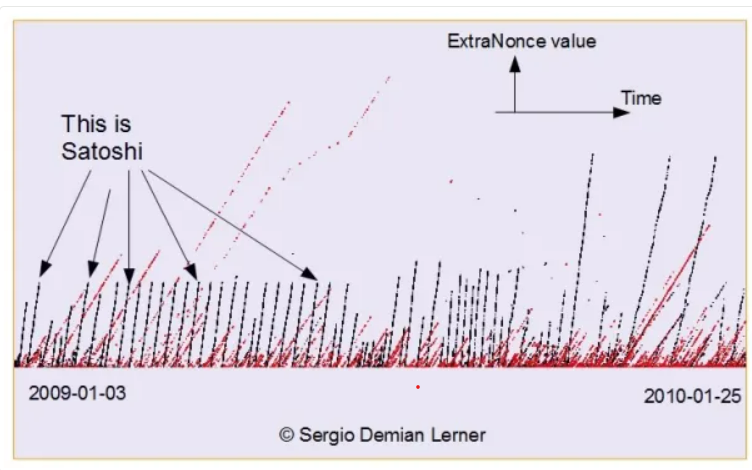
The attribution of approximately 1.1 million BTC to Satoshi Nakamoto relies heavily on circumstantial evidence, primarily the identification of the "Patoshi pattern." In 2013, researcher Sergio Demian Lerner observed a unique fingerprint within Bitcoin’s earliest blocks, suggesting the activity of a single miner employing a distinct methodology compared to others on the network. This pattern was traceable across thousands of blocks. Lerner’s analysis led him to estimate that this miner had accumulated around 1.1 million BTC, an assessment he still upholds.
Lerner acknowledges that his findings are circumstantial, lacking definitive mathematical proof or direct eyewitness accounts. However, he posits that the case for connecting the "Patoshi" miner to Satoshi extends beyond the mining fingerprint. He notes that several prominent early Bitcoin users, including Hal Finney, Dustin D. Trammell, Nicholas Bohm, and Mike Hearn, received transfers originating from coinbases exhibiting the Patoshi pattern. "All those transfers were made from coinbases in the Patoshi pattern: that provides compelling reasons that Patoshi and Satoshi are the same person, although not proof," Lerner stated.
Furthermore, Lerner suggests that the miner was likely using specialized mining software, distinct from the standard client released shortly before Bitcoin’s launch. He deems it "highly improbable" that another miner could have developed a functional, specialized setup within the narrow timeframe between the Bitcoin v0.1 announcement and the mining of the first block, concluding, "Whoever was mining the Patoshi pattern started right at the earliest beginning."
Bitquery Reconstructs the Genesis Fortune
Over a decade after Lerner’s initial identification, Bitquery undertook a comprehensive reconstruction of the Patoshi pattern using raw blockchain data. Their analysis, spanning 54,316 early Bitcoin blocks and tracking coin movements through September 1, 2026, resulted in a "highest grade" reconstruction that agreed with the public Patoshi list on 99.2% of blocks. The firm also found no discrepancies in timestamp ordering across 5,836 adjacent block pairs, with Agrawal remarking, "I don’t know of a stronger test for this."
However, Bitquery’s analysis introduced nuance to the widely cited 1.1 million BTC figure. The calculated size of the Patoshi stash varied depending on the strictness of the pattern application. Under a stringent application, the fingerprint encompassed just under 0.9 million BTC, while a more liberal interpretation reached approximately 1.17 million BTC. Agrawal clarified that while their findings did not significantly alter the established range, they underscored how the estimated total depends on the methodology employed.
Linking Satoshi to the 1.1 Million BTC
Agrawal breaks down the claim of "Satoshi owns 1.1 million BTC" into three interconnected assertions. The first, that the coins originated from a single mining machine, is strongly supported by evidence. The second, that this machine belonged to Satoshi, is based on circumstantial evidence and the Patoshi pattern. The third, that the private keys remain under his control, cannot be definitively proven simply by the fact that the coins have not moved.
Bitquery also uncovered a previously undocumented 2010 transaction involving 600 BTC, which moved in two transactions approximately an hour apart on May 17, 2010. The first transaction, at 22:04 UTC, utilized 10 block rewards totaling 500 BTC, while the second, at 23:07 UTC, spent two block rewards amounting to 100 BTC. These coins were mined at various points throughout 2009, including rewards from the early and late stages of Bitcoin’s inaugural year.
Agrawal highlighted the significance of this transaction: "It matters, I think, because it is the clearest moment where the chain itself, and not a statistical pattern, says these blocks belong together." He described this as "as close as the chain gets" to confirming that block rewards mined across the entirety of 2009 were held in a single wallet, a scenario consistent with the broader claims of the Patoshi pattern. This transaction demonstrates that the controller of those keys had access to block rewards mined throughout 2009, but it does not reveal their identity.
In contrast to the May 2010 transaction, the 600 BTC that moved in September are not attributed to the Patoshi miner, and no new evidence links them to Satoshi’s purported holdings. As Agrawal concluded, "nothing in the math settles it, so we will never be sure."