 11
11 1
1 2
2 3
3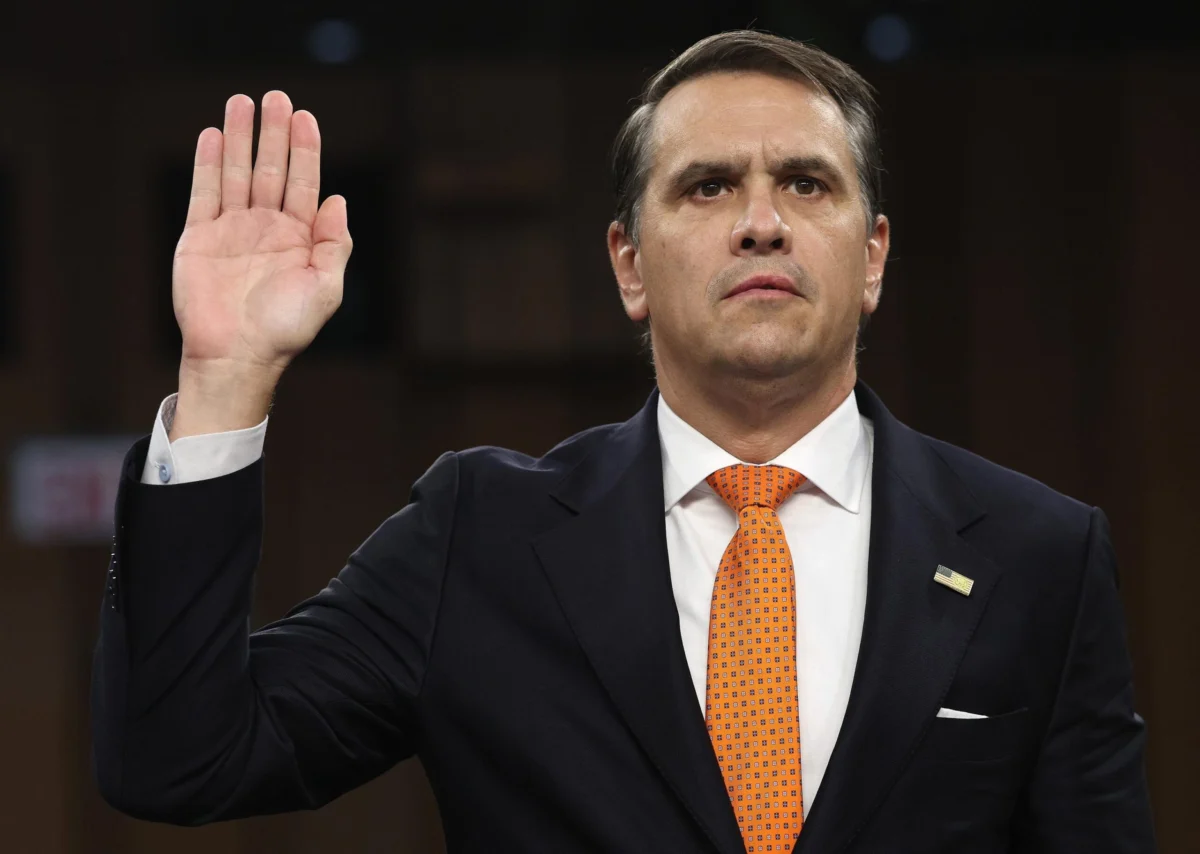
Todd Blanche was formally sworn in Monday as Attorney General, a pivotal moment following a contentious confirmation process that saw him approved by a narrow 50-49 Senate vote. His appointment has immediately thrust him into a series of high-profile legal cases and potential actions that will rigorously test the Attorney General’s capacity to operate independently of President Donald Trump. Throughout his confirmation, numerous senators, particularly Democrats, voiced profound concerns that Blanche, who previously served as Trump’s personal defense attorney, might continue to prioritize loyalty to the president over the impartial application of the law.
The White House press secretary, Karoline Leavitt, officially announced Blanche’s formal swearing-in on X, confirming his permanent assumption of the role after serving as acting attorney general. This marked the culmination of a challenging confirmation journey that underscored deep divisions within Congress regarding the Department of Justice’s (DOJ) independence.
Blanche’s journey to the top legal position in the country began when he joined Trump’s Justice Department, having previously gained prominence as the president’s personal attorney during his years out of office. Most notably, he represented Trump during his criminal trial in Manhattan, a role that heavily influenced the scrutiny he faced during his confirmation. Democrats swiftly leveraged this background to question his suitability for a position traditionally seen as insulated from political influence. Senator Dick Durbin, D-Ill., articulated these concerns forcefully during a Senate Judiciary Committee hearing, arguing that Blanche "continues to operate as the president’s personal lawyer," implying a conflict of interest that could compromise the DOJ’s integrity.
Upon taking office, Attorney General Blanche immediately confronts a complex landscape of issues within the DOJ, many of which directly involve President Trump. These challenges will compel Blanche to navigate a delicate balance, either aligning with the president’s stated priorities or demonstrating a willingness to act in ways that might displease the commander-in-chief. Key among these issues are the DOJ’s handling of the sensitive Epstein files, ongoing litigation related to Trump’s controversial settlement with the IRS, the prosecution of individuals perceived as Trump’s political adversaries, legal disputes concerning Trump’s White House ballroom project, and various election-related lawsuits ahead of the upcoming November midterms.
Blanche, for his part, has publicly affirmed his commitment to following the Constitution. However, he has stopped short of explicitly pledging complete independence from the president. During his Senate confirmation hearing, he stated that the DOJ is "part of the executive" branch and acknowledged that, if confirmed, he would be subject to dismissal by President Trump at any time. This statement, while factually correct regarding presidential appointment powers, did little to assuage critics concerned about the potential for political interference in prosecutorial decisions.
In a surprising departure from tradition, Blanche’s swearing-in ceremony on Monday took place behind closed doors at the White House, with no press access. Historically, such events have been open to media coverage. In lieu of actual press footage, White House Press Secretary Leavitt shared a video on X depicting the Attorney General taking his oath of office in the Oval Office, with President Trump and other White House officials present. This lack of transparency further fueled questions about the administration’s approach to the DOJ’s public image and accountability.
During his confirmation hearing, Blanche faced pointed questions regarding his independence from Trump, especially in light of the DOJ’s historic separation from the White House. He responded by asserting that the DOJ "certainly operate[s] with integrity" and exists to "serve the American people and do the right thing." Yet, his subsequent remark, "I will be a member of the Cabinet … and President Trump can fire me whenever he wants," highlighted the inherent tension of his position. He attempted to reassure senators by suggesting that while "President Trump trusts me to give him counsel," this "counsel does not mean I’m a yes man." A notable moment that raised eyebrows during his testimony occurred when Senator John Kennedy, R-La., inquired about his friendship with Trump. Blanche initially responded, "I am his lawyer," before quickly correcting himself to "I was his lawyer," a slip that many interpreted as revealing the ongoing nature of their relationship in some capacity.
The financial ties between Blanche and President Trump have also been a point of significant scrutiny. Federal records indicate that Trump, through his Save America PAC, has paid Blanche’s law firm a substantial $9.8 million in legal fees. These payments were made between April 2023 and February 2025, with a payment of $543,711 occurring shortly after Trump’s inauguration. The Save America PAC has been widely utilized to cover the president’s legal expenses in his personal battles, and this considerable sum would have supported not only Blanche but also other attorneys and staff at his firm. This financial relationship further exacerbated concerns about Blanche’s ability to act without bias in matters involving the president.
Epstein Files: Blanche Faces Thursday Hearing Over Redacted Documents
One of the immediate and sensitive challenges Blanche faces involves the handling of the Epstein files. Even as deputy and acting attorney general, he drew criticism for the manner in which these documents were released to the public. The process garnered widespread condemnation due to issues with victim identities not being properly redacted, leading Epstein’s victims to accuse Blanche of not adequately addressing their concerns. Blanche is scheduled to appear in court on Thursday for a hearing concerning whether the DOJ must release certain unredacted Epstein documents, alongside additional materials reportedly covering unsubstantiated allegations against Trump. The DOJ has, until now, resisted the full disclosure of these documents, though it did provide materials for private judicial review. Judge Emmet G. Sullivan scheduled the hearing to address several inconsistencies and deficiencies in the DOJ’s arguments. The judge specifically noted that Blanche had not provided proper documentation to justify the redactions hiding victims’ names, failed to explain why handwritten notes could not be redacted, and had not yet complied with the Epstein Files Transparency Act’s requirement to submit a log detailing the justification for every single redaction. Blanche’s approach during this hearing will be closely watched, as he could either continue to vigorously fight disclosure or adopt a more cooperative stance, even on documents potentially implicating the president.
Trump’s IRS Deal: Will $1.8 Billion Fund Come Back?
The most significant hurdle to Blanche’s confirmation centered on his involvement in, and subsequent defense of, Trump’s settlement of a lawsuit against the IRS. This settlement notably included a $1.776 billion "anti-weaponization fund" intended to compensate political allies and a broad agreement that ostensibly shielded the president and his affiliates from government legal action. Although Blanche stated that the $1.8 billion fund was "dead" after bipartisan criticism, and issued an order halting it in response to concerns from Senators John Cornyn, R-Texas, and Thom Tillis, R-N.C., ahead of his committee confirmation vote, the issue remains unresolved. He also issued a written statement narrowing the scope of the immunity deal to specifically protect Trump, his eldest sons, and the Trump Organization from legal action by the IRS and Treasury Department based solely on past actions and previously filed tax returns. Crucially, these orders issued by Blanche are not legally binding under the terms of the original settlement, which can only be modified with the written consent of all parties—a consent that was never fully secured. This lack of legal finality has led Democrats to express fears that Blanche could simply issue a new order and reinstate the anti-weaponization fund now that he is Attorney General. The ultimate fate of this issue, and the possibility of payouts to political allies, including individuals involved in the January 6 events, remains an open question that Blanche will have to address.
DOJ Goes After Trump’s Enemies
The Department of Justice under Trump has initiated numerous investigations into perceived political enemies of the president, leading to indictments against several notable figures, including New York Attorney General Letitia James, former FBI Director James Comey, and former Trump adviser John Bolton. Trump famously fired then-acting Attorney General Bondi after publicly expressing dissatisfaction with her perceived reluctance to aggressively pursue his critics, suggesting he sought a more punitive approach. It is widely anticipated that Blanche will now face similar pressure from the president to prosecute individuals who have opposed him. Currently, the DOJ is prosecuting James Comey (after initial charges against him and Letitia James were dismissed) and is reportedly conducting investigations against other prominent Trump critics such such as Senator Adam Schiff, D-Calif., former CIA Director John Brennan, Minnesota Governor Tim Walz, and Minneapolis Mayor Jacob Frey. Blanche will face critical decisions on whether to proceed with charges against these notable figures, particularly given that previous sets of charges have often faced strong criticism from legal experts for being based on tenuous legal arguments.
Could Blanche Help Trump-Friendly Businesses?
The DOJ also holds significant sway over corporate entities, with the power to pursue or drop cases against businesses. This role takes on added significance when those businesses have connections to the president, his family, or his political allies. While there have been no direct allegations of impropriety regarding Trump-linked businesses being granted reprieves from the federal government, several instances have occurred during Trump’s second term where cases against Trump-friendly companies were dropped. SpaceX, led by Elon Musk, a onetime Trump adviser, saw a discrimination lawsuit against it dropped by the DOJ in February 2025. Similarly, criminal probes against Boeing and Abbott Laboratories concluded after these companies made significant donations to Trump’s inaugural fund. It is important to note that the government has consistently denied any connection between these donations and the decisions to drop the cases. Nevertheless, as Attorney General, Blanche could face indirect or direct pressure from the president to adopt a more lenient stance towards companies aligned with him or those that have provided financial support.
Trump’s D.C. Priorities: White House Ballroom And Reflecting Pool
Blanche will also have to navigate President Trump’s intense personal focus on specific construction projects within Washington D.C. and the legal challenges that have arisen from them. This includes Trump’s allegations of vandalism at the Reflecting Pool and an ongoing dispute over the construction of a new White House ballroom. His swearing-in closely followed Trump’s public fury over U.S. Attorney Jeanine Pirro’s decision to drop federal charges against David Hearn, who was accused of vandalizing the Reflecting Pool. Trump told reporters that Pirro "made a mistake" and "folded like an umbrella." The former Olympian was initially indicted, but Pirro unexpectedly reversed her decision, stating that the damage to the Reflecting Pool was clearly the result of a "botched installation" rather than vandalism. Concurrently, a federal appeals court recently ruled to halt construction on Trump’s proposed $400 million White House ballroom. Although the ruling will not take immediate effect, allowing the administration time to appeal, it sets the stage for a potential Supreme Court showdown over what the president termed a "National Security threat to our Nation." Additionally, Blanche will oversee continued litigation related to Trump’s attempted takeover of the Kennedy Center for the Performing Arts, where a tarp still covers the venue’s sign after an order to remove Trump’s name.
DOJ’s Role In November Midterms
The Department of Justice under Attorney General Blanche could play a crucial role in the upcoming November midterm elections. The agency is tasked with defending President Trump’s sweeping executive orders and directives concerning voting. Trump has consistently made unsubstantiated claims of widespread election fraud, and his administration has responded with numerous measures, including attempts to restrict mail-in voting, demands for states’ voter rolls, and directives to the U.S. Postal Service to withhold certain absentee ballots if the voter is not on a state-approved list. Many of these directives are currently entangled in court, and Blanche’s DOJ will be responsible for defending them in the run-up to the midterms. Furthermore, the DOJ could also be tasked with handling litigation after the election, should President Trump choose to challenge any perceived irregularities or issues that arise.
In conclusion, Todd Blanche assumes the role of Attorney General at a moment of significant political tension and legal complexity. His past relationship with President Trump, coupled with the myriad of politically charged cases he inherits, ensures that his tenure will be under intense scrutiny from Congress, the media, and the public. His actions in balancing the demands of the executive branch with the foundational principles of justice and independence will define his legacy in this critical position.