 11
11

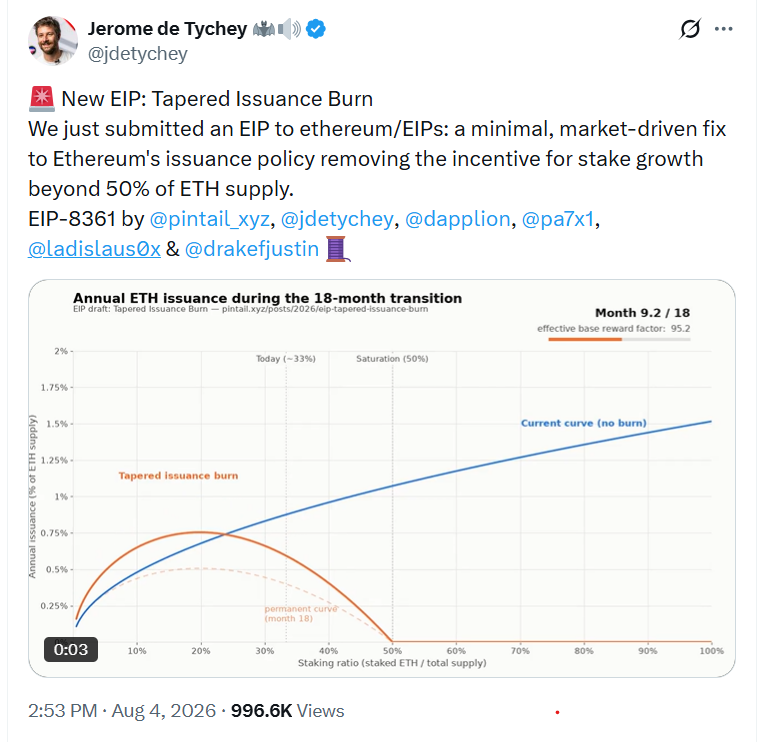
Ethereum researchers aiming to subtly adjust staking incentives have inadvertently ignited one of the most significant economic debates on the network since "The Merge." The proposed Ethereum Improvement Proposal (EIP) 8363, dubbed "Tapered Issuance Burn," seeks to gradually reduce staking rewards as more Ether is locked up to secure the network. The ultimate goal is to eliminate new protocol issuance entirely once 50% of the total Ether supply is staked.
Authors of EIP-8363, including Justin Drake from the Ethereum Foundation and Jerome de Tychey, co-founder of the Ethereum Community Conference (ETHCC), argue that Ethereum has reached a point where additional staking yields diminishing security returns. They contend that further increases in staked Ether dilute the value for holders who choose not to stake, effectively meaning Ethereum is paying for security it no longer critically needs.
However, the proposal has met with widespread opposition from various stakeholders, including decentralized finance (DeFi) builders, staking providers, and institutional investors. Critics express concerns that EIP-8363 could weaken network decentralization, disrupt Ethereum’s lending markets, and undermine confidence in the network’s monetary policy. Mike Silagadze, founder of Ether.fi, stated, "This is so disappointing on every level. […] This is bad for decentralization, this is bad for Ethereum adoption, and this is bad for the credibility of the network." Dr. Steve Berryman, Bitwise’s head of client partnerships for Ethereum, echoed these sentiments, noting that "Institutional adoption requires certainty and playing with the issuance at the margin would cause uncertainty and institutions hate uncertainty." This raises the central question: is Ethereum currently overpaying for security, or is EIP-8363 an unnecessary solution?
Is Ethereum Over-Staked?

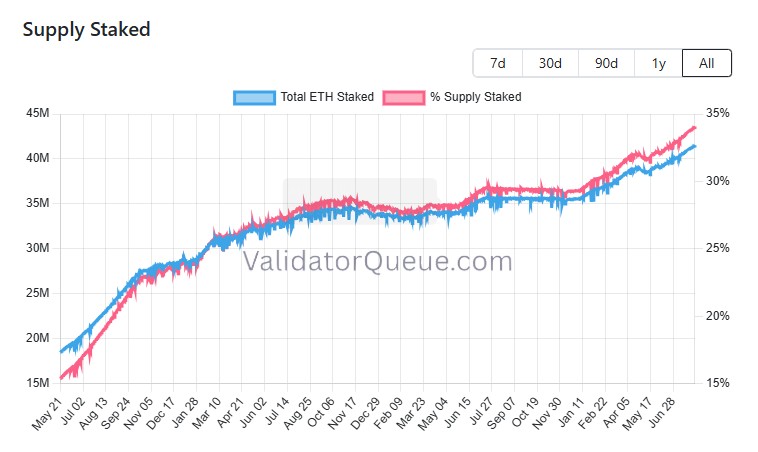
Currently, approximately 41.5 million ETH is staked, yielding an average of 2.67% and representing 34.07% of the total Ether supply, according to data from the Ethereum Validator Queue. While a higher amount of staked Ether generally enhances network security against attacks, the authors of EIP-8363 posit that these security gains become increasingly marginal as Ethereum continues to issue rewards to validators. The proposal aims to phase out these incentives, arguing that Ethereum should cease subsidizing additional staking once the network’s security is deemed sufficient.
Conversely, a significant portion of the community does not perceive the current staking level as problematic. Some argue that market forces are already naturally moderating staking participation without the need for altering issuance policy. Berryman suggests that staking participation will likely reach a natural plateau by the end of the year, as yields fall to around 2%, making it less attractive for further significant ETH lockups. He attributes the recent growth primarily to institutional investors like Bitmine and BlackRock, anticipating that participation will stabilize once these entities complete their staking allocations.
Ethereum commentator Leo Lanza, who opposes the proposal, challenges the notion that current issuance constitutes a substantial "stealth tax" on non-stakers. He points out that Ethereum’s annual inflation rate remains below 1%, which is comparable to or even lower than the supply expansion of gold, a widely recognized monetary asset. Lanza advocates for allowing the market to self-regulate, stating, "The free market already solves this […] Let the market adjust."
Could the Cure Be Worse Than the Disease?
While proponents of EIP-8363 believe it would curb unnecessary issuance and prevent staking from becoming excessively concentrated among large custodians and liquid staking providers, critics argue the proposal risks exacerbating existing issues. Greg Koumoutsos, technical research lead at the Lido Labs Foundation, acknowledges the validity of proactively considering excessive staking but believes the current staking ratio of roughly one-third of ETH supply is not inherently unhealthy.
More critically, Koumoutsos argues that the proposal oversimplifies the multifaceted purpose of Ethereum’s issuance. He states, "Ethereum is not only paying for slashable ETH; it is paying for decentralization, operator diversity, censorship resistance, and network resilience." Lowering issuance, he contends, is not inherently a superior security policy without considering these broader trade-offs.
The deep integration of liquid staking into Ethereum’s DeFi ecosystem also presents a significant concern. Staking derivatives are widely utilized as collateral and within lending and yield-generating strategies. Silagadze warns that implementing EIP-8363 "will obviously kill a huge chunk of DeFi which is built around the staking ecosystem." Stani Kulechov, founder of Aave, Ethereum’s largest decentralized lending protocol, shares this concern, suggesting that reduced staking rewards could disincentivize ETH holders from participating in the ecosystem, potentially leading them to seek yield in alternative assets. He argues, "Ethereum should not be punished for its growth."
Smaller Validators May Bear the Cost
A further concern raised by critics is that reducing staking rewards could inadvertently lead to increased concentration of power among larger participants. Independent validators, unlike large staking businesses, exchanges, or institutional operators, do not benefit from economies of scale. Lower protocol rewards could render solo staking economically unviable, while larger entities continue to operate profitably. Koumoutsos explains, "A solo validator has real costs: some ideological solo stakers may remain, but many marginal solo validators will not, and fewer new ones will enter, if any." He also notes that centralized platforms stake for reasons beyond yield, including customer retention, regulatory positioning, and product integration, making them less likely to reduce their participation. Koumoutsos further cautions that even within delegated staking, lower rewards might favor centralized custodial products over on-chain staking protocols, which incur higher maintenance, governance, and upgrade costs.
A Debate Beyond Staking
Supporters of EIP-8363 argue that reduced issuance would bolster Ether’s long-term monetary profile. However, opponents contend that continuous adjustments to Ethereum’s monetary policy erode its claims of predictability and reliability. Berryman emphasizes that institutions prioritize predictability over marginal yield increases and that altering the issuance curve introduces "yield governance risk," which institutional investors will factor into their decisions. He adds, "It’s not broken, why try and fix it?" Silagadze concurs, stating, "Any nation state or large institution looking at this will justifiably have a dramatic loss of confidence in the governance and stability of Ethereum."
The timing of the proposal’s release, just two days before the August 6th deadline for proposals to be considered for the next Ethereum network upgrade, also drew criticism. Silagadze argued that a change with "far reaching implications for all of DeFi" should not be introduced with such a compressed timeline. The intense backlash highlights the increasing difficulty of modifying Ethereum’s economic parameters, particularly when any adjustment inevitably creates winners and losers across the staking, DeFi, and institutional markets.