 11
11 1
1 2
2 3
3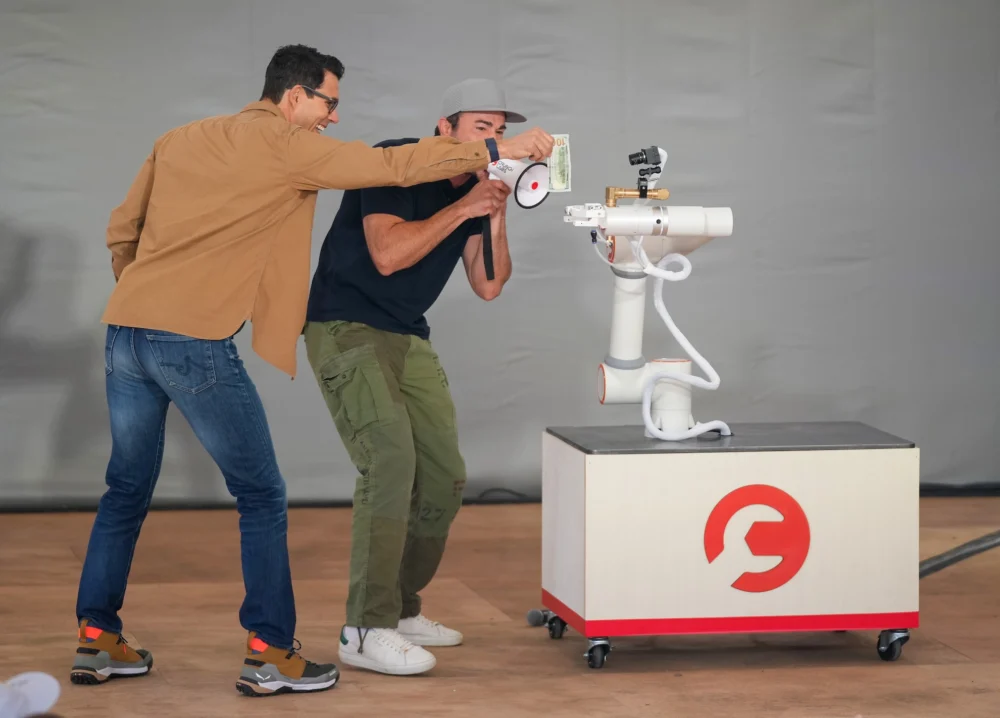
Serial entrepreneur RJ Scaringe, best known as the founder and CEO of electric vehicle (EV) manufacturer Rivian, has launched his third company, Mind Robotics, marking a significant foray into the burgeoning field of robotics. This new venture, focused on industrial automation, recently secured a substantial $500 million Series A funding round, co-led by prominent venture capital firms Accel and Andreessen Horowitz, pushing its valuation to an impressive $2 billion.
Scaringe’s entrepreneurial journey began with Rivian, an EV maker that burst into the public consciousness in 2018 with the debut of its innovative electric truck featuring a distinctive gear tunnel. Rivian, now a publicly traded company, is on the cusp of delivering its most strategically important vehicle to date: the mid-sized R2 SUV. This model is designed to be significantly more cost-effective to produce, with Scaringe stating it’s "roughly half" the cost of its flagship R1 counterpart, while also boasting enhanced technological capabilities. Crucially for consumers, the R2 will be more affordable, with the initial version starting at $57,990, making it 20% cheaper than the base R1T pickup. This strategic move aims to broaden Rivian’s market appeal and secure its long-term growth.
Beyond Rivian, Scaringe also oversees Also, a micromobility startup that originated as an internal "skunkworks" program within Rivian before spinning out as an independent entity last year. Also received significant backing, including $105 million from venture capital firm Eclipse, though Rivian maintains a minority stake. In October 2025, Also introduced its first products: a pedal-assist modular electric bike and a cargo quad vehicle, both designed for urban and last-mile logistics. Scaringe remains deeply involved in this startup, demonstrating his commitment to diverse transportation solutions.
Now, Scaringe’s focus has expanded to robotics with the establishment of Mind Robotics. Unlike Also, this new company was not born within the confines of Rivian, though the automaker anticipates potentially becoming a customer in the future. Mind Robotics, founded in November 2025, has swiftly raised $615 million in total funding, culminating in its recent $500 million Series A round in March 2026. This rapid ascent in valuation underscores investor confidence in Scaringe’s vision and the potential of his new robotics platform.
In an exclusive interview on the sidelines of South by Southwest, an event where Rivian served as a primary sponsor, Scaringe shared insights into his latest venture and broader entrepreneurial philosophy. When asked if he was "done spinning off companies," he responded with a thoughtful "Probably," after a brief pause, adding, "Yeah. I mean, yeah." He expressed satisfaction seeing his brands co-exist, noting Also’s presence at the event. He highlighted that Mind Robotics is a completely new company where Rivian acts as a partner. "I’m wildly bullish on it. It really benefits Rivian, but I think it has the potential to be a very large business, just given the scale of what’s happening," Scaringe affirmed, indicating a strategic synergy between his ventures.
The genesis of Mind Robotics is intrinsically linked to Rivian’s R2 production strategy. Scaringe revealed that about two years ago, as confidence in the R2’s market potential grew, so did the realization of the massive manufacturing scale required. "If we’re gonna have to build four or five plants over the next decade, that means we’re going to spend many, many billion dollars in capex," he explained, referring to capital expenditures. This prompted a critical question: "What are these plants going to look like? And we don’t want to build a bunch of plants and then have them immediately be outdated."
This foresight led Scaringe to initiate a comprehensive study into "the future of manufacturing." His conclusion was stark: while "classic industrial robotics," like those seen in existing automotive plants, would persist, the emergence of "robotics with human-like skills" would be paramount. Already holding a strong conviction about the role of AI in the physical world, Scaringe engaged with numerous companies developing robots capable of performing human-like tasks.
His market analysis revealed a dichotomy. On one hand, established industrial robotics companies were not poised to build robots with human-like dexterity. On the other, a new wave of startups, surprisingly many focused on domestic applications like folding towels or doing dishes, lacked crucial elements for industrial deployment. "We just came to the view that the ingredients to be successful, none of them had all of those ingredients," Scaringe elaborated. These missing components included industrialization experience, a deep understanding of industrial operations, a robust "data flywheel" for training AI models, and established supply chains. Scaringe was unwilling to "build Rivian’s future manufacturing dependency on companies that have never industrialized a product." This conviction solidified his decision to launch a new company, which secured its seed funding on day one, followed by the recent Series A.
Interestingly, Mind Robotics wasn’t its original moniker. Scaringe disclosed its internal project name was "Project Synapse." He explained the rationale: "The name of the company Mind, it sort of links to synapse and links to the brain." The inspiration also came from his children’s school, called Synapse. While he almost named the company Synapse, he ultimately opted for "something simpler," though a board member still occasionally refers to it by its original project name. The board of Mind Robotics includes Scaringe himself, Jiten Behl of Eclipse, Sameer from Accel, and a representative from Rivian, reflecting a streamlined governance structure typical of private companies.
Scaringe also offered a critical perspective on current trends in robotics, particularly when compared to companies like Boston Dynamics, known for its Atlas humanoid robot, and its collaboration with AI labs like Google DeepMind. Mind Robotics, he clarified, is building the entire stack: the AI models, the robotics hardware, and the infrastructure for large-scale deployment.
He expressed skepticism about the "surprising emphasis on mimicking human biomechanics" or even creating overly complex mechatronics in many contemporary robot designs. Scaringe argued that in industrial settings, "the work happens with the hands. So, the hands are very, very important. Everything else, from a robotic system point of view, is to get the hands to the right place." He believes that robots performing complex motions like backflips, while impressive demonstrations of flexibility, often introduce "unnecessary complexity" for the vast majority of industrial tasks. For scalable deployment, minimizing complexity, reducing failure modes, and optimizing power consumption are paramount. He contends that many humanoid systems being considered for manufacturing are "way too complex relative to what they do." While his robots will be human-like in having hands, a perception model, and locomotion, directly mimicking full human biomechanics "misses some of the fundamental points of manufacturing, which is, it’s all hand based."
Acknowledging that hands are indeed the most complicated part of robots, Scaringe countered that this is precisely where all energy, investment, and focus should be directed. He emphasized that "there’s not one set of hands that’s going to be perfect" for all industrial applications. The gripping solution required for lifting a large four-inch steel pipe is fundamentally different from the dexterity needed to thread an M4 fastener into an aluminum casting.
Scaringe drew parallels with biological evolution, noting how different optimal biomechanics have developed for specific tasks in nature (e.g., swimming, running, climbing). He argued that "to assume that the shape and form factor of a human is the optimal shape and form factor for all types of work, I think, just misses the fact that we didn’t evolve in a plant." While factories have evolved around human capabilities, robots primarily need to fit into human-sized spaces and possess capable hands. He highlighted the distinct "operational design domain" (ODD) of a factory versus a home. Industrial environments offer "much more friendly constraints for deployment at scale"—no stairs, carpet transitions, pets, or children to contend with. The environment is mappable and largely static, simplifying robotic navigation and task execution.
Interaction with humans in a factory setting remains a critical consideration. Scaringe stressed the importance of the user interface (UI), envisioning a robot that "needs to feel friendly, because it’s gonna work a long time with humans." However, he cautioned against designs that appear "dopey" or overly "lean, muscular forms that look very Terminator like," a trend he attributed to science fiction influences on industrial design. Instead, he advocates for an "approachable, but not dopey" form factor, a design philosophy he also applied to Rivian’s powerful yet non-intimidating vehicles.
This emphasis on modularity, purpose-built functionality, and a user-centric design aesthetic draws a clear thread between Mind Robotics and Scaringe’s other ventures, particularly Also. Just as Rivian demonstrated that a 1,000-horsepower truck doesn’t have to look intimidating, Mind Robotics aims to show that advanced robotic capability can be delivered in a friendly, approachable package, fundamentally redefining industrial automation.