11
11
Brand new sounds reverberated through a packed concert hall at Georgia Tech this past weekend, marking the 28th annual Guthman Musical Instrument Competition. This prestigious event, a beacon for innovation in music technology, showcased an extraordinary array of novel instruments from around the globe, culminating in the crowning of a new champion. The competition, hosted by Georgia Tech’s School of Music, has long been a platform for pushing the boundaries of musical expression, and this year proved no exception, highlighting creativity, ingenuity, and a forward-thinking approach to instrument design.
Ten distinguished finalists, meticulously selected from a vast pool of candidates who had engineered all manner of new music-making devices, converged in Atlanta, Georgia. Their mission: to present their groundbreaking instruments to an expert panel of judges. The diversity of these creations was astounding, spanning a remarkable spectrum of size, shape, and conceptual design. Among them were colossal inventions, such as an imposing 6-foot-11 hybrid instrument that ingeniously combined elements of a traditional double bass with the ancient Indian Rudra Veena. At the other end of the scale were more compact, yet equally inventive, designs like a stringed instrument artfully shaped like a bicycle wheel. Adding to this eclectic mix was a collection of modular devices activated by electrical impulses transmitted through salt water, demonstrating a truly avant-garde approach to sound generation.
Jeff Albert, an associate professor at Georgia Tech’s School of Music and the esteemed head of the Guthman competition, shed light on the intricate process of selecting these finalists. He explained that creativity forms the bedrock of their criteria, though he acknowledged its elusive nature. "Once you say this is what we’re defining as an instrument, it leaves some stuff out, and it makes it hard for new things to break in," Albert remarked, emphasizing the competition’s commitment to fostering genuinely new ideas rather than adhering to rigid definitions. He further elaborated that practical considerations also play a role, stating, "A little bit of it has to do with what makes a good concert. Does it sound good for 5 minutes?" Beyond raw novelty, Albert indicated that instruments accrue points for their meticulous craftsmanship, aesthetic appeal, and, crucially, their audio quality.
The competition unfolded over two distinct days. On Friday, the inventors presented their devices to the panel of judges, detailing their design philosophies, technical specifications, and sonic capabilities. The following day, Saturday, was dedicated to public performances, where each finalist was paired with talented local Atlanta musicians. This collaborative concert allowed the inventors to demonstrate their proficiency, showcasing their "chops" by playing their own creations live. The resulting presentation was described as a veritable "sonic bath of drones and chaotic, unpredictable weirdness," an atmosphere that Albert and the organizers fully embraced as central to the competition’s ethos. This deliberate embrace of the unconventional underscored the event’s commitment to exploring the outer limits of musical soundscapes.

One such instrument that epitomized this spirit of adventurous design was the Demon Box, a creation by Alexandra Fierra, Bryn Nieboer, and Jordan Bortner. Fierra aptly described it as "this Pandora’s box of things." This ominous-looking electromagnetic synthesizer is capable of detecting and translating frequencies from virtually any object passing over its sensors, whether it be a delicate finger or the robust vibrations of a power drill. These detected frequencies are then transformed into a range of outputs, including audio signals, MIDI data, and even captivating, trippy visual displays, inviting users into a dark sonic world of electromagnetic exploration.
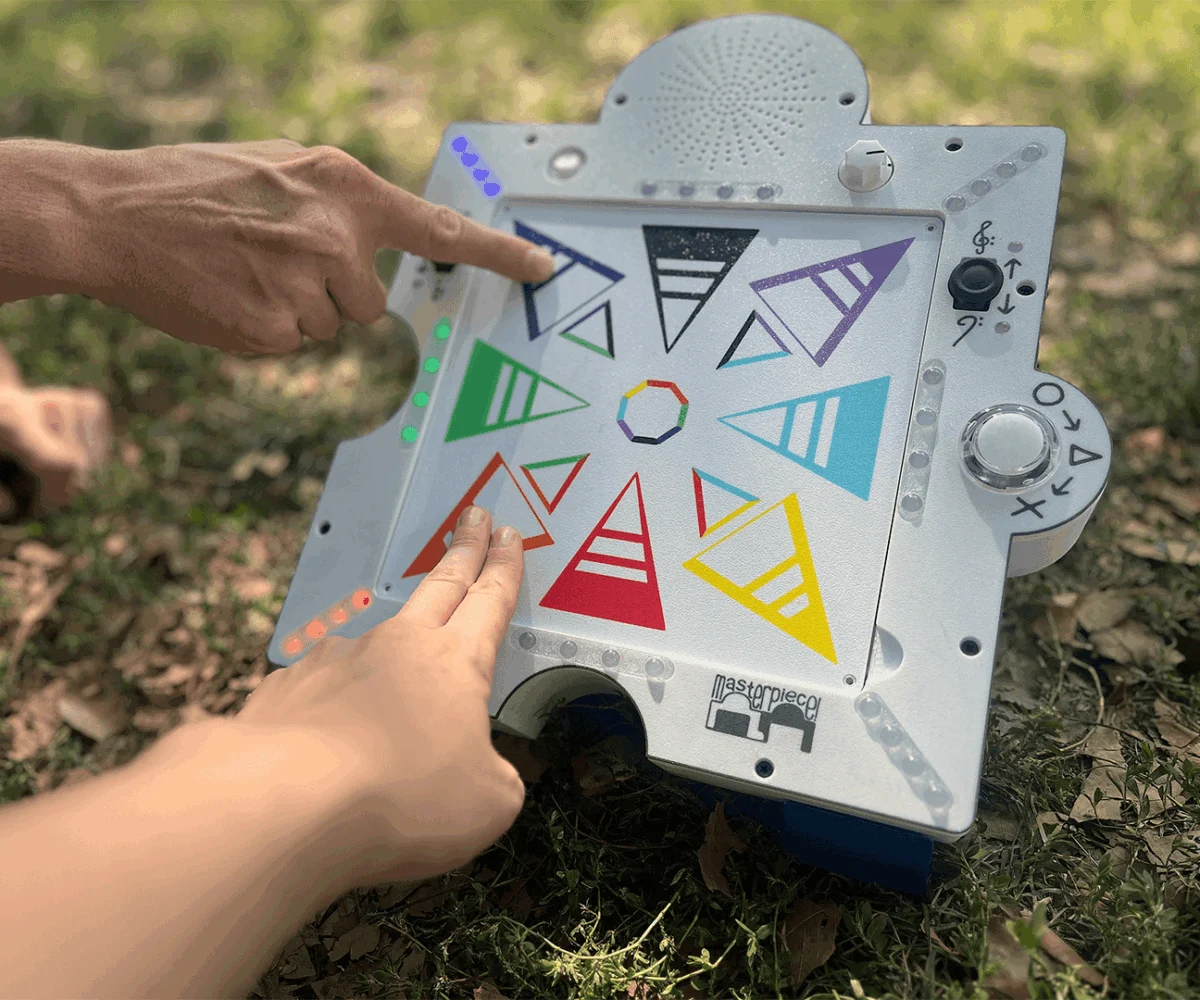
The stakes of the competition were high, culminating in a significant $10,000 grand prize. This year, the coveted top honor went to the Masterpiece, an instrument profoundly focused on accessibility. Developed by Brian Culligan, this open-source, touch-based synthesizer draws inspiration from fidget toys and sensory devices, designed to be played simply by pressing virtually anything onto its surface. Securing second place was the Fiddle Henge, a visually striking installation featuring four fiddles standing upright around a continuously spinning circular bow, which produced haunting and resonant drones. The people’s choice award, determined by audience vote, was claimed by the Lethelium, an instrument ingeniously crafted from bicycle and guitar parts, taking on the distinctive circular shape of a bicycle wheel. A third-place winner, the Verto, an analog electric machine by Berlin-based musician Michael Doron, which utilizes electromagnetic gloves and rotating tonewheels, was also recognized, though not explicitly detailed in the initial prize announcement.
The Guthman Competition serves as an invaluable barometer for discerning emerging trends within the dynamic world of music-making. A clear and compelling theme this year was the concerted effort to make musical instruments more accessible to a broader audience. The Masterpiece, the first-place winner, stands as a prime example of this trend. Its creator, Brian Culligan, is a dedicated musician and teacher who works with the Daniel’s Music Foundation, a nonprofit organization committed to providing enriching music opportunities for individuals with disabilities. Culligan articulated his motivation, stating, "The individuals I was working with are very musical and very expressive and have such big personalities. But the musical tools, the instruments that we were working with, were not maximizing their self-expression."
The Masterpiece, with its puzzle-piece aesthetic, was conceived with accessibility at its core. Its pressure-sensitive surface facilitates polyphonic synthesis, enabling the simultaneous playing of multiple notes. Critically, it can be activated by a wide variety of inputs: hands, feet, textured fabrics, or even malleable materials like Play-Doh. Culligan articulated the transformative potential of such design: "If I could make an instrument where this is the interface, then it could potentially draw people into music making just by exploring something that feels good in their hands. Then all of a sudden they realize that they are making music. It kind of lowers that barrier, that intimidation factor of trying out a new instrument." This philosophy represents a significant step towards democratizing music creation. In a special recognition during the showcase presentation, New Zealander Andrew McMillan was honored for his Ultrasonic Accessible Wind Instrument. McMillan, unfortunately, could not attend the event and thus wasn’t listed as an official finalist due to mobility issues that prevented his travel to Atlanta, underscoring the real-world challenges accessibility aims to overcome.
Another prominent theme weaving through the competition was the innovative repurposing of materials that would otherwise be discarded, transforming them into novel musical instruments – a practice known as upcycled art. Jeff Albert observed this growing trend, noting, "Taking extra or discarded materials and turning them into musical instruments; I’m seeing more and more of that coming into the mainstream. They’re beautiful pieces of art, and they also sound really cool."

The most literal and celebrated example of this upcycling trend was the people’s choice winner, the Lethelium. Its creator, Lateef Martin, a prolific Montreal-based builder, musician, and author of the "Cyclepunk" comic book series, recounted the instrument’s genesis. The idea first sparked when he playfully plucked the spokes of a bicycle in a bike shop. This inspiration evolved into combining bicycle components with guitar strings in place of spokes, resulting in a unique circular playing surface. The Lethelium can be played by either plucking its strings or using a bow, producing sounds across two octaves. Martin affectionately described his creation as a "lovechild between a dulcimer and a harp and a steel pan. They had a threesome, and that’s the Lethelium."
The performances at Guthman, characterized by unconventional instruments, inevitably carried a sense of unpredictability. This inherent chaos, however, was not seen as a flaw but rather as a fundamental human element that the participants actively sought to embrace. Berlin-based musician Michael Doron, creator of the third-place winning Verto, articulated this sentiment. "This world specifically needs more experimental instruments," Doron asserted, arguing that in an era increasingly dominated by MIDI controllers and computer-based instruments, "it is important… to have something real to play with." His statement highlights a longing for tangible, tactile interaction in music creation amidst the digital surge.
Krzysztof Cybulski, a music teacher from Poland and the inventor of the Post Digital Sax instrument, a five-time contestant at Guthman, offered a perspective on the enduring role of human musicians. He contended that artificial intelligence would face its greatest challenge in replacing human performers. "This is the area where we can still survive," Cybulski stated, emphasizing the irreplaceable human touch, improvisation, and emotional nuance in live performance that experimental instruments like his aim to preserve.
For the creators of these instruments, winning the competition, while certainly desirable due to the prize money, is not always the sole or ultimate goal. The Guthman competition has a rich history of recognizing instruments that, despite not winning the top prize, have gone on to achieve significant success as full-fledged products. Notable previous contenders include the expressive Roli Seaboard, the innovative Artiphon Orba, and Teenage Engineering’s immensely popular OP-1, none of which secured a first-place win at Guthman, yet all became highly regarded in the music technology landscape.
Jeff Albert underscored the profound value of the competition beyond monetary rewards. "Everybody wants to win because there’s money involved," he acknowledged, "Really, the beauty of it is you get all these creative people in town for a weekend, and they hang out. You see people starting to make connections, and they start checking each other’s instruments out. That exchange of both information and excitement is a lot of fun." This vibrant community aspect, fostering collaboration, inspiration, and the shared pursuit of musical innovation, remains a cornerstone of the Guthman Musical Instrument Competition’s enduring legacy.