 11
 1
 2
 3
AI rank tracking tools, often referred to as AI visibility trackers, are emerging as crucial instruments for businesses seeking to understand their presence within the rapidly evolving world of artificial intelligence-powered search. These tools offer insights into how frequently brands are recommended by AI platforms such as ChatGPT, Gemini, and Google AI Overviews, their positioning within AI-generated answers, and their competitive standing. However, the landscape of these tools is complex, with varying methodologies for tracking visibility and often challenging pricing structures that make direct comparison difficult. This guide delves into a comparison of eight prominent AI rank tracking tools, examining their pricing and features, and presents findings from proprietary research that highlight the significance of tracking brand mentions over mere positional data.
Understanding AI Rank Tracking Mechanisms
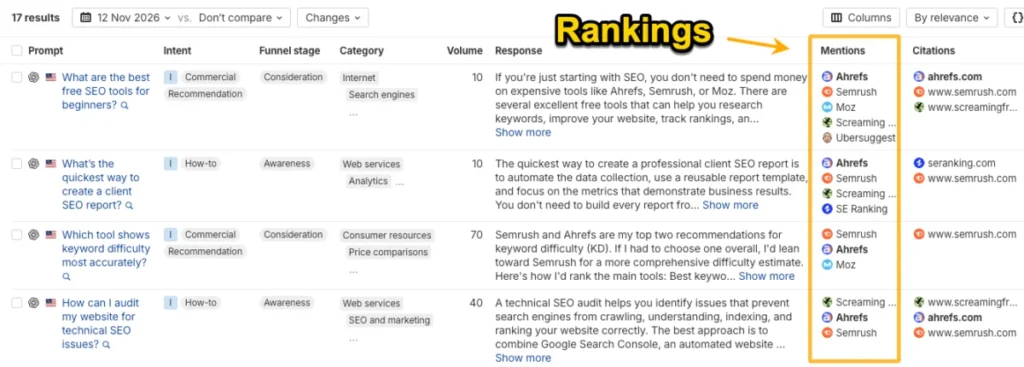
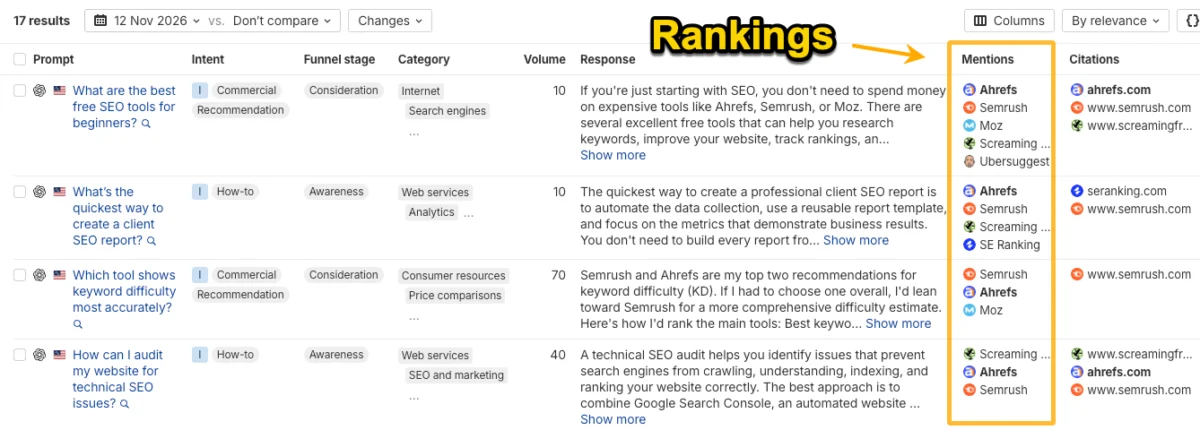
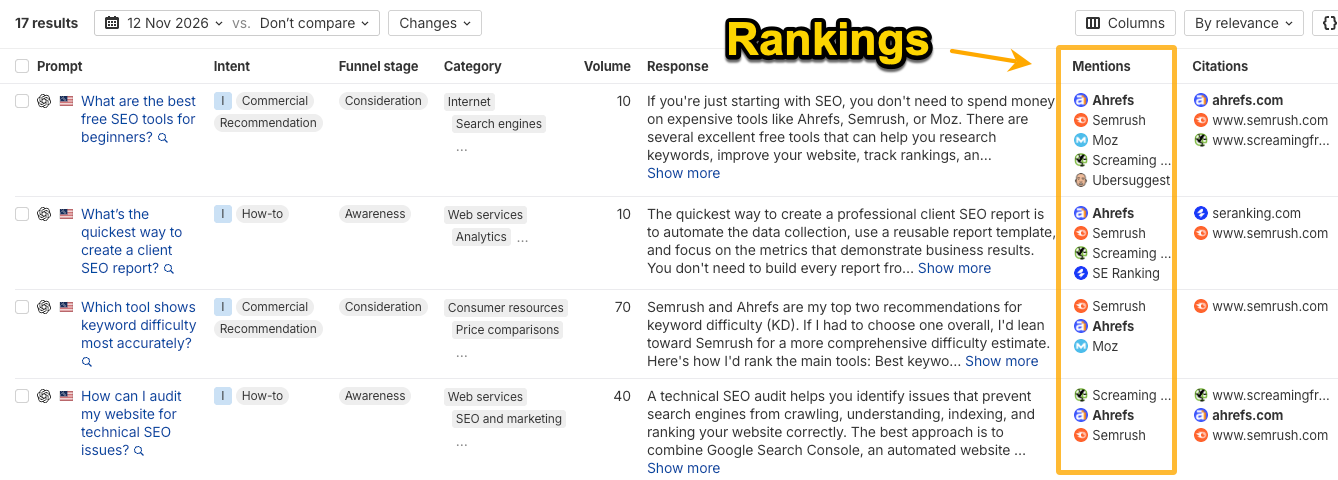
AI visibility tools function by collecting responses from AI chat interfaces, either through direct scraping of consumer-facing interfaces or via third-party data providers and API calls. Scraping offers a more authentic representation of the user experience, while APIs provide an alternative access method, particularly when scraping is not feasible. For instance, Brand Radar utilizes Claude’s API alongside scraping for other AI systems. These tools then parse and store the collected answers, identify brands and their sources, and calculate key metrics like mention rate and position. Within tools like Ahrefs Brand Radar, users can observe the ordinal rank of brands mentioned within a single AI answer, indicating their sequence of appearance rather than an explicit recommendation of superiority. The interpretation of these rankings in the context of AI-generated content necessitates a nuanced approach, considering factors beyond simple positional order.
Comparative Analysis of AI Rank Tracking Tools: Pricing and Features
A practical approach to selecting an AI visibility tool involves testing several options with a consistent set of prompts to compare their outputs. To facilitate this decision-making process, a comparative table has been compiled, detailing monthly plan prices, daily prompt allowances, and the AI platforms covered by each tool. The data is organized by cost per daily tracked prompt, calculated by dividing the monthly plan price by the number of daily prompts tracked. It is important to note that platform coverage varies across tools, making these figures indicative rather than directly equivalent. Pricing information was accurate as of November 3, 2026.
| Tool | Monthly Price, Plan | Daily Prompts | AI Platforms Available | Platforms Included in Cost | Cost Per Daily Prompt |
|---|---|---|---|---|---|
| Ahrefs Brand Radar | $50, Basic | ~83 | 7 | 1 | $0.60 |
| Rankscale | $99, Pro | 160 | 17+ (most by API) | 1 | $0.62 |
| SE Visible | $89, Basic | 75 | 5 | All 5 | $1.19 |
| Peec AI | $95, Brands Starter | 50 | Choose 3 of 6 | 3 | $1.90 |
| Otterly AI | $29, Lite | 15 | 4 | All 4 | $1.93 |
| Nightwatch | $99, Starter | 50 | 5 | 1 | $1.98 |
| Scrunch | $250, Core | 125 (daily for 14 days) | 4 | 4, non-daily | Not comparable |
| Profound | Custom quote, Brand Enterprise | Custom | Up to 10 | Depends on plan | Quote required |
Additional cost savings may be available through annual billing options or lower-tier plans with adjusted tracking limits. Costs can also fluctuate based on the specific AI platform and the frequency of checks. Higher-volume plans can significantly reduce the per-prompt cost; for example, Ahrefs Brand Radar’s Scale plan brings the cost down to approximately $0.30 per daily tracked prompt, while SE Visible’s Agency plan averages around $0.40.
Feature Highlights and Pricing Structures of AI Rank Tracking Tools
While pricing serves as an initial benchmark, a deeper examination of each tool’s offerings, unique strengths, and limitations is essential.
Ahrefs Brand Radar: This tool provides two distinct methods for tracking AI visibility. Custom prompt tracking operates on a pay-per-check model, with pricing tiers based on the number of checks per month: Basic ($50/month for 2,500 checks), Growth ($100/month for 7,000 checks), and Scale ($250/month for 25,000 checks). This translates to approximately $20, $14, and $10 per 1,000 answers, respectively, for platforms using one check per answer (Claude uses eight). Additional checks can be purchased on a pay-as-you-go basis for $0.010 to $0.020 each. The AI Visibility Index offers access to over 500 million existing AI answers dating back to 2025, with estimated impressions based on search frequency, starting at $199/month per platform or $699/month for all platforms, including 2,500 custom-prompt checks.
Rankscale: Rankscale employs a credit-based system for AI checks, offering greater flexibility than fixed prompt allowances. The Essentials plan starts at $17/month (billed annually) with 120 credits. Checks cost 0.25 credits on platforms like ChatGPT and Gemini, and 2 credits on Claude, allowing for approximately 16 daily prompts on less expensive engines. Higher-tier plans, such as Pro ($84/month) and Pro+ ($195/month), offer increased credits and features like exports and API access. A free 7-day Pro trial is available.
SE Visible: This tool bases its pricing on the number of prompts, projects, and locations tracked. The Basic plan begins at $71/month (billed annually, $89 monthly) and includes 75 daily prompts across supported AI platforms, 5 projects, and one location per project. API access and MCP are included from the outset. Higher tiers like Core ($151/month annually) and Agency ($319/month annually) offer increased prompt allowances and project limits. Tracking the same prompt in multiple locations consumes separate prompt slots. A 10-day free trial is offered.
Peec AI: Peec AI’s pricing is primarily determined by the number of prompts, projects, and countries tracked. The Starter plan costs $80/month (billed annually, $95 monthly) and includes 50 daily prompts across three AI models, one project, and one country. Pro plans offer increased allowances and API access. Team members are unlimited across all plans. Additional AI models incur extra costs, and separate agency plans are available.
Otterly AI: Otterly AI charges based on the number of tracked prompts, with additional fees for extra AI models. The Lite plan starts at $25/month (billed annually, $29 monthly) and includes 15 daily prompts across four platforms. Each country tracked requires its own prompt slots. Standard and Premium plans offer higher prompt allowances and API access. Extra prompts can be purchased in blocks.
Nightwatch: Nightwatch integrates traditional SEO rank tracking with AI visibility features. The Starter plan ($79/month billed annually, $99 monthly) includes 500 Google keywords and 50 AI prompts with 1,500 AI answers per month. Professional and Agency plans offer increased allowances, API access, and Looker Studio integration. The monthly answer allowance may impact the number of AI platforms that can be tracked. A 14-day free trial is available.
Scrunch: Scrunch bases its pricing on prompts and monthly AI responses, with limitations on team members, countries, and platforms. The Core plan costs $250/month for 125 prompts and 5,000 responses across four AI platforms, with 5 seats. New prompts are checked daily for 14 days, then every 72 hours by default, indicating non-continuous daily tracking. Enterprise pricing is customized and includes expanded platform support and API access.
Profound: Profound’s main Enterprise plan requires a custom quote. Its free 7-day trial tracks 50 fixed prompts daily across three AI platforms but lacks editable prompts and API access. The Enterprise plan adds these capabilities and more. Agency plans start at $99/month, with additional client workspaces costing $399/month each. Profound’s AI Agents utilize a separate credit allowance for content and marketing tasks.
Divergent Dynamics of AI and SEO Rank Tracking
A fundamental difference between AI search and traditional SEO lies in the emphasis on positional ranking. While SEO heavily relies on a page’s position in search results, AI search dynamics are more fluid. Individual positions within AI answers can fluctuate significantly, even when the same brands consistently appear. Proprietary research tracking 15 "best tools" prompts across seven AI platforms for 76 days revealed that a tool maintained the same position on consecutive days only 36% of the time. Gemini exhibited the highest ranking instability, with positions changing on 77% of days, while Google AI Overviews showed greater stability at 53%.
Despite positional volatility, the brands recommended by AI demonstrated remarkable consistency. Approximately three core tools appeared in nearly every answer for most prompts. When these regularly recommended tools were present, they were mentioned again the following day 98% of the time, irrespective of their positional changes. This phenomenon can be likened to a consistent guest list where individuals frequently change their seats.
Mentions vs. Rankings: A Strategic Perspective
The research further indicated a strong correlation between mention frequency and a brand’s appearance in top positions. Tools mentioned most frequently appeared in the top three positions in 61% of answers that included them, compared to just 12% for occasionally mentioned tools. This suggests that both metrics reflect a brand’s perceived relevance by AI. However, mention rate often serves as a more valuable starting point, as average rankings can obscure the significant reality of a brand’s absence from AI responses altogether. For example, a brand might have an average position of number one when it appears, but if it only appears in 30% of answers, its overall AI visibility is considerably lower than a ranking alone might suggest.
Reporting Beyond Single Rankings
Instead of relying on a single AI ranking position, it is more effective to track three key metrics for each AI platform, comparing the last four weeks with the preceding four weeks to identify trends. These metrics include: mention rate, average position when mentioned, and the proportion of answers that feature the brand. For custom calculations, tools like Ahrefs’ Agent A can be utilized by describing desired measurements. Data can also be exported or integrated with other AI assistants via API or MCP.
Conclusion: Prioritizing Visibility over Position
Ironically, rank tracking may be the least critical feature to prioritize when evaluating AI rank trackers. The dynamic nature of AI answer positions underscores the importance of understanding how frequently a brand is mentioned, which provides a more accurate reflection of its AI visibility than a snapshot of its ranking. Therefore, it is more beneficial to view these tools as AI visibility platforms, focusing on their capacity to reveal which questions elicit brand mentions, which sources are cited, and how a brand stacks up against competitors. The selection of a tool should be based on its ability to facilitate investigation and improvement, with pricing considered in relation to the required prompts, platforms, and checking schedules. For agencies serving clients, comparing agency plans is paramount. Ultimately, understanding a brand’s standing in AI responses is the precursor to enhancing its visibility, a process detailed in comprehensive guides on Answer Engine Optimization (AEO).