 11
 1
 2
 3
The initial phase of any complex project is frequently characterized by resistance, commonly referred to as the "blank page problem." While the immediate availability of generative artificial intelligence offers a tempting solution to jump-start the creative process, new research from Atlassian’s Teamwork Lab suggests that outsourcing the initial "spark" of an idea to an AI prompt carries significant hidden costs. According to the study, teams that rely on AI to generate first drafts from scratch often trade a sense of ownership and originality for mere speed. To combat this, the Teamwork Lab conducted a series of studies investigating a "think-aloud" workflow that prioritizes human cognition at the start of a project, using AI only in a secondary, polishing role.
The Teamwork Lab’s hypothesis centered on the idea that articulating thoughts verbally would help team members overcome initial inertia while capturing more original, nuanced thinking than a standard AI prompt could generate. To test this, the Lab conducted two separate studies involving Atlassian employees engaged in real-world tasks. The primary goal was to observe the impact of a workflow where participants first recorded their "messy" thoughts aloud before employing AI tools to structure and refine the resulting transcripts.
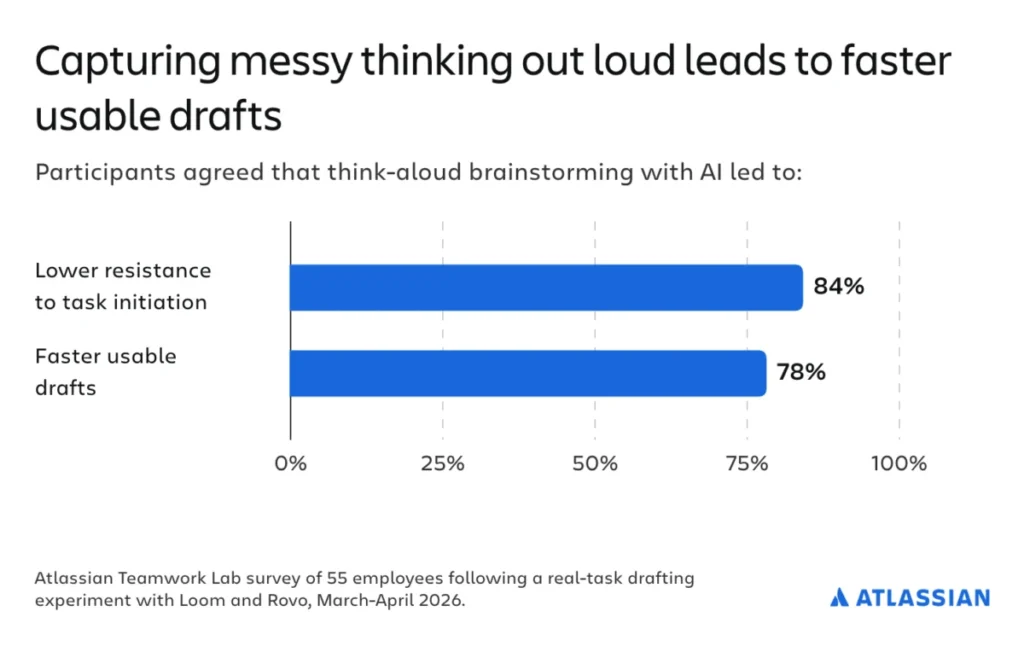
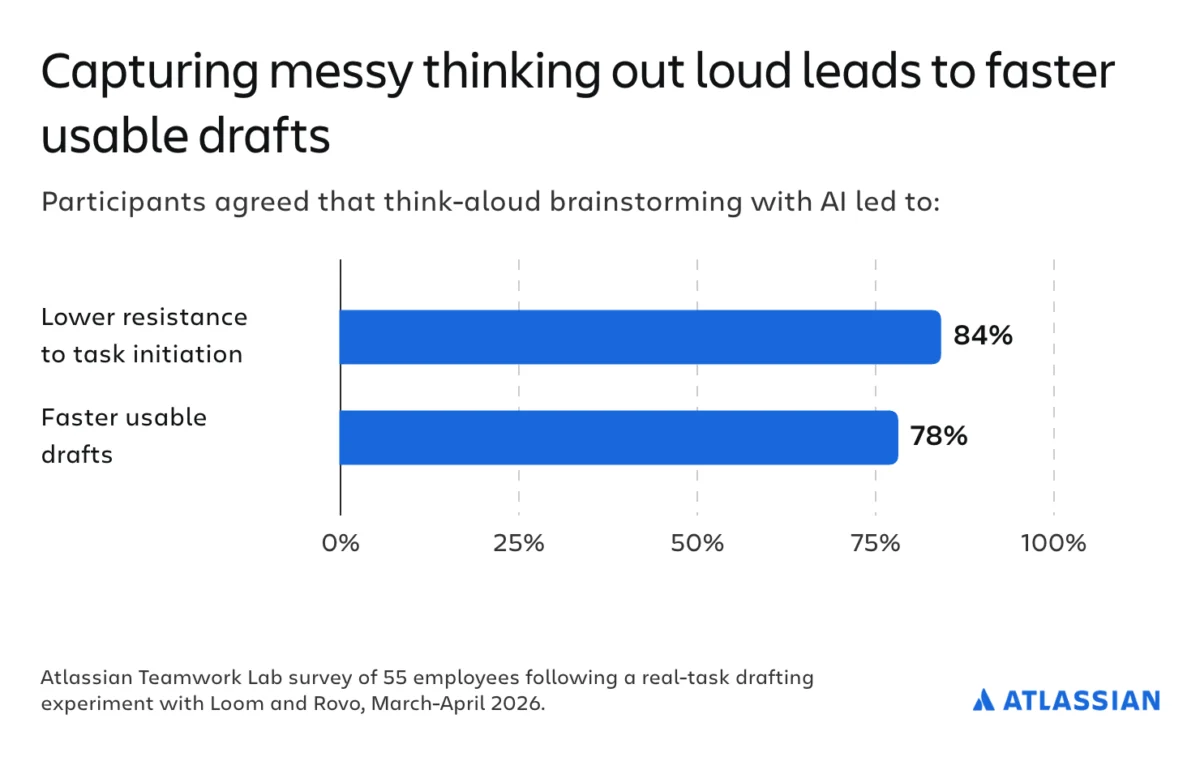
The first study, conducted between March and April 2026, focused specifically on the brainstorming process. It involved 55 Atlassians who were not currently utilizing a think-aloud workflow. These participants were asked to select a genuine piece of work they felt "stuck" on, such as a strategic plan, a project poster, or a feature roadmap. The methodology required each participant to record a 10-to-15-minute session in Loom, during which they talked through the project’s objectives, risks, and options. Following the recording, they utilized Rovo, Atlassian’s AI agent, to transform the verbal transcript into a structured Confluence outline or a draft.
The results of this brainstorming study indicated that capturing raw, unpolished thinking aloud leads to faster, more usable drafts. Participants reported that the act of talking through the problem helped them clarify their own reasoning before the AI intervened. By the time the AI was introduced to organize the thoughts, the human "owner" of the project had already established the strategic direction, ensuring the output remained aligned with their original intent rather than defaulting to generic AI-generated suggestions.
The second study, carried out between January and February 2026, examined the application of this workflow in the context of goal-setting. Writing high-quality SMART goals—those that are Specific, Measurable, Achievable, Relevant, and Time-bound—is a cognitively intensive task that requires alignment with both individual career paths and broader company objectives. This study involved 42 Atlassians during an optional goal-setting cycle. Participants recorded their performance and goal-setting conversations with their managers via Loom. These transcripts, along with information regarding the employee’s job level and growth profile, were fed into Rovo using specific template prompts. The AI then drafted SMART goals and Objectives and Key Results (OKRs) based on the actual conversation.
The goal-setting study demonstrated that chaining AI tools like Loom and Rovo can transform ambiguous, high-pressure workflows into clear, review-ready outcomes. The researchers found that when employees started with a human conversation, the resulting goals were more personalized and felt more achievable to the participants. The AI acted as a secretary and structural editor rather than a primary creator, which maintained the integrity of the manager-employee dialogue.
Sami Nesnidol, Lead Behavioral Scientist at the Teamwork Lab, noted the psychological benefits of this approach. "For many, getting your ideas on paper is the hardest part," Nesnidol stated. "This workflow helps remove that barrier by allowing you to just talk, letting your ideas flow, and then bringing in AI to organize your thoughts into something shareable." This perspective highlights a shift in how AI is integrated into the workplace—moving away from AI as a replacement for thought and toward AI as a tool for cognitive offloading and organization.
The Teamwork Lab has codified this approach into a five-step "think-aloud brainstorming" playbook, designed to help teams move from stagnation to action without losing the human element of their work.

The first step in the playbook is to identify a project that is particularly "messy" or requires high-judgment. These are often tasks involving multiple stakeholders, significant risks, or long-delayed kickoffs. The lab recommends opening a blank Confluence page to serve as a digital scratchpad for the process.
The second step involves recording 10 to 15 minutes of thinking aloud. The participant is encouraged to explain the situation as if they were speaking to a trusted colleague who is unfamiliar with the specific details. This narrative should cover the goals of the project, the intended audience, potential risks, and the various options under consideration. The emphasis is on raw communication rather than perfection. For those struggling to articulate the problem, the lab suggests prompts such as identifying the "biggest unknown" or explaining why the project has been delayed.
In the third step, the AI assistant is introduced to structure the draft. The user asks the AI to review the video transcript and organize the information. The researchers emphasize that the output should be treated as a rough draft. Users can give the AI specific instructions, such as writing a clear problem statement, defining key goals, or identifying areas where the human’s reasoning seems contradictory or "fuzzy."
The fourth step is critical human review. The Teamwork Lab warns against "AI workslop"—the tendency to accept AI-generated content without scrutiny. Users are instructed to read the draft with a critical eye, looking for generic language, factual errors, or omissions. Every AI-generated document must undergo human editing to ensure it meets professional standards before it is shared with stakeholders.
The final step is to determine the "driver" for the draft. A successful think-aloud session must end with a clear next step, such as converting the draft into a project brief, a summary for Slack, or specific work items in Jira or Trello.
The broader implications of this research suggest that the order of operations in human-AI collaboration is vital. When individuals "talk before they prompt," they are statistically more likely to follow through with the project and utilize the results. This method also serves as a preventative measure against mental exhaustion. By reducing the friction of the "blank page," the think-aloud workflow preserves a positive relationship with creative work, preventing the burnout often associated with high-pressure brainstorming.
Furthermore, human-first brainstorming addresses the "standards problem" inherent in modern AI usage. When AI is used to generate the initial idea, the resulting work often lacks the specific context and "high-judgment" nuances that only a human professional can provide. By capturing human thinking first, the AI is forced to work within the parameters of a specific, human-driven context, resulting in a more sophisticated and relevant final product.
In conclusion, the Teamwork Lab’s findings suggest that the most effective way to use AI in a professional setting is not as a replacement for the initial creative spark, but as a sophisticated tool for organizing and polishing human thought. By adopting a think-aloud workflow, teams can overcome the psychological barriers of starting new projects, maintain a higher degree of ownership over their work, and produce usable results faster than traditional methods or AI-only prompting. The integration of tools like Loom for capturing speech and Rovo for structuring data provides a scalable framework for this human-centric approach to productivity.