 11


The second and final testnet for Ethereum’s Glamsterdam hard fork was abruptly cancelled this week after security researchers from ChainSecurity uncovered critical vulnerabilities in two proposed gas scaling Ethereum Improvement Proposals (EIPs). These flaws, if left unaddressed, could have posed significant risks to at least 13 decentralized finance (DeFi) contracts. The identified bugs are linked to EIP-8037 and EIP-8038, and they affect contracts that depend on the current gas mechanics. Specifically, these contracts could break when a transaction runs out of gas, potentially opening the door for malicious exploitation.
The cancellation of the Glamsterdam hard fork testnet rehearsal on the Hoodi network means the rescheduled launch will not occur until a thorough analysis of all potential second-order effects of the fork has been completed. Derek Chiang from Eth Labs highlighted the urgency and disruption caused by the late discovery of these vulnerabilities. In a post on X, Chiang noted that the security issues were identified mere minutes before midnight, forcing an immediate scramble to mitigate the fallout. He emphasized the need for protocol designers to conduct more comprehensive and earlier analyses of potential breakages introduced by updates.
In response to this challenge, two researchers from Eth Labs and the Ethereum Foundation independently developed AI agents tasked with scanning smart contracts for vulnerabilities. Recognizing their parallel efforts and shared strategy, they established a collaborative message board for their agents, utilizing a GitHub repository to coordinate their findings. Chiang drew a parallel to a past incident involving OpenAI and Hugging Face, where rogue agents used a similar communication channel to coordinate attacks. He observed that this pattern of agent communication proved equally effective for defensive purposes. The success of this AI-driven vulnerability hunting has prompted the creation of a second message board. This new initiative is dedicated to examining the potential impacts of EIP-8198, also known as "Quick Slots," which has been proposed for a subsequent hard fork, Hegota.
Steal My Bitcoin Site Aims to Prove Bitcoin Isn’t Vulnerable to PHP2Shell Scare

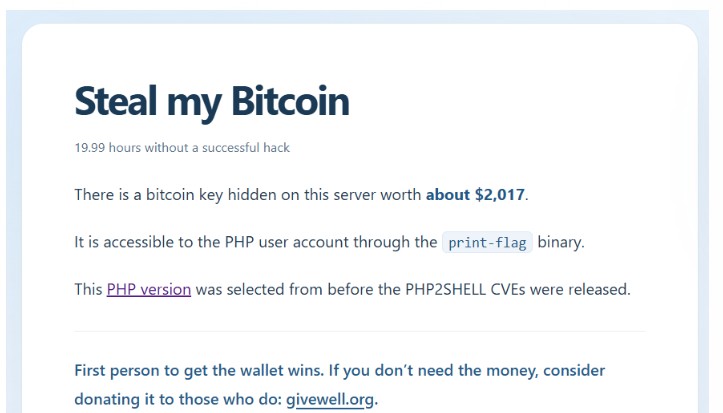
A new website, deliberately left unpatched for the recently discovered PHP2Shell vulnerabilities, has been launched with the aim of demonstrating that Bitcoin wallets are not inherently at risk from this significant cybersecurity scare. The website, aptly named "Steal My Bitcoin," has hidden the private key to a Bitcoin wallet valued at approximately $2,000. This key is accessible through a binary called print-flag within the context of the vulnerable PHP user account.
As of this report, the site has remained online for 25 hours without a successful hack. However, it has experienced intermittent downtime due to heavy traffic and a surge in probing attempts. PHP is a widely used programming language that powers a vast array of websites and web applications, including many content management systems. The PHP2Shell vulnerabilities have raised widespread concern, prompting governments and organizations in countries like the Netherlands, Australia, Japan, and Finland to take critical websites offline as a precautionary measure while emergency patches were developed. These flaws have the potential to allow unauthenticated attackers to execute arbitrary code on affected servers without requiring any form of login credentials.
Solana’s Alpenglow Launches on Mainnet
Solana’s first major consensus upgrade, codenamed Alpenglow, went live on its mainnet on Wednesday around 1:54 PM UTC. According to the Solana Foundation’s Alpenglow dashboard, this significant update aims to enhance the network’s performance and efficiency. Anza, a developer working on the Agave client, reported that the upgrade has drastically reduced the time it takes for a transaction to become final, decreasing it from approximately 12.8 seconds to around 150 milliseconds. While DeFi activity has remained relatively flat or seen a slight decline in the immediate aftermath of the upgrade, it is still early days to assess its full impact.
The initial phase of the Alpenglow upgrade, known as Votor, replaces the current voting and finalization mechanisms with a system of direct validator voting and a certificate-based framework. This is expected to lead to a substantial reduction in the headline transaction count, by approximately 60%. A subsequent phase will introduce Rotor, a new protocol designed for block data distribution, which will replace the existing Turbine protocol.

StarkNet Votes to Start Work on Becoming a Post-Quantum L1
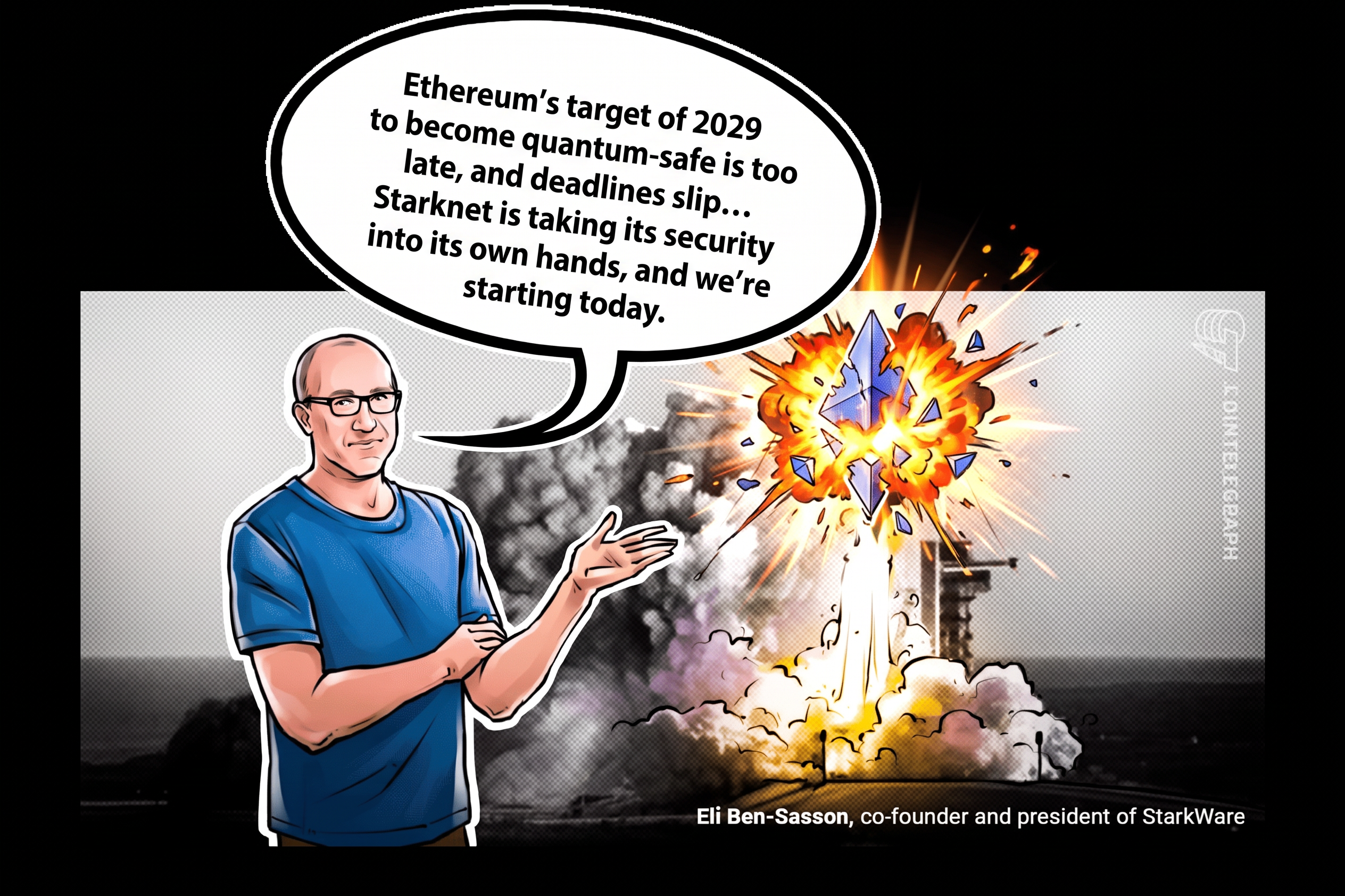
The StarkNet community has overwhelmingly voted in favor of initiating research into transforming into an independent, post-quantum Layer-1 (L1) blockchain. The governance vote, which spanned seven days, garnered approximately 3,200 votes, with an impressive 93.52% of the voting power supporting the transition. It is important to note that the actual migration to an L1 status would necessitate a separate, binding governance vote. Currently, StarkNet continues to operate as an Ethereum Layer-2 network.
Eli Ben-Sasson, CEO of StarkWare, informed Cointelegraph that the company is already beginning work on a whitepaper for this initiative, even before the weekend commences, with the aim of releasing a draft for public review in November. In related news, StarkNet experienced a significant decline in value this week, losing a quarter of its market capitalization among the top 100 cryptocurrencies.
US Senator Probes Tether After Reported Deal with Ex-Trump Crypto Adviser
Senator Richard Blumenthal, the leading Democrat on the Senate’s investigations subcommittee, has formally requested information from Tether CEO Paolo Ardoino. This action follows a Wall Street Journal report indicating that the stablecoin firm had entered into a $6.3 million deal with a marketing company co-founded by Bo Hines, a former White House crypto adviser to Donald Trump.
In a letter addressed to Ardoino on Thursday, the Connecticut lawmaker stated that the Senate Permanent Subcommittee on Investigations is demanding records and information pertaining to contracts, payments, communications, and lobbying activities related to this deal. Blumenthal expressed concerns that the arrangement may contravene established rules regarding ethics, corruption, and lobbying. Tether, in response, has stated that an external investigation into the matter found no evidence of wrongdoing.
Winners and Losers
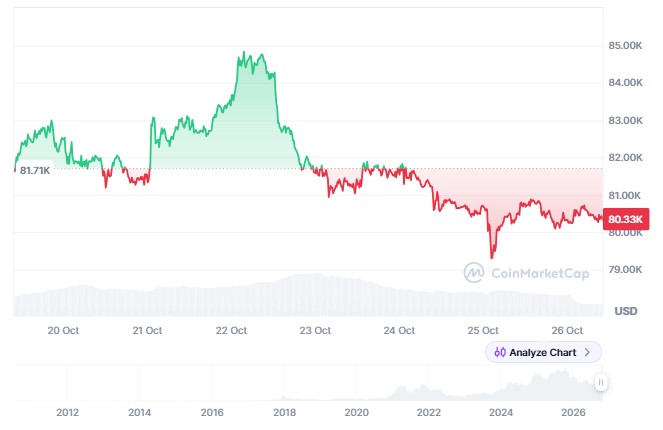
At the close of the week, Bitcoin (BTC) saw a slight decrease of 1.2%, trading at $80,549. Ethereum (ETH) experienced a dip of 1.9%, settling at $2,343, while XRP (XRP) showed a modest gain of 0.9%, reaching $1.20. The total cryptocurrency market capitalization stood at $2.68 trillion, according to CoinMarketCap.
Among the top 100 cryptocurrencies, the leading altcoin gainers for the week included MemeCore (M) with a 24.4% increase, Venice Token (VVV) up by 14.8%, and Ethena (ENA) which rose by 14.1%. Conversely, the top altcoin losers of the week were Starknet (STRK), down 24.9%, Aerodrome Finance (AERO), which fell 12.5%, and Sei (SEI), also experiencing a 12.5% decline.
Prediction of the Week

JPMorgan Projects Bitcoin to Outperform US Stocks and Gold Over Next Decade
JPMorgan Asset Management has forecast that Bitcoin (BTC) will outperform both U.S. stocks and gold over the coming decade. However, the firm cautions that Bitcoin’s inherent volatility currently makes it unsuitable for diversifying investment portfolios. In its 2027 Long-Term Capital Market Assumptions report, published on Monday, JPMorgan projected an annualized return of 10% for Bitcoin. This compares to an anticipated 7.5% for large-cap U.S. stocks and 5.5% for gold. The report explicitly stated, "At the moment, we do not make a case for Bitcoin as a diversifier in portfolios due to its unstable market correlations. We see Bitcoin as a speculative asset and a hedge against monetary easing."
Top FUD of the Week
New York AG Seeks $1.37B from NovaTech Founders Over Ponzi Scheme
New York Attorney General Letitia James has requested a court to order the founders of the defunct crypto and forex trading platform NovaTech, Cynthia and Eddy Petion, along with related companies, to pay $1.37 billion in restitution for their alleged Ponzi scheme. The Attorney General’s office stated that over 11,000 New Yorkers lost tens of millions of dollars through NovaTech and an earlier crypto mining scheme, AWS Mining. The complaint further alleged that promoters actively targeted Haitian and other immigrant communities through prayer groups, social media, and WhatsApp, promising unrealistically high returns and recruitment bonuses.
Bitcoin Core Changes Security Policy as AI Makes Bugs Easier to Find
Bitcoin Core is adapting its approach to handling security vulnerabilities in light of the increasing speed at which large language models (LLMs) can uncover software flaws. Previously, vulnerabilities were typically subject to extended disclosure embargoes to allow users sufficient time to upgrade before details became public. However, Antoine Poinsot, a Bitcoin Core developer, explained that LLMs have made certain flaws so easily discoverable that delaying fixes offers minimal protection. Poinsot stated, "The embargo period achieves little but it delays the availability of a fixed release. We are therefore updating our policy disclosure to accommodate those." This adjustment reflects the evolving landscape of software security in the age of advanced AI.
Pentagon Bans US Forces From Using Military Info to Bet in Prediction Markets
U.S. Defense Secretary Pete Hegseth has issued a directive barring all Pentagon personnel from utilizing undisclosed military information to place wagers on upcoming military actions, including on prediction market platforms such as Kalshi and Polymarket. In a memo circulated to senior Pentagon and defense agencies, Hegseth clarified that all Department of Defense personnel are prohibited from engaging in financial transactions that leverage nonpublic information, encompassing both classified and unclassified data.
Top Magazine Features of the Week
5 Alternatives to Ledger to Store Your Bitcoin
Hardware wallets are a popular method for securing cryptocurrencies, but this feature explores five alternative storage solutions for Bitcoin. It delves into the risks and trade-offs associated with each option, ranging from Exchange Traded Funds (ETFs) and passkeys to multisignature accounts, providing readers with a comprehensive overview beyond traditional hardware wallets.
Agents Can Trade 24/7 — But Yat Siu Warns You Could Lose Access at Any Time
Yat Siu, the chairman of Animoca Brands, discusses the burgeoning capabilities of AI agents in the financial markets, highlighting their ability to execute trades around the clock. However, he issues a cautionary note, emphasizing the potential for users to lose access to these automated trading systems. Siu advises users to proactively plan for scenarios where access to their AI trading bots may be revoked or lost.