 11

The rapid advancement of artificial intelligence has brought forth an array of transformative technologies, yet it also introduces a critical distinction between errors in digital interfaces and those in the physical world. While an AI chatbot might provide an unsatisfactory response, an AI system controlling an aircraft, vehicle, or robot faces vastly higher stakes. A miscalculation in such autonomous systems can lead to severe consequences, including grounding an aircraft, causing a vehicle crash, or compromising a critical mission. This inherent risk raises a paramount question for innovators and policymakers alike: How does one truly determine when an autonomous system is robust and reliable enough to transition from the controlled environment of a laboratory to real-world deployment?
This vital inquiry will be at the forefront of discussions at TechCrunch Disrupt 2026, where an esteemed panel of industry leaders will converge to address the complexities of "Building AI Systems When Failure Is Not an Option." The session, hosted on the Real World AI Stage, promises to delve deep into the rigorous processes and foundational principles required to deploy AI where the margin for error is virtually nonexistent. Attendees will gain insights into establishing a comprehensive safety culture, developing advanced testing and validation methodologies, navigating intricate regulatory landscapes, and, crucially, earning the indispensable trust of users and the public.
Scheduled for October 13–15 at Moscone West in San Francisco, TechCrunch Disrupt 2026 is poised to be a pivotal event for the tech ecosystem. With over 10,000 founders, investors, operators, and tech leaders expected, alongside more than 250 speakers and 300 exhibiting startups, the conference offers unparalleled opportunities for networking, deal-making, and exploring the future of technology. The discussion on real-world AI is just one of over 200 sessions spanning six industry stages, roundtables, and breakouts, highlighting the event’s comprehensive agenda. For those looking to secure their participation, a significant saving of up to $200 on Disrupt passes is available, with the deadline for this offer set for September 25 at 11:59 p.m. PT. Furthermore, a second pass can be obtained for 50% off select ticket types during this promotional period, underscoring the urgency for interested parties to register.
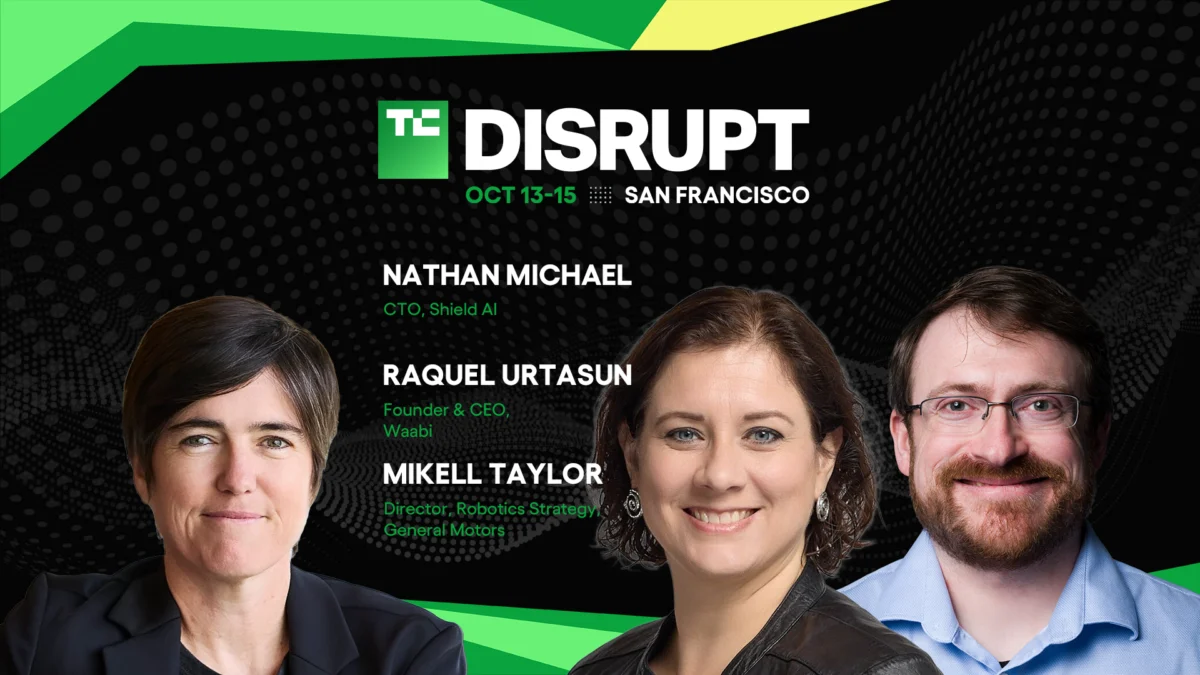
Leading this critical conversation are three luminaries at the cutting edge of autonomous technology: Nathan Michael, Chief Technology Officer at Shield AI; Raquel Urtasun, founder and CEO of Waabi; and Mikell Taylor, Director of Robotics Strategy at General Motors. Each brings a unique perspective from their respective domains, where the consequences of AI failure range from national security implications to public safety on roadways and operational efficiency in industrial settings.

Ready for the Mission?
Nathan Michael, as CTO of Shield AI, stands at the forefront of developing artificial intelligence for defense applications, arguably one of the highest-stakes environments imaginable. His leadership is central to the development and deployment of Hivemind, Shield AI’s innovative platform-agnostic mission autonomy software. Michael’s extensive background in AI, control systems, perception, and multi-robot systems, honed during his tenure at Carnegie Mellon University’s Robotics Institute where he directed the Resilient Intelligent Systems Lab, provides him with a deep understanding of the technical and operational challenges.
Shield AI’s work is not merely theoretical; it has tangible, real-world impact. In a significant development earlier this year, Hivemind was selected as an autonomy provider for the U.S. Air Force’s Collaborative Combat Aircraft (CCA) drone prototype program, a testament to its advanced capabilities and the trust placed in its reliability. This endorsement underscores the critical need for AI systems in defense to exhibit not only superior performance but also unassailable assurance. The company’s impressive trajectory was further validated a month later with the announcement of $1.5 billion in Series G funding, bringing its post-money valuation to an astounding $12.7 billion. Michael’s insights at Disrupt will thus be invaluable for understanding how AI leaders are developing autonomous systems for environments where precision, resilience, and unwavering reliability are paramount. His perspective will illuminate the stringent criteria required to trust AI with missions where human lives and strategic objectives are on the line.
Ready for the Road?
Raquel Urtasun, a veteran with 25 years dedicated to AI and autonomous vehicles, brings an equally compelling perspective to the panel. Before establishing Waabi, her pioneering autonomous driving company, Urtasun served as the chief scientist and head of R&D at Uber ATG, where she played a crucial role in advancing self-driving technology. Her academic contributions are also extensive, holding a professorship in computer science at the University of Toronto and co-founding the Vector Institute for AI. Her prolific research career boasts over 200 published AI papers, cementing her status as a leading authority in the field.

Waabi’s ambition is to revolutionize transportation through its autonomous-driving technology, with a particular focus on robotaxis. The company recently achieved a major milestone, raising $1 billion in funding and announcing a strategic partnership with Uber to facilitate the deployment of 25,000 or more Waabi Driver-powered robotaxis. Central to Waabi’s methodology is its innovative Waabi World simulator, a sophisticated virtual environment designed to rigorously train, test, and stress-test the Waabi Driver. Urtasun has consistently emphasized that her company’s autonomous trucks, for instance, must undergo complete validation before any driverless deployment, highlighting a cautious yet determined approach to safety. Her participation in the panel will directly address the core question of determining when an AI system is genuinely ready to operate without human intervention, sharing crucial insights into the testing, validation, and ethical considerations inherent in bringing autonomous vehicles to public roads.
Ready to Work Alongside People?
Mikell Taylor, Director of Robotics Strategy for General Motors’ Autonomous Robotics Center, offers a unique perspective on the integration of AI-powered machines into human-centric environments. With over two decades of experience dedicated to building robots designed for practical, useful work, Taylor has been instrumental in shaping how autonomous systems interact with people. Her career journey includes leading the Amazon Robotics team responsible for developing Proteus, Amazon’s first autonomous mobile robot, a project that showcased her ability to merge advanced robotics with operational demands.
Taylor’s path into robotics began in a less conventional, yet illustrative, manner – she once built a robotic senior prom date. This early experience foreshadowed a career that would span diverse applications, from autonomous underwater vehicles to complex industrial robotic systems. Her consistent focus has been on creating robots that are not only practical and reliable but also capable of effectively collaborating with human workers. Taylor’s insights will be critical for understanding a fundamental challenge in real-world robotics: the necessity of considering user experience and adoption from the initial stages of product design and deployment planning. The human element is paramount when AI-powered machines move beyond controlled demonstrations and enter workplaces where people depend on them for safety and efficiency. Her discussion will explore how to build autonomous systems that people can confidently work alongside and trust, addressing the social and psychological dimensions of AI integration.
Learn How to Know When AI Is Ready at Disrupt

The varied yet interconnected experiences of Nathan Michael, Raquel Urtasun, and Mikell Taylor underscore a universal truth in the realm of advanced AI: whether the application involves aircraft, autonomous vehicles, or industrial robots, the core challenge remains the same. When the consequences of failure are tangible and severe, what precise steps and assurances are necessary to deploy these systems with unwavering confidence?
For founders, technology leaders, and innovators actively building autonomous systems, this session at TechCrunch Disrupt 2026 presents an unparalleled opportunity. It offers a rare chance to compare and contrast how leading minds in defense, autonomous driving, and industrial robotics approach the critical decisions that delineate a promising prototype from a system truly ready for the complexities of the real world. The insights shared will be invaluable for navigating the technical, ethical, and regulatory hurdles inherent in bringing cutting-edge AI to fruition.
This particular session is merely a glimpse into the vast array of content and networking opportunities available at Disrupt. The conference is designed to foster connections, facilitate deal-making, and provide a comprehensive overview of the latest trends and innovations shaping the technology landscape. With 10,000+ attendees and 300+ exhibiting startups, it’s the ideal environment for forging partnerships and accelerating growth.
In an era where "almost ready" simply isn’t sufficient when failure carries real-world consequences, understanding the path to deployment with confidence is paramount. As the deadline approaches, interested individuals have only two days left to secure their Disrupt pass and save up to $200. By registering before September 25 at 11:59 p.m. PT, attendees can ensure their participation in this crucial dialogue and benefit from an additional 50% off a second pass on select ticket types, gaining access to the collective wisdom of leaders who are defining the future of AI where it matters most.