11
11

South Korea has witnessed a significant surge in cryptocurrency trading volumes, particularly between the Korean won (KRW) and Tether (USDT), as its primary stock market, the KOSPI, experienced a sharp decline of nearly 18% this week. This correlation between a falling stock market and a rising crypto trading appetite highlights a dynamic shift in investor behavior and strategy within the nation’s financial landscape.
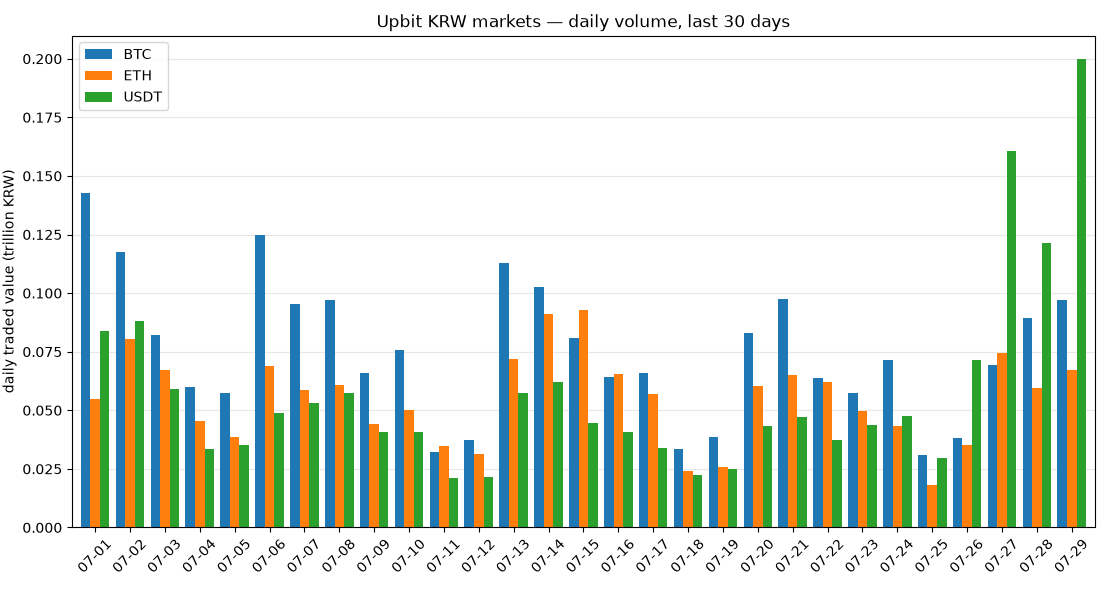
Data emerging from Upbit, South Korea’s largest cryptocurrency exchange, reveals a dramatic acceleration in KRW/USDT trading volumes. On July 29, this volume approached 200 billion won, equivalent to approximately 140 million USDT. This represents a staggering 600% increase compared to the 20 million USDT recorded just four days earlier on July 25. This surge underscores a notable movement of capital and a heightened interest in digital assets as traditional markets falter.
The downturn in the KOSPI can be attributed to several consecutive days of losses, primarily driven by a sell-off in chip-maker stocks. In response to this market volatility, investors appear to have pursued two main strategies: seeking refuge and capitalizing on the downturn. Local media outlet Seoul Economic Daily, referencing analysis from market participants, suggested that capital may have flowed out of traditional stock investments and into cryptocurrencies. Furthermore, it is speculated that investors might have also utilized overseas cryptocurrency exchanges to trade derivatives linked to Korean equities.

Cho Yoon-sung, a senior researcher at Tiger Research, an independent digital asset research and data provider, commented on this phenomenon. He indicated that the increased demand could stem from investors seeking to move funds to offshore exchanges or personal wallets to engage in trading perpetual stock futures. This suggests a more sophisticated approach to hedging and speculating on market movements, extending beyond direct asset ownership.
This trend of capital reallocation is not entirely new. As previously reported by Cointelegraph, earlier in the year, there was a notable influx of investment into semiconductors and a corresponding outflow from cryptocurrencies, particularly with the rapid rise of the Artificial Intelligence (AI) trade. However, the current market conditions are now prompting a re-evaluation of these investment strategies, with the tide turning once again.
Cryptocurrency trading continues to be a vibrant sector in South Korea, with a particular affinity for risk among younger traders. This penchant for leveraged bets is a characteristic feature observed in both the cryptocurrency markets and the broader retail boom seen in the AI sector this year. The current market turbulence appears to be amplifying this existing trend, pushing more investors towards the perceived liquidity and speculative opportunities within digital assets.
The impact of KOSPI volatility on cryptocurrency trading volumes has been observable prior to the recent significant rout. On July 14, Upbit experienced a conspicuous surge in trading volume following a substantial 10% plunge in the KOSPI index within a single day. This earlier event served as a precursor, signaling the potential for increased crypto activity during periods of significant stock market distress.
In commentary on the latest market developments, Andre Dragosch, European head of research at crypto asset manager Bitwise, highlighted the apparent lack of contagion from the semiconductor sector’s "meltdown" into broader financial markets. He observed that Bitcoin has remained relatively flat since the peak of semiconductor stocks in late June, suggesting an unexpected resilience in the cryptocurrency’s price performance.
In a detailed analysis released earlier this week, Bitwise underscored Bitcoin’s "remarkable outperformance" when compared to a range of US mega-cap stocks. The report stated that Bitcoin continues to demonstrate notable strength and resilience against prominent US companies such as the "Magnificent 7" and SpaceX. This relative outperformance is considered particularly significant within the context of tightening financial conditions and aligns with Bitwise’s view of Bitcoin as a leading indicator for macroeconomic trends, akin to the historical role of a "canary in the coal mine."
Bitwise further posited that Bitcoin might be providing early signals of future monetary policy easing by central banks, even in the face of rising inflation and the potential for short-term interest rate hikes. This perspective suggests that Bitcoin’s price movements could be anticipating broader economic shifts and central bank responses. The analysis is supported by comparative charts illustrating BTC/USD’s performance against SpaceX and the Magnificent 7 stocks, showcasing Bitcoin’s relative strength.
This article has been prepared in accordance with Cointelegraph’s Editorial Policy and is intended for informational purposes only. It does not constitute investment advice or recommendations. All investments and trades carry inherent risks, and readers are strongly encouraged to conduct their own independent research before making any financial decisions.