 11
11
Publicly traded Bitcoin (BTC) mining companies have collectively offloaded more BTC in the first quarter of 2026 than in all four quarters of the preceding year, as the industry grapples with increasingly challenging business conditions. These significant sales, amounting to over 32,000 BTC, surpass even the levels seen during the crypto bear market of Q2 2022, marking a new record for miner liquidations in a single quarter.
The data, compiled by TheEnergyMag and corroborated by Cointelegraph’s analysis, reveals that major players in the publicly listed Bitcoin mining sector, including Marathon Digital Holdings (MARA), CleanSpark, Riot Platforms, Cango, Core Scientific, and Bitdeer, were among the significant sellers. This Q1 2026 sales volume of more than 32,000 BTC eclipses the approximately 20,000 BTC sold in Q2 2022, a period characterized by the collapse of the Terra-Luna ecosystem and a broader cryptocurrency downturn. TheMinerMag has identified this recent surge in sales as a "new record" for BTC miner liquidations within a single quarter.

This dramatic increase in Bitcoin sales by miners is directly linked to the prevailing economic landscape for the industry, primarily driven by a sharp decline in "hashprice." Hashprice, a critical metric representing the profitability of Bitcoin mining by measuring the value generated per unit of computing power, has fallen to record low levels, dipping below $35 per petahash/second per day (PH/s). Data from Hashrate Index indicates that the current hashprice is hovering around $33 PH/s per day.
This sub-$35 PH/s level is widely considered the breakeven point for a substantial portion of Bitcoin miners, particularly those operating older, less efficient mining equipment. The current market conditions mean that an estimated 20% of the global Bitcoin mining industry is operating at a loss, according to analysis from CoinShares, which highlights a narrowing field of viable operators.
The broader pressures contributing to this aggressive selling include several interconnected factors. The mining industry is experiencing increased competition, evidenced by a steadily rising network hashrate – the total aggregate computing power dedicated to securing the Bitcoin network. Simultaneously, the halving events, which periodically reduce the block rewards miners receive for validating transactions, have historically put pressure on profitability. Compounding these issues are ongoing macroeconomic headwinds that affect operational costs and the broader financial markets.

Long-Term Decline in Miner BTC Reserves Contrasts with Treasury Accumulation
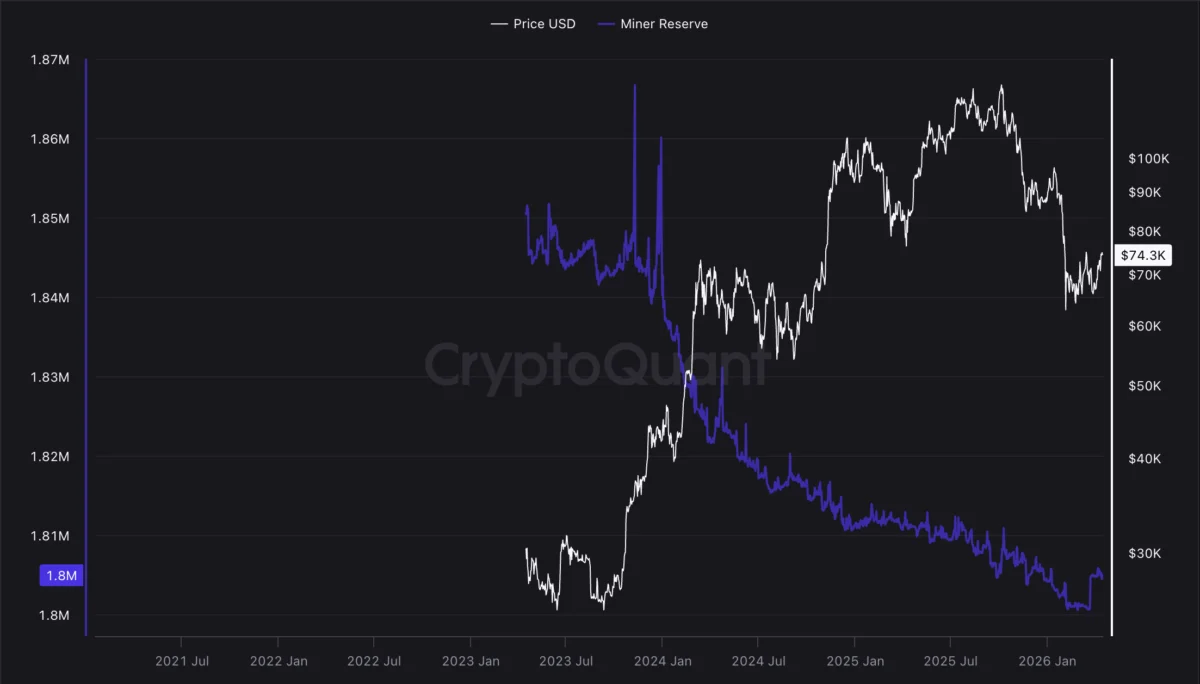
The trend of declining Bitcoin reserves held by miners has been a gradual but consistent one, dating back to 2023. According to data from CryptoQuant, the Bitcoin Miner Reserve, a metric that tracks the total amount of BTC held by mining entities, has seen a steady decrease. At the close of 2023, Bitcoin miners collectively held over 1.86 million BTC. However, this figure has since dwindled to approximately 1.8 million BTC at the time of this report.
While miners have historically engaged in periodic sales of their Bitcoin holdings to cover operational expenses, the current environment has compelled many to liquidate larger portions of their treasury. The confluence of lower cryptocurrency prices and escalating energy costs has created a perfect storm, forcing miners to sell assets that they might otherwise have held for longer-term appreciation.

Asset manager CoinShares, in its Q1 2026 Bitcoin Mining Report, projected further capitulation among higher-cost mining operations in the first half of 2026, "unless BTC’s price recovers materially." This sentiment underscores the precarious financial situation faced by many miners.
In stark contrast to the selling pressure from miners, Bitcoin treasury companies have continued their accumulation strategies. Firms like MicroStrategy, led by its outspoken co-founder Michael Saylor, have remained consistent buyers of Bitcoin. Saylor recently signaled that MicroStrategy is actively acquiring more BTC, even as the price retreated from its recent local high of over $73,000. His characteristic social media posts, often accompanied by charts of MicroStrategy’s Bitcoin purchase history, have become synonymous with imminent acquisitions. On Sunday, Saylor posted "Think bigger," alongside a chart illustrating the company’s continuous BTC buying spree, reinforcing the narrative of ongoing accumulation by treasury-focused entities.
The current market dynamics paint a picture of two diverging strategies within the Bitcoin ecosystem: publicly traded miners are being forced to sell their holdings to manage operational costs and maintain solvency, while Bitcoin treasury companies are leveraging market fluctuations to increase their BTC reserves. This divergence highlights the differing financial pressures and strategic objectives of these distinct market participants. The continued decline in hashprice and the ongoing pressure from increased network hashrate suggest that the challenging business conditions for Bitcoin miners are likely to persist, potentially leading to further consolidation or operational adjustments within the industry. The resilience of Bitcoin treasury companies, on the other hand, suggests a strong conviction in the long-term value proposition of the digital asset, regardless of short-term market volatility.