 11
11
Atlassian has unveiled a comprehensive strategic framework for its internal AI transformation, centered on a recurring quarterly program known as AI Builders Week. This initiative is designed to transition the company’s research and development organization into an "AI-native" entity by equipping product managers, designers, and engineers with advanced technical skills. By dedicating specific time each quarter to experimentation and skill-building, Atlassian aims to create a playbook for organizational change that can be applied both internally and eventually shared with its global customer base. The most recent iteration of the program saw significant participation, with 77% of the Product Management organization and 80% of the Design organization attending a highly technical curriculum focused on moving beyond theoretical AI use cases into measurable, production-ready impact.

The program’s evolution reflects the rapid advancement of the artificial intelligence sector. While the inaugural AI Builders Week focused on foundational elements—such as responsible AI usage, basic prototyping, and an introduction to agent workflows—the latest session moved into deeper technical territory. The curriculum now emphasizes advanced agentic workflows, the creation of "golden data sets" for evaluation, and the replacement of time-intensive manual tasks with autonomous AI agents. A central goal of this shift is to collapse the traditional boundaries between different product crafts, enabling non-engineering roles to get closer to the development environments typically reserved for software engineers.
Atlassian’s approach to AI Builders Week is governed by four overarching design principles intended to maximize the practical utility of the training. The first principle is learning through hands-on building. Participants form cross-functional teams to create tangible artifacts, ranging from working prototypes and automated workflows to new internal processes and templates. Technical support and virtual mentoring are provided throughout the week to ensure that teams can overcome technical hurdles and produce solutions that are immediately "remixable" or adoptable by other departments.

The second principle is the "Customer Zero" philosophy. Atlassian utilizes its own internal teams as the primary testing ground for its AI and developer tools. By "dogfooding" products like Rovo and Forge, the company identifies areas for improvement in its own software while simultaneously adopting the latest AI capabilities to streamline internal operations. This creates a feedback loop where the builders of the tools are also the most demanding users of those tools.
Thirdly, the initiative focuses on building practical workflows to shape the future of teamwork. The goal is to move past basic prompt engineering into end-to-end agentic workflows that automate complex, multi-step business processes. This requires an advanced curriculum that often involves learning how to commit production code. Finally, the program encourages bold experimentation. Atlassian fosters a culture where teams share both their breakthroughs and their failed experiments, viewing the latter as valuable lessons that inform the company’s broader AI strategy.

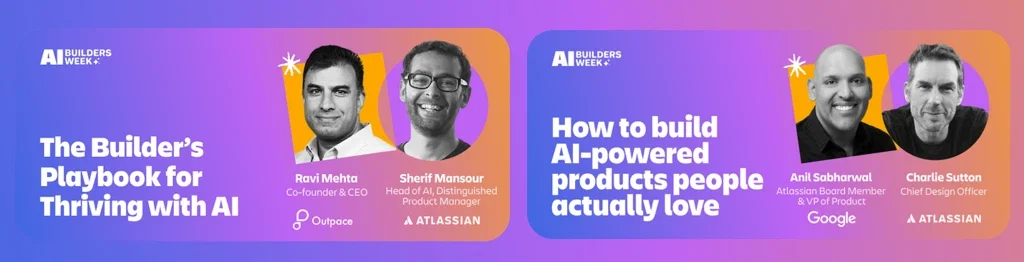
The most recent AI Builders Week began with insights from external industry leaders, including Ravi Mehta and Anil Sabharwal. Mehta provided a metaphor for the current shift in product development, comparing the traditional "assembly line" approach to a "jazz band." In this new era, Mehta suggests that products are no longer built through rigid, linear steps but through a collaborative environment where different crafts—like instruments in a band—interact dynamically to create a cohesive experience. Sabharwal complemented this by emphasizing the enduring importance of human judgment. He argued that in a future where AI handles pattern recognition and execution, the human role becomes more focused on defining "good" and applying empathy, taste, and creativity to ensure AI-driven experiences remain trustworthy and user-centric.
The structural agenda of the week is divided into four distinct phases: Inspire, Hands-On Advanced Skills, Build Day, and Demo Day. On the first day, the focus is on visionary thinking, featuring showcases of how early adopters within the company are already replacing manual workflows with agents. The second day transitions into technical training, covering topics such as prompt engineering for agentic workflows, utilizing Model Context Protocol (MCP) integrations, and mastering internal tools like Rovo Studio and Forge.

Day three, the "Build Day," is the core of the event. Participants choose from seven specialized tracks supported by live mentoring. These tracks include automating work with Rovo agents, building customizations via Forge and App Builder, optimizing agent quality through continuous evaluation, and partnering directly with Atlassian customers to test ideas in real-time. Other tracks focus on moving prototypes into production environments and utilizing AI to enhance design systems. The week concludes with a "Demo Day," where teams submit video demonstrations of their work, celebrate successes, and analyze failures.
A critical component of the technical curriculum is the transition from prototyping to production. Atlassian teams explored how rapid prototyping environments like Replit, DevBox, and Cursor can accelerate the journey from a concept to functional code. By pairing these environments with existing design systems, the company ensures that even early-stage prototypes remain consistent with production standards. Participants are taught modern developer tooling, including Integrated Development Environments (IDEs) and the use of Bitbucket for collaboration.

One illustrative example of this process involved a growth designer for Loom. Using Cursor and Rovo Dev alongside a Bitbucket repository, the designer built a live, code-based prototype for an editing panel. This allowed for the real-time adjustment of UI elements, such as hover animations and opacity, using on-screen sliders. Instead of the traditional back-and-forth communication between design and engineering teams over minor interaction details, the designer was able to refine the decisions independently and push updates directly to the repository. This shift represents a significant change in how Atlassian views the division of labor, moving product and design roles closer to the actual shipping of production-ready interaction tweaks.
The program also addresses the necessity of continuous evaluation for AI quality. Using Rovo Studio, teams conducted no-code evaluations of their AI agents by importing real user queries and setting automatic pass/fail criteria. This process is essential for identifying hallucinations, instances where agents lack context, or moments where they ignore specific instructions. By establishing "golden data sets," Atlassian ensures that its AI tools maintain a high standard of accuracy and reliability.

Furthermore, the integration of Model Context Protocol (MCP) sources has opened new avenues for automation. During the hands-on sessions, teams automated several common internal workflows. These included the generation of weekly status reports by pulling data from Jira and Google Docs, the triage of customer support tickets through automated sentiment analysis and priority labeling, and the summarization of Slack discussions into actionable project tasks.
The use of Forge and the new App Builder (currently in beta within Rovo Studio) allows participants to build powerful customizations for Jira, Confluence, and Jira Service Management. Atlassians utilized these tools to create custom fields, macros, and full-page apps. As "Customer Zero," the internal teams provided feedback that directly influenced the evolution of these building platforms, ensuring they meet the needs of developers who want to extend the functionality of Atlassian’s core products.

Ultimately, Atlassian views AI Builders Week as a manifestation of its core belief in being the change it seeks. By creating a dedicated space for experimentation with agents, evaluations, and rapid prototyping, the company is attempting to live the future of teamwork before delivering it to its clients. The initiative suggests that the successful integration of AI into a corporate environment requires more than just new software; it requires a fundamental upskilling of the workforce and a willingness to collapse traditional craft boundaries to foster a more agile, AI-native R&D organization.