 11
11
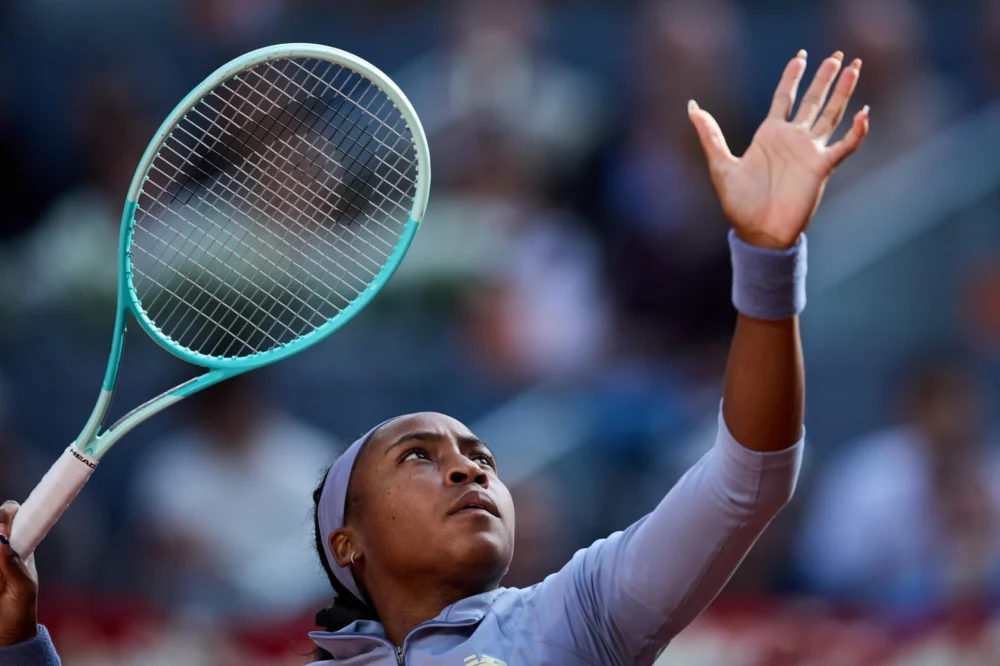
Despite her remarkable ascent to become the highest-paid female athlete in the world, boasting two Major titles and three Grand Slam tournament finals appearances, Coco Gauff continues to grapple with a persistent and puzzling flaw: her serve. This foundational stroke, which for many top players is a reliable weapon, has remained an Achilles’ heel throughout her young, illustrious career, often oscillating between moments of brilliance and bouts of unforced errors. As the 2026 BNP Paribas Open in Indian Wells commences this week, all eyes in the tennis world will once again be fixated on whether the 21-year-old American phenom has finally found a lasting solution to her serving woes.
The statistical evidence for Gauff’s struggles in early 2026 is stark. Just two months into the season, she leads the entire WTA Tour in double faults, accumulating a staggering 103. In sharp contrast, her ace count stands at a meager 19. This glaring disparity becomes even more pronounced when compared to her peers at the elite level. Australian Open champion Elena Rybakina, for instance, leads the WTA with an impressive 110 aces while committing only 30 double faults in the same period. This highlights not only Gauff’s propensity for errors but also a significant underutilization of her raw power, a factor that profoundly impacts her ability to dictate points from the outset.
The consensus among many tennis experts is that Gauff’s serving saga has transcended mere technical deficiencies and deeply infiltrated her psyche. The mental aspect, they argue, now plays a more significant role than any mechanical fault. This psychological battle is a common theme for players experiencing a "yips" phenomenon, where the pressure of performance causes a breakdown in a seemingly simple action.
Four-time Major champion Kim Clijsters, a former world No. 1 known for her mental fortitude, believes Gauff might be overthinking her serve. During a recent episode of the "Love All" podcast, Clijsters observed, "It’s like the mental side of it, right, where the focus and you start to doubt, you know, your shot more and more, and it becomes, you know, an obsession to try and fix it. But a lot of times working too hard on it can also kind of get into, you know, the negative spiral and become an obsession in a way." Clijsters’ insights suggest that Gauff’s intense focus on correcting the serve might inadvertently be exacerbating the problem, leading to a cycle of self-doubt and heightened anxiety during crucial moments. The pressure of being a top-ranked, highly scrutinized athlete only amplifies this internal struggle.
Recognizing the gravity of the situation, Gauff made a significant coaching change last year. In August 2025, she brought on Gavin MacMillan, a biomechanics specialist whose reputation precedes him. MacMillan is famously credited with transforming Aryna Sabalenka’s serve from a "double-fault disaster" into a formidable and reliable weapon, a testament to his expertise in optimizing player mechanics. The hope was that MacMillan could work similar magic with Gauff, unlocking her potential and instilling consistency. However, despite this high-profile partnership, the desired "lasting improvement" has yet to materialize consistently on the match court. Gauff’s inconsistency on serve continues to cast a shadow over her otherwise remarkable consistency in the Top 5 of women’s tennis, raising questions about whether the issue is indeed beyond purely technical adjustments.
Further underscoring the perceived mental nature of the problem, Gauff briefly worked with Andy Roddick in 2024. Roddick, a former U.S. Open champion, is renowned for possessing one of the highest first-serve percentages in ATP Tour history and a serve that was a genuine weapon throughout his career. His expertise in this area was expected to provide Gauff with valuable insights. During the 2025 U.S. Open, the serve issue dramatically resurfaced when Gauff hit eight double faults in a challenging win over Donna Vekic. While not her worst serving performance, the continued inability to rectify this flaw visibly impacted her, leading to emotional tears during a post-match interview. Roddick addressed Gauff’s serving woes and her emotional response on his podcast, "Served: with Andy Roddick," offering a unique perspective. "The serve is mental, and I have stood three feet from her and watched her hit 50 beautifully serves in a row. I have seen it," Roddick affirmed. "She has the ability to be a great server. I do think that she will be a dominant server at some point. I really do." Roddick’s observation underscores the frustrating disconnect between Gauff’s practice performance and her match-day execution, a classic indicator of a mental block.
Adding another layer to the analysis, Gauff’s former coach, Brad Gilbert, who famously guided Roddick to his 2003 U.S. Open title, recently shared his concerns on "The Big T podcast." Gilbert, known for his pragmatic approach to the game, expressed greater worry over Gauff’s low ace count than her high number of double faults. "I know she has been struggling with her serve," Gilbert stated. "103 double faults in 14 matches is a massive number. But the thing I am most curious about is that in 14 matches this year is only 19 aces. I feel like for someone who can serve as big as she can, that is a low number and should be way up." Gilbert’s point is crucial: while double faults give away free points, a low ace count suggests that even when Gauff gets her serve in, it’s not consistently producing the offensive pressure expected from a player with her power, diminishing its effectiveness as a weapon.

Indeed, Gauff’s fastest recorded serve clocked in at a blistering 128 mph, a speed that would be considered powerful even on the men’s ATP Tour. This raw potential makes her current serving statistics all the more perplexing. As New York Times tennis writer Matt Futterman eloquently put it in an analysis of Gauff’s serve, "Ever since she broke out at 15 with her run to the fourth round of Wimbledon, Gauff has had a feast-or-famine serve. When it’s on, it’s a nearly 130 mph weapon that explodes the ball off her racket. It sails past her opponent before she can move for it. When it’s off, the 21-year-old American can give away a set’s worth of points with double faults." This encapsulates the extreme variability that defines her serve, making it a constant source of uncertainty in her matches.
The frustrating chasm between Gauff’s practice court performance and her actual match play is a recurring theme. Those who have witnessed her practice sessions consistently report seeing a serve that is fluid, powerful, and accurate. Gilbert himself recounted how, after a poor serving performance, Gauff would hit the practice court and execute second serves flawlessly, never missing. Gauff herself has voiced her bewilderment and frustration over this disconnect. "I just feel like some of the things I’ve been working on in practice just aren’t translating into the match court, which is super frustrating," Gauff explained in a press conference following a 6-4, 6-2 loss to Elisabetta Cocciaretto in Doha. "I’ve been having good practices, but just not playing well in the matches. I think I just need to find how to get that to translate." This sentiment highlights the profound psychological barrier she faces when the lights are on and the stakes are high.
The ripple effect of Gauff’s unreliable serve extends beyond just a few lost points; it impacts the entirety of her game. When her serve falters, particularly her second serve, it creates a palpable "walking-on-eggshells mentality." This lack of security on her own service games means that no lead is ever truly safe, forcing her to expend more mental and physical energy on every point. In a sport where margins are incredibly fine, anything that diminishes a player’s swagger or confidence provides a significant advantage to the opponent.
A prime example of this detrimental impact was seen at the 2026 Australian Open, where Elina Svitolina comprehensively dismantled Gauff. Svitolina broke Gauff’s serve a remarkable six times en route to a decisive 6-1, 6-2 victory in just 59 minutes. This match served as a stark illustration of how a vulnerable serve can unravel a player’s entire strategy and confidence, allowing an astute opponent to exploit the weakness relentlessly.
Adding to the chorus of expert opinions, 1987 Wimbledon champion Pat Cash made a bold assertion to Tennis365 in January, claiming he could have fixed Gauff’s serve in "five minutes." Cash, who worked with Gavin MacMillan on Brandon Nakashima’s serve, expressed concern that Gauff might abandon MacMillan prematurely and continue to struggle. "Gauff’s serve could have been a five-minute fixing job, but she has taken her years to sort it out," Cash contended, suggesting a fundamental, yet easily rectifiable, flaw. "I worked alongside Gavin MacMillan as we found a solution to Brandon Nakashima’s serve, and now he has gone on to become this serving guru."
Meanwhile, Rick Macci, a renowned coach who has worked with legends like Serena Williams and Maria Sharapova, offers a more nuanced view. While acknowledging that "Coco and her serve is better. Technically it is better," Macci, like many others, still believes the primary impediment is mental. "What happened at the United Cup was all mental. She is on track," Macci wrote in a post on X, reinforcing the idea that the technical improvements are there, but the mental application under pressure remains the final frontier.
With the prestigious Indian Wells tournament currently underway, soon to be followed by the Miami Open and the demanding clay-court season, Gauff faces a critical period to address this lingering mental block. These tournaments are not just opportunities for titles but also crucial proving grounds for her serve ahead of the French Open, where she claimed one of her Major victories in 2025. Despite the ongoing challenges, Gauff’s determination and long-term perspective remain unwavering. Following her straight-sets loss to Naomi Osaka at the 2025 U.S. Open, she exuded a profound sense of optimism about her future and her ability to evolve. "I think today when I walked on the court—and, I don’t know, I feel like I put so much pressure on myself at my age at 21, and I realize how much the girls on tour are being successful at 25, 26, at those ages," Gauff reflected. "For me it just gets me excited to realize if I have four more years of just working as hard as I am right now and actually doing the right things, like where my game could be. It has obviously improved in the last four years from four years ago to now. So I think if I can make that same jump of improvement, it’s a lot to be excited for the future for." Her resilience and belief in her trajectory suggest that while the serve remains a puzzle, Gauff possesses the mental strength and dedication to eventually solve it, cementing her place as a dominant force in women’s tennis for years to come.